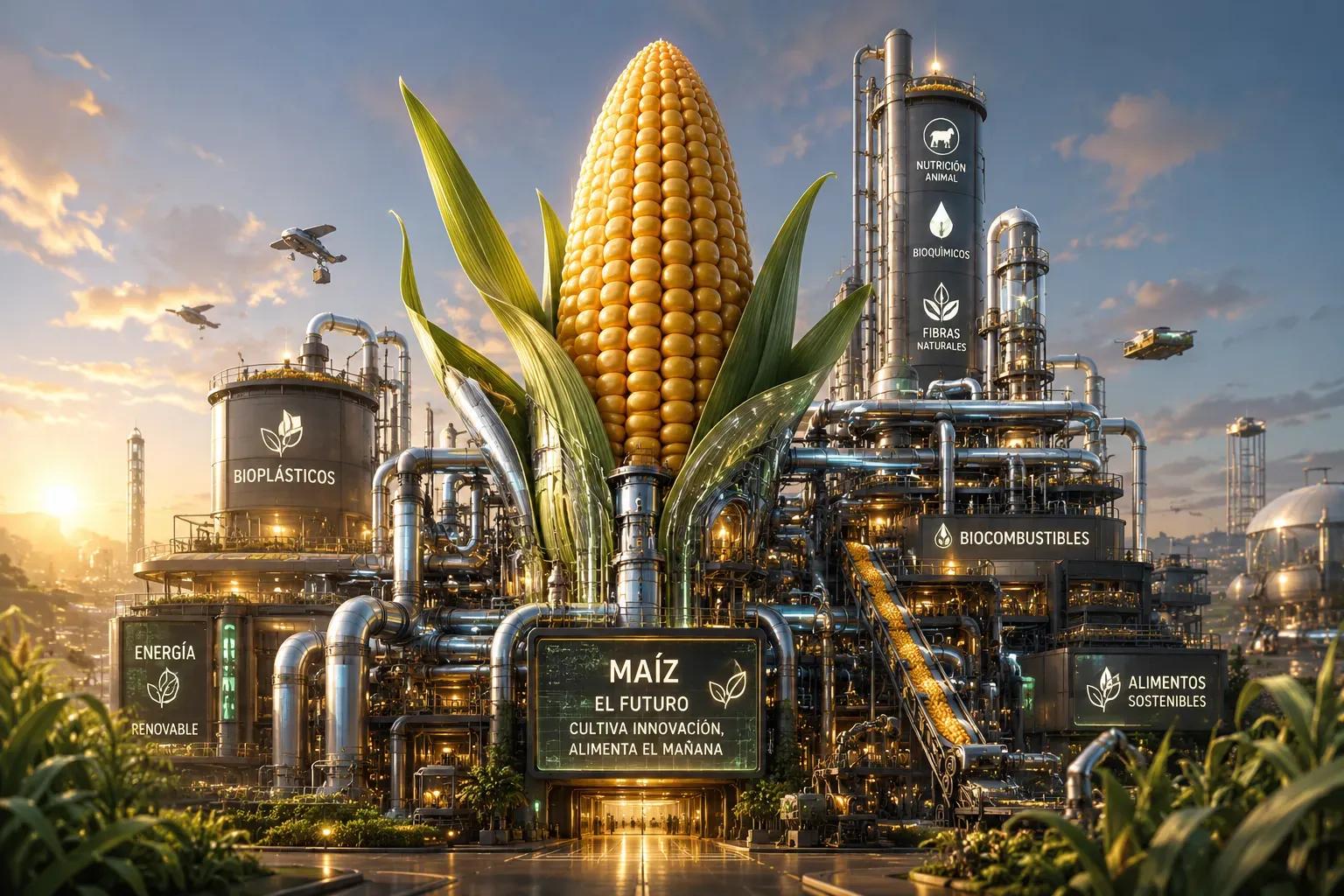
What is Corn and why is it so important in these times?
By definition, Corn is a grass from the “Poaceae” family originating in Mesoamerica, specifically in what is now central Mexico, its designation as a crop for its exploitation dates back approximately 12,000 years. Since that time, it was a transformative crop, as the Mayans used it both as "Currency," "Animal feed," and it was key in their diet processed through nixtamalization (a process where corn is cooked in a solution of water and lime).
Thanks to its natural qualities, the use of "Corn" as a crop spread to the rest of the world; in Argentina, it dates back to 1800, but there are records of sown area from 1872.
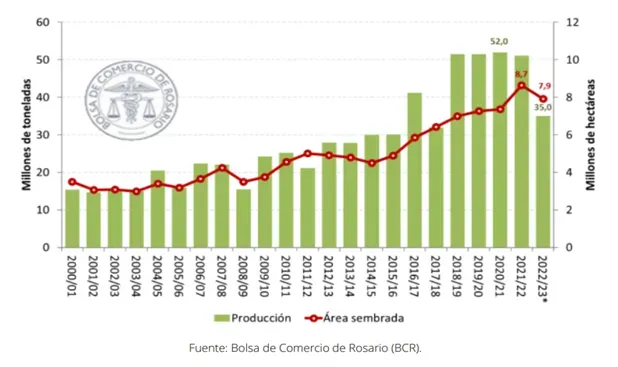
At that time, the main crops in Argentina were Corn, wheat, and sunflowers, with constant innovations that were not fully consolidated until the 80s, when glimmers of a new paradigm shift in agriculture began to appear. In the last 20 years, corn production has experienced significant growth, driven primarily by the development of new technologies and varieties. Already in the 1990s, the technological boom in agriculture began: mechanization was solidified, and genetic modification started to play a central role in agricultural production. As a consequence, since the 2000s, corn has seen strong growth in sown area and productivity.
Currently, organizations such as the National Institute of Agricultural Technology (INTA) have developed and registered with the National Seed Institute (INASE) more than 60 native and synthetic varieties adapted to the different productive regions of Argentina, contributing to improving the yield and adaptation of the crop.
What is corn used for?
In Argentina, corn occupies a fundamental place within modern agricultural production systems. Its importance goes far beyond the acquisition of grain for consumption or commercialization, as it plays a strategic role within the production scheme based on direct seeding, a technology that has increased agricultural productivity while favoring the conservation of natural resources.
Within agricultural rotations, corn is considered one of the most valuable crops due to the multiple benefits it brings to the soil. On one hand, it has a high capacity for capturing atmospheric carbon, contributing to the generation of organic matter and improving the physical, chemical, and biological quality of the soil. On the other hand, it develops a deep root system that can exceed 1.5 meters in depth, allowing it to explore lower layers of the profile, improve soil structure, and reduce compaction problems. Additionally, the large amount of crop residues left after harvest protects the surface against water and wind erosion, helps conserve moisture, and adds dry matter that will later be incorporated into the production system. For these reasons, corn should not be seen solely as a crop generating income but rather as a key tool for maintaining the sustainability of agriculture in the long term.
Understanding the agronomic importance of the crop, a central question arises:
What is corn used for?
The most common answer is often linked to human and animal nutrition. For decades, it has been part of the diet of millions of people around the world, both through the direct consumption of the grain and through products made from it, among which polenta, flours, flakes, and numerous industrialized foods stand out.
However, an even more significant part of corn production is destined for animal feed. In beef production systems in feedlots, corn serves as one of the main energy sources used to achieve high weight gains in relatively short periods. Similarly, in poultry production, it accounts for approximately 70% of the composition of balanced feeds, indirectly becoming chicken meat and eggs. A similar situation occurs in pork production and other intensive livestock activities, where corn is one of the fundamental pillars of animal nutrition.
Nevertheless, limiting analysis solely to these uses would overlook the profound transformation that this crop has undergone in recent decades. Corn is no longer considered merely a grain destined to produce food; today it is viewed as a raw material capable of generating a vast array of high value-added industrial products.
Through the industrial processing of corn, it is possible to obtain starches, oils, syrups, alcohols, biofuels, balanced feeds, pharmaceuticals, cosmetics, and a wide variety of chemicals used by different industries. The development of biofuels, particularly bioethanol, has generated a new demand for the crop, allowing the energy captured by the plant during its growth to be transformed into renewable fuels capable of partially complementing or replacing petroleum derivatives.
Furthermore, technological advances have enabled the use of almost all parts of the plant. The grains are destined for the food and energy industries; the stalks, leaves, and cobs can be used to generate biomass, energy, or industrial materials; while various processing residues are reused in animal feed or as inputs for other productive processes. This capacity for comprehensive utilization makes corn one of the most efficient crops within the circular economy models that modern agro-industry currently promotes.
Therefore, when analyzing the importance of corn, it becomes evident that its value goes far beyond grain production. Its contribution to soil conservation, its role within agricultural rotations, its participation in human and animal nutrition, and its growing use as an industrial raw material make it one of the most strategic crops for the economic and productive development of Argentina. Corn has ceased to be simply an agricultural crop to transform into a true platform for generating food, energy, and industrial products serving multiple sectors of the modern economy.
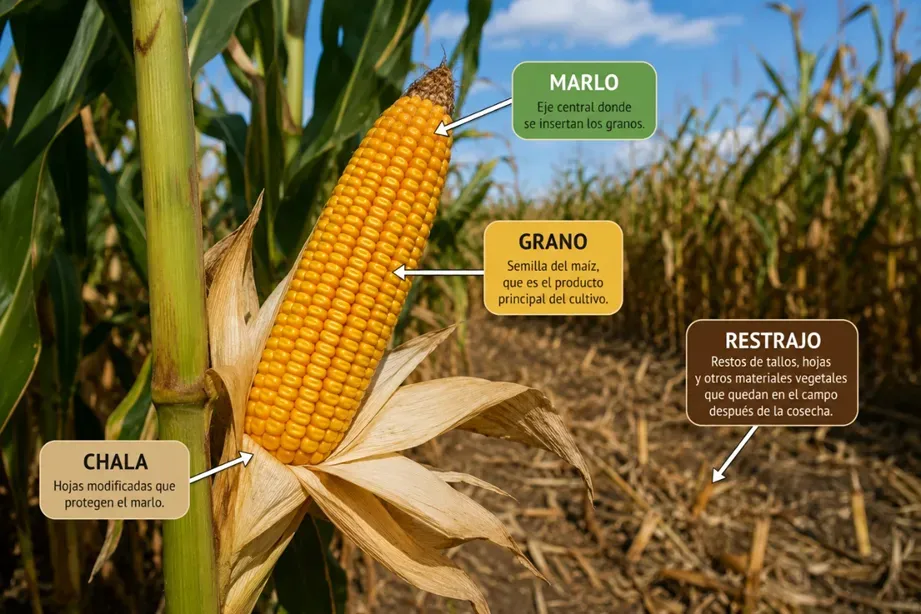
· Husk: The corn husk is an agro-industrial byproduct that has various uses and applications. It is traditionally used in animal feed as fibrous material for livestock, although it also has applications in compost and organic fertilizers due to its contribution of organic matter to the soil. Additionally, in some regions, it is used to manufacture handicrafts and decorative products. Currently, its use is also being studied in biomass, paper, and biodegradable materials production, seeking to sustainably utilize the waste generated by corn cultivation.
· Corn residue: It is made up of the remains of the plant that are left in the field after harvest, such as stalks, leaves, and parts of the cob. Its importance in agricultural production is significant, as it helps protect the soil from erosion caused by wind and rain, conserves moisture, and contributes organic matter as it decomposes. In addition, it can be used for animal feed and also as biomass for energy production. Currently, the management of crop residue is fundamental in direct sowing systems and sustainable agriculture.
· Cob: The Venado Tuerto Regional Faculty of the National Technological University (UTN) patented an innovative system that allows for the production of clean energy through the use of corn cobs, resulting in lower costs for heat production while being environmentally friendly.
· Grain: Corn grain is one of the most important agricultural products in the world due to its enormous variety of food, industrial, and energy uses. Its value lies in its high starch, energy, oil, and nutrient content, allowing practically all its parts to be utilized in different productive processes.
Throughout history, corn has proven to be much more than just an agricultural crop. Its ability to feed people, transform into animal protein, provide raw material to numerous industries, and become a renewable source of energy places it among the most strategically important resources today. Few crops possess the versatility to simultaneously integrate into food production, energy generation, chemical industry, biodegradable materials manufacturing, and the development of new sustainable technologies.
However, perhaps the most relevant aspect is that not all its potential uses have yet been explored. As the world faces challenges related to population growth, food security, energy transition, and environmental care, corn emerges as one of the tools with the greatest capacity to provide concrete solutions. In this context, Argentina has a unique opportunity. Thanks to its productive conditions, the technological development achieved by the agricultural sector, and the importance that corn has within sustainable agricultural systems, the country has a solid foundation for advancing towards schemes of greater value-added.
The experience of Brazil (sugarcane and its transformation into biofuels) demonstrates that it is possible to successfully integrate agricultural production with energy industry through the development of biofuels. The large-scale incorporation of ethanol, along with the use of Flex fuel vehicles, allowed a part of agricultural production to be transformed into energy, reducing dependence on fossil fuels and generating new economic opportunities. Given an international scenario where oil prices continue to be a determining factor for economies, the question inevitably arises about the role Argentina could assume in this energy transition and how much additional value it could capture from its own corn production.
In short, corn has ceased to be merely a crop intended for grain production to become a true platform for economic, industrial, and technological development. Its importance transcends the field and reaches all of society, linking production, industry, energy, and sustainability. The challenge for the coming years will not only be to produce more corn but also to create the necessary conditions to transform it locally, add value at the origin, and harness all the potential that this strategic crop can offer to the development of Argentina.

Comments