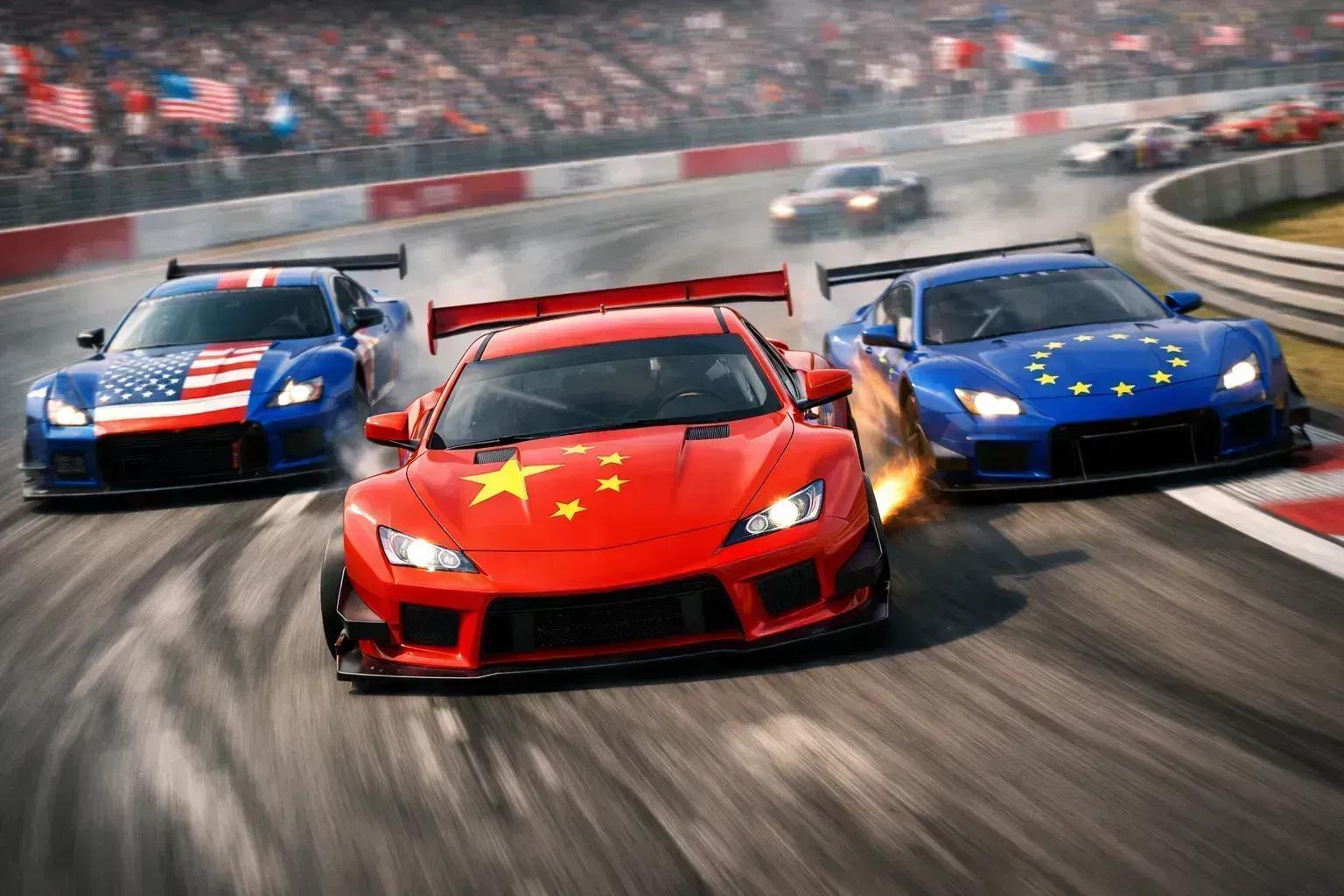
The year 2026 began with a striking piece of news for the global automotive industry: BYD (Build Your Dreams), a leading Chinese company in electric cars, surpassed Tesla, Elon Musk's brand, as the world's largest seller of electric vehicles (EVs) in 2025. While Tesla's sales fell nearly 9% in 2025, to 1.64 million units – its second consecutive year of decline – BYD recorded an increase of close to 28% in battery vehicle sales, surpassing 2.25 million.
At the same time, Argentina is experiencing a flood of Chinese electric car brands. What had become a marginal story by the end of 2025 turned into a media phenomenon, especially after the arrival of 5,800 BYD EVs on one of its ships taking advantage of the tariff reduction for an annual quota of 50,000 EVs.
The world, including Argentina, is surprised by the sudden "invasion" of Chinese electric cars. One must ask: Why? How did China come to dominate the EV market and displace the West (the U.S. and Europe)?
China did not achieve dominance in the automotive market overnight, but rather it was a long process characterized by the centralization and planning of the economy by the Chinese Communist Party (CCP). Understanding the political, economic, and geopolitical practice behind this historical fact allows for a better grasp of how the Asian giant operates.
Jim Farley, the spokesperson for those who didn’t see it coming
Historically, the largest automotive market was the United States, but this changed a few years ago: the North American country currently sells between 15 and 16 million cars a year, of which approximately 1.5 million are electric, while China sells over 30 million, of which 10 million are electric.
This wide disparity can be explained by the fact that China manufactures 70% of the world's electric cars, which is equal to the combined production of the U.S., the EU, Japan, and South Korea. In fact, China has already reached the point where more electric cars are sold than combustion engine cars.
These figures astound managers of Western automakers, who only recognized the tsunami when they were already drowning.
This is the case of Ford's CEO, Jim Farley, who has been notably candid on numerous occasions regarding the current state of the global automotive industry. For instance, he has acknowledged more than once that he drives a Xiaomi SU7, as “to beat you, you must know them,” in his own words.
Were the Chinese merely imitators of Western products? Perhaps, but the current reality is exactly the opposite: Western brands test, study, and dismantle Chinese cars to understand their engineering and software.
This is the “humiliation” that Jim – as he expressed in an interview for Aspen Ideas Festival – feels in the face of China.
What did China do to achieve dominance?
One of the keys to the phenomenal development of the Chinese automotive industry – but also of its economy in general – was the transfer of knowledge through joint ventures.
The upward process begins with the very misunderstood process of “reform and opening,” particularly with the Sino-Foreign Joint Venture Law of 1979, which led to the creation of the greatest technique of Chinese industrial policy: joint ventures (JVs). A JV – joint venture, in Spanish – is a business agreement where two or more companies combine their resources to achieve a goal, creating a new independent legal entity wherein each party contributes capital, technology, knowledge, or assets and shares risks, costs, and profits.
Foreign companies could only own a maximum of 50% of an automotive JV when partnering with a Chinese manufacturer, which was generally a state-owned enterprise. This resulted in a “forced technological transfer” that, on one hand, opened a market of more than a billion people to Western brands, while on the other hand facilitated the transfer of knowledge in science, technology, and engineering to China.
The Chinese state was, without a doubt, the engine of what is now the Chinese automotive industry. In the beginning, the state was the only player, and through companies like FAW, Dongfeng, and SAIC, it created the industrial base during the Mao era. Later, through the joint ventures, China opened up to the international market and allowed the influx of foreign capital but always under the orbit and control of the state. Finally, in the consolidation stage of the last 10 or 15 years, private companies and startups have taken the reins of the electric car market, all while following the guidelines of the CCP.
Currently, the Chinese automotive industry can be grouped into four divisions: state-owned enterprises, provincial ones, private companies, and startups.
Firstly, state-owned automakers are directly supervised by the central government, and their main objectives - rather than obtaining profits - are to lead technological advancement, create jobs, strengthen the industry, and project power. Some examples include FAW, Dongfeng, SAIC.
Secondly, provincial brands managed by local governments aim to create jobs, generate profits, and prestige for the province. They are used as tools for interprovincial competition. Some examples are BAIC, GAC, JAC, Chery.
These aforementioned state and provincial automakers are part of the Fortune Global 500.
Thirdly, private automakers focus on controlling the supply chain and mass production to gain market share through volume. They lead in technology and innovation, and they are the most dynamic in the electric vehicle segment.
Lastly, startups focus on vehicle software or user experience. Their unique characteristic is that they do not see themselves as car manufacturers but as technology companies offering “services on wheels”.
The state’s role was to build the entire structure, the cluster, or foundational industry that allowed for increased productivity and reduced costs.
As Roger Laneyrie – former fleet manager of Volkswagen Group China – explained in an interview for Auto Test: cost optimization in China occurs due to factors such as the existing production ecosystem or the quality of infrastructure, given that the cost structure there is not so different from that of other competing countries. He also clarifies that optimization does not come from labor costs, as salaries are at an “international level.”
Something similar was stated by Tim Cook, CEO of Apple, at the Fortune Global Forum in 2017: “the truth is that China stopped being a low labor cost country many years ago.” He explains that it is the level of specialization, technological advancement, and the number of specialized engineers in one location that makes it attractive to set up factories.
Improvements in productivity, infrastructure, and the industrial cluster of the Chinese automotive market lead to a downward trend in the costs and prices of EVs. Furthermore, due to intense competition, brands prioritize cost reduction, and dealerships sell at low prices or offer significant discounts even at a loss.
This means that, in China, one can find many hatchbacks and some sedans for less than 10,000 dollars. Meanwhile, for 12,000 dollars, one could buy a high-end sedan, or even a minivan. For daily city use, there are mini car options for less than 5,000 dollars.
Titan Project, a boost for BYD
In many cases, the transfer of technology was also driven by the voluntary actions of Western private companies, who decided to relocate their productions to China and turn it into the “factory of the world.” This, combined with the planning and economic centralization by the CCP, created the conditions for Chinese leadership.
In 2014, Apple launched its ambitious “Titan Project,” a project to create an electric and autonomous vehicle, integrated into the Apple ecosystem. The main contractor for creating the battery for this car was the company that assembles its iPads, called BYD.
After 10 years and 10 billion dollars, Apple abandoned the “Apple Car” initiative to redirect funds towards generative artificial intelligence. The result: it ended up with neither. Meanwhile, the big winner was BYD, which, thanks to the experience and knowledge acquired, became the second-largest producer of batteries for electric cars, just behind CATL, which is also Chinese.
This idea of achieving integration between the Apple Car and the company's ecosystem was eventually realized by Xiaomi with its smart ecosystem “Human x Car x Home,” which allows connecting smartphones, wearables, smart home devices, and electric vehicles.
Xiaomi VS Apple
In March 2021, Xiaomi announced a 10 billion USD investment over 10 years to enter the electric vehicle market. The company started mass production in December 2023, and within a few years, it is already leading the industry. Apple had a similar plan, but with opposite results.
There are multiple reasons for these vastly differing outcomes, but the most relevant is the support of the state’s role.
Thanks to an agreement with the Beijing Government, Xiaomi received support to build a large highly automated factory – capable of producing one EV every 76 seconds – land at a symbolic price - even free - investment and job creation subsidies, soft government loans, expedited regulatory approval, public procurement commitments, and guaranteed infrastructure. Meanwhile, the benefits for the Beijing Government included skilled job creation, a new and significant future tax base, more investment through attracting suppliers, and an improved competitive position against other Chinese provinces.
On the other hand, Apple received nothing more than R&D tax credits for the Titan Project – something any large company in the U.S. receives.
The difference is clear: in China, investments are guided by long-term plans established by the state. This allows for sustainable and directed development in areas that may not be immediately profitable, but are crucial for the country's progress.
A second reason may be the strategy implemented by each company. On one hand, Xiaomi sought to differentiate itself from its competitors by leveraging its prior knowledge in telecommunications, integrated technology, and user experience, and preferred to use proven electric motors and batteries from leading suppliers.
On the other hand, Apple aimed to create a Level 5 autonomous vehicle (without a steering wheel or pedals). This required developing the necessary software. All this, without any experience and without an integrated electric vehicle ecosystem, which Xiaomi had.
Bascially, Xiaomi did not aim to reinvent the wheel; instead, it focused on what it already did well.
Thirdly, the excessive regulations that the Titan Project had to face, such as safety and legal liability regulations, or even an unclear framework for autonomous vehicles, may have also played a role. In contrast, in China, the regulations – even for Xiaomi – were agile, clear, and favorable for EV production.
Dominance of the complete cycle
Now, China is focusing on a future problem: recycling the batteries of these cars, which will become a huge market in the coming years.
By 2030, China estimates that more than one million tons of batteries will be taken out of use each year, as they lose autonomy and cease to be viable for the demands of a car. This turns them into a new source of lithium, nickel, cobalt, and magnesium.
The response was swift. It is estimated that there are already approximately 200,000 companies related to EV battery recycling in the Asian country, most of which have been created in the last three years.
CATL is already operating this stage at an industrial scale and reports recoveries of more than 99% of some materials through a process that is cheaper, more energy-efficient, generates less pollution, and requires less water.
The paradigmatic case is BYD. This tech giant produces its batteries (which account for 30-40% of an EV's cost), semiconductor chips, motors, bodies, and controls its critical supply chain. It even has investments in lithium mines and has its own maritime fleet for exporting its cars. Now, it also includes battery recycling.
China leads, the West adapts
Initially, joint ventures were a tool through which China could learn about engineering, technology, and science from the West. But in recent years, this political technique modernized into a kind of business alliance and began to take on a very different role.
This was clearly seen with the recent alliance between BMW and Momenta to access competitive software and technology. A decision that the German giant likely made after a 29% drop in its net profits in the first half of 2025, which BMW attributed to a decline of up to 16% in the Chinese market – after decreasing 13% in 2024 – which represents about 30% of its global sales.
Meanwhile, Huawei reported delays and long lines in its stores to acquire its EVs.
Following this alliance, BMW announced the launch of a new model for 2026 that will be produced and launched first in China, when historically, models would not arrive.Germans were the first to launch themselves in Europe. This news was alarming in Europe.
Although this is not the first time it happens. In fact, Western brands, through JVs, produce and sell exclusive models for the Chinese market. This is the case of the Volkswagen Magotan, manufactured by "FAW-Volkswagen Automobile Co., Ltd.", a different and electric version of the famous Passat. And while the price of the "Western version" starts at 51,000 euros in Europe, the "Chinese version" starts at 20,000 euros.
**BMW was not the only one who decided to ally to survive in the Chinese market**, Volkswagen has also done so, for example, with XPeng to access the electric platform and software of the Chinese brand. Other examples can be Ford with CATL, the joint venture "BYD Toyota EV Technology Co.", or Mercedes-Benz alongside Tencent.
**Currently, a car without some degree of driver assistance capability (ADAS) leaves the model or brand at the end of the line in China.**
This is a clear example of the humiliation that Jim Farley speaks of. **Automakers with over 100 years of history have to ally with Chinese startups to survive.**
**The tariff paradox**
Currently, **China has a phenomenal overproduction of EVs**, with several million units of excess supply that it cannot place in its internal market, but it also cannot export massively due to the high tariffs imposed by the West. Jim Farley already warned about this situation, stating: “there is enough capacity in China, with existing factories, to supply the entire US market and leave us all out of business.”
Meanwhile, the West is going through a long period of **little political imagination** to compete against the advance of the East and continues with a tariff protectionist policy in perpetuity that is not accompanied by effective industrial policies.
Both the drop in EV prices in the internal Chinese market and in the external market to almost "dumping price" - due to the excess production - harms European brands, and makes Chinese cars the biggest rival for Western governments.
Here is a paradox: the overproduction of EVs in China is explained, in part, by the joint ventures formed by Western and Chinese brands. This is, **when the West accuses China of “flooding its market” with electric cars at dumping prices, it is indirectly accusing not only purely Chinese brands but also those integrated by European brands that are part of that excess supply.**
Returning to the case of BMW. If the German brand decided to export its surpluses from China to mitigate its profit drop - assuming the current tariffs exist - it would generate a bankruptcy of its factories and production matrix in Europe. Obviously, in the logic of the free market, a company always benefits from having more sales to achieve greater profit. But what stands in the way of this utopia is geopolitics: **tariffs are a historical instrument to defend the strategic industrial base of a Nation and make it competitive.**
**Critical points of Chinese automakers**
Currently, it is estimated that there are **180 car brands in China**, because the entry barrier to manufacturing electric cars has lowered significantly. Many will disappear due to mere "market nature" or will be absorbed by those that survive. This is a typical explicit case of the Chinese model of **"State Socialism" to Build and "Wild Capitalism" to Compete.**
Once the goal of global market dominance is achieved, the State withdraws its safety net. Companies compete and eliminate each other, so those that are most competitive globally survive. **The State does not rescue losers, but supports survivors with diplomacy, export credits, and trade agreements.**
**The ultimate goal is not the profitability of each company, but the economic sovereignty and geopolitical power of China.**
Initially, dealerships were very profitable due to a 20-30% annual growth in the automotive market. Then, the same thing happened as with craft breweries.
According to Roger Laneyrie, it is estimated that by 2024, **60% of dealerships will have suffered losses** from selling cars at low prices due to high competitiveness and excess supply. Of the remaining 40%, approximately half manage to survive, while the rest would have real profits. These last two cases would be explained, in part, by the after-sales services or bonuses received from brands upon reaching a certain number of sales.
Many companies, especially startups, opt for online sales, without the need to have a large number of dealerships. **A considerable reduction in dealerships is expected due to closures, starting with Western brands that fail to adapt to the demands of the Chinese market.**
One of the biggest problems approaching is the **increase in unemployment.** An optimistic scenario would be that, given China's dynamic economy and its perpetually transforming industrial ecosystem, the unemployed are absorbed by other industries. The pessimistic scenario is a rescue based on subsidies for the unemployed and the likelihood that many factories will become abandoned spaces.
The other major problem could be the domino effect caused by the closure of a large number of companies or factories, which **would generate difficulties or defaults in payments to suppliers or lines of credit.** The large network of companies behind the automotive industry would be dragged. But the financial consequences can be extremely deep due to the great **leverage through debt in this sector.**
**What was initially driven by the State could now turn against it.**

Comments