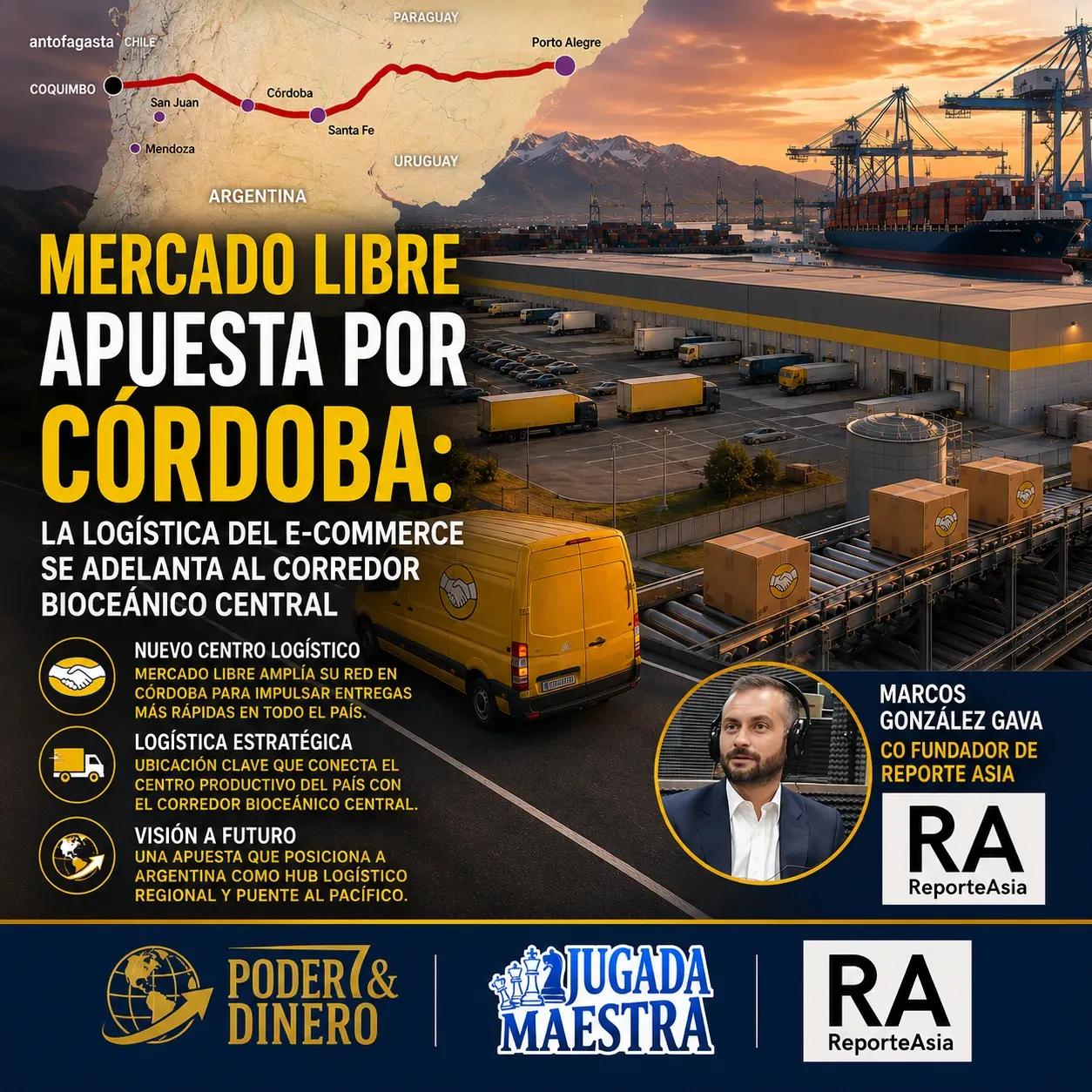
The company will invest US$91 million in its first storage center outside the AMBA, located in Estación Juárez Celman. The project comes at a time when Córdoba seeks to consolidate itself as a key node of the land route to the Pacific and, from there, to Asian markets.
Mercado Libre confirmed in early August the construction of a 60,000 square meter storage center in Estación Juárez Celman, north of Greater Córdoba. With an investment of US$91 million, the project will be the company's fifth warehouse in Argentina and the first to be established outside the Metropolitan Area of Buenos Aires. It is part of the investment plan of US$3.4 billion that the company announced for the country during 2026.
The complex, which will be developed by Plaza Logística, will have the capacity to store up to six million products and will function as a central supply node for last-mile warehouses in the Centro, NOA, and NEA regions. It is estimated to generate up to 2,000 direct jobs, plus several hundred indirect jobs, with startup projected for late 2027.
Governor Martín Llaryora received representatives of the company to learn the details of the project, while the Country Manager of Mercado Libre Argentina, Adrián Ecker, described the decision as a key step in the strategy to federalize the company's logistics. Córdoba was already a relevant location for Mercado Libre: the province has a corporate office in Villa Allende —which will employ 1,300 people when it opens in January 2027—, five last-mile centers that process 75,000 packages daily, and more than 18,000 SMEs and entrepreneurs who use the platform as a sales channel.
A location that is not casual
The new warehouse responds, first and foremost, to a domestic business logic: to shorten delivery times and reduce logistics costs for the interior of the country. But its location coincides with the corridor that, in the medium term, could turn Córdoba into a mandatory passage point between the Atlantic and the Pacific: the Central Bioceanic Corridor.
This corridor connects the Brazilian port of Porto Alegre with the Chilean port of Coquimbo, crossing Uruguay and the Argentine provinces of Entre Ríos, Santa Fe, Córdoba, and San Juan via National Route 150, in a route of over 2,400 kilometers. Its critical point is the Agua Negra pass, nearly 4,800 meters high, which today remains closed for much of the year due to snow. The project that aims to resolve this obstacle —the bi-national Agua Negra tunnel, nearly 14 kilometers long between San Juan and the Chilean region of Coquimbo— has been in various stages of study, financing, and postponement for over a decade.
The project regained political momentum this year: the meeting on April 6 between presidents José Antonio Kast and Javier Milei at Casa Rosada relaunched the bi-national agenda for the tunnel. In fact, however, the project remains in the structuring phase: the Inter-American Development Bank has been funding a specific program (PETAN) since 2017 to prepare the bidding for the design and construction, with the latest monitoring report dating from March of this year.
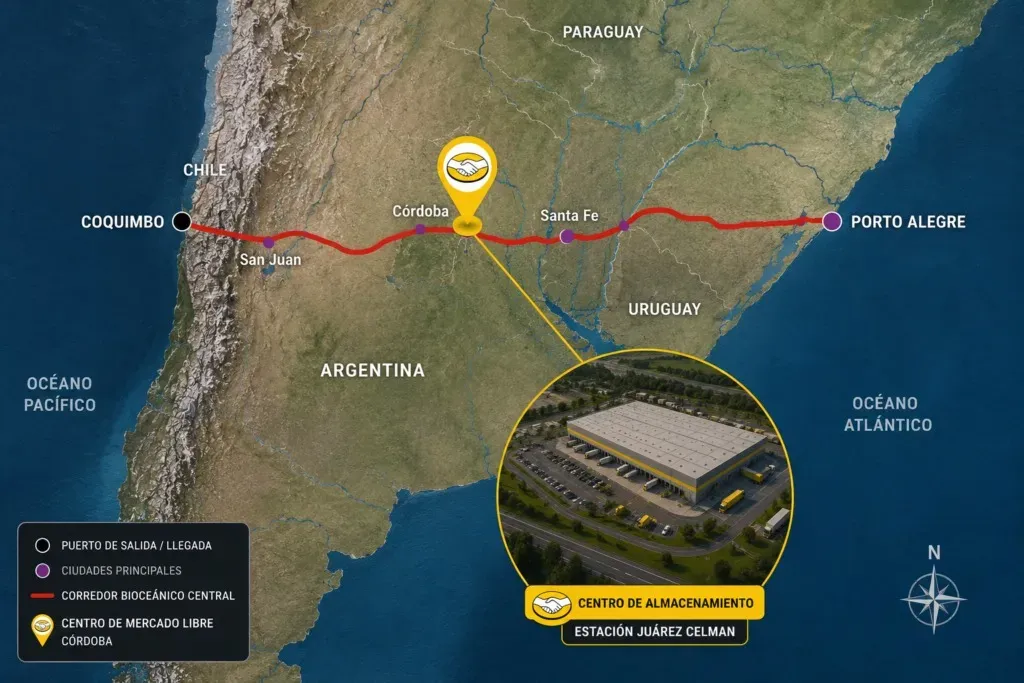
The project comes at a time when Córdoba seeks to consolidate itself as a key node of the land route to the Pacific and, from there, to Asian markets.
According to a note published in June by El Cronista, work on paving and improving access in high mountain areas is already advancing in Chile, while in Argentina the main excavations have not yet begun, although the national government has allocated recent funds for complementary works in the corridor. Once the work is awarded, the construction of the tunnel would take between nine and ten years. As a reference for the current state of the mountain pass that the tunnel seeks to replace: in May of this year, it remained passable uninterrupted for six consecutive months, a record that its promoters use as an argument in favor of the project, although local figures like the Chilean consul in San Juan avoid giving concrete deadlines for the institutional reactivation of the project.
The Asian interest, already present
The extra-regional component of the corridor is not a distant hypothesis. In previous tenders for the tunnel, Chinese state companies —including China Railway Tunnel Group and consortia linked to Power China and CCCC— were among those interested in constructing the work. And in instances of commercial promotion organized in the Coquimbo region, delegations from Argentina, Brazil, Vietnam, Indonesia, and China participated, exploring opportunities related to the corridor. The underlying argument that its promoters handle is that the permanent connection with the Pacific would significantly shorten transit times for South American exports to Asia, which are currently almost entirely dependent on the Atlantic outlet.
The Córdoba Stock Exchange itself participated, along with universities from Argentina and Chile, in an academic follow-up work on the status of progress of the Central Bioceanic Corridor and the Agua Negra tunnel, showing that there was, at least at the time, an institutional outlook on this long-term project in the province.
Two times that converge
The investment of Mercado Libre and the Central Bioceanic Corridor operate, for now, on different time scales: one is a corporate decision executed in months; the other, a binational engineering work that still needs years of political and financial definitions.
But both coincide in the same diagnosis: Córdoba has geographical and institutional conditions to function as a logistics platform in the center of the country. If the corridor to Coquimbo is finally realized, the infrastructure that e-commerce is currently building could end up serving a much broader flow of goods, destined for ports on the Pacific and, from there, to Asian markets.
Marcos González Gava is Co-Founder of Reporte Asia. A specialist in financial and commercial business and cultural affairs with the People's Republic of China.

Comments