In a world where artificial intelligence learns to reason, machines write poems, and algorithms seem to know us better than we know ourselves, an uncomfortable question arises: are we emotionally evolving at the same speed as our technology?
I confess that I am fascinated by technology. From blockchain to the aerospace industry, through renewable energies and artificial intelligence, I have always thought that innovation has extraordinary potential to transform our society.
But there is a small paradox in all of this: we can develop systems capable of processing millions of data in seconds, yet it takes us years to question a simple belief about ourselves.
We can ask ChatGPT how to change professions, start a business, or improve our productivity. But what happens when what we really need is not a quicker answer, but to ask ourselves a different question?
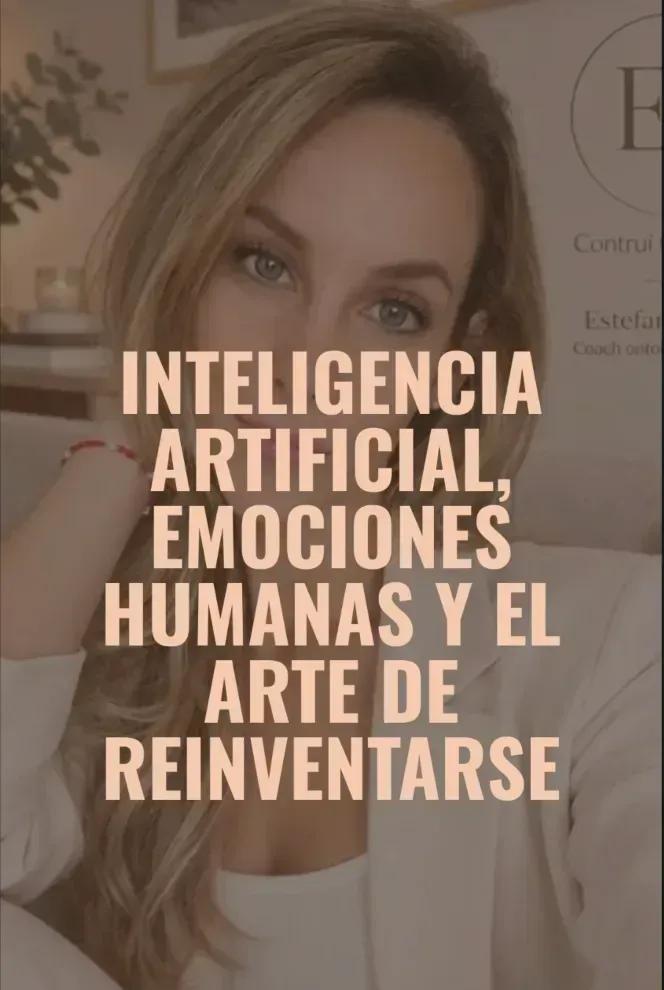
To explore this contradiction, I spoke with Estefanía Castillo, professional ontological coach, about the role of coaching in a society driven by artificial intelligence, the skills we will need to navigate this new scenario, and why true personal development remains deeply human.

And no, apparently there is still no software update capable of installing self-esteem into us, although some of us would greatly appreciate that functionality.
Artificial intelligence advances, but what about people?
Patricia: Estefanía, we live surrounded by tools that promise to make us more efficient, productive, and even creative. However, many people still feel insecure, blocked, or unable to move forward. Are we developing our technological capabilities faster than our human skills?
Estefanía Castillo: I believe that today we have access to extraordinary tools, but that does not necessarily mean that we know how to relate better to ourselves.
Many people feel that there is a huge gap between who they are today and who they know they could become. They live trapped in internal conversations full of doubts, postpone important decisions, or allow a lack of confidence to determine how far they dare to go.
From ontological coaching, we understand that these barriers do not necessarily define who you are, but rather how you are observing yourself.
Technology can facilitate many tasks, but it does not replace the personal work of recognizing our beliefs, managing our emotions, and taking responsibility for our decisions.
Patricia: It seems interesting because, in technology, we constantly talk about updating systems. But many times we continue to function with beliefs that we installed twenty years ago. Could we say that we need to update our emotional operating system?
Estefanía: It's a good analogy. Many of our limitations come from interpretations we have constructed based on past experiences.
The ontology of language teaches us that language not only describes our reality but also participates in its construction.
When a person constantly repeats to themselves “I am not good enough,” “I can't do it,” or “this is not for me,” those internal conversations influence their emotions, behavior, and ultimately, their possibilities for action.
The first step is to start observing those conversations and understanding that we can question them.
It is not about thinking positively all the time, but about developing a more conscious and responsible perspective about ourselves.
The human skills that no machine should make us forget
-Patricia: There is a lot of talk about reskilling and upskilling, about learning new competencies so we don't get left behind in the job market. But I have the impression that we are obsessed with learning to use tools and spend less time learning to use ourselves. What skills do you consider essential for the future?
-Estefanía: I believe that there are several deeply human skills that we should strengthen.
The first is self-knowledge. We need to understand what moves us, what our values are, what emotions we experience, and what beliefs condition our decisions.
Next, I would highlight emotional intelligence, understood as the ability to recognize and manage our emotions and relate more consciously to others.
Active listening is also fundamental. We live in a society where we all have something to say, but many times we listen only to respond.
And I would add adaptability, assertive communication, personal confidence, and the ability to move from intention to action.
It is not enough to acquire knowledge. We also need to develop the confidence to use it and the clarity to know where we want to direct it.
-Patricia: It is curious. In the corporate world, we talk about risk management, resilience, governance, and sustainability. However, we rarely apply those same concepts to our personal lives. How can we make better decisions when we are going through constant changes?
-Estefanía: By learning to distinguish between what happens and the interpretation we make of it.
When we go through a professional change, a personal difficulty, or a situation of uncertainty, we tend to construct stories about what that experience means.
Ontological coaching invites us to observe those interpretations, recognize our emotions, and explore possibilities that we could not see before.
It is about transforming the way we observe to expand our capacity to act.
Can artificial intelligence become our coach?
-Patricia: I have to ask you the inevitable question. Today, we can tell our problems to an artificial intelligence at three in the morning, ask it to organize our goals, and even request it to help us identify behavioral patterns. Do you think AI can replace a coach?
-Estefanía: Artificial intelligence can be a very useful tool for organizing ideas, stimulating reflection, and helping us formulate questions.
But I consider it important to distinguish between having information and undergoing a personal transformation process.
In ontological coaching, we work with language, emotions, and corporality. We observe how a person interprets their experiences, how they relate to themselves, and what possibilities for action they can discover.
Human presence, listening, and creating a space of trust have particular value.
AI can complement personal learning, but we should not confuse an automated conversation with a human support relationship.
-Patricia: So perhaps the question is not humans against machines, but humans who better use machines without losing their humanity.
-Estefanía: Exactly. The question is how we use those tools and from what place we make our decisions.
Technology can offer us possibilities, but we still need to develop our judgment, connect with our values, and decide what we want to do with them.
The true luxury of the 21st century: trusting in oneself
-Patricia: On social media, we constantly see seemingly perfect lives, spectacular careers, businesses that take off overnight, and people who seem to have discovered the secret to success while having a matcha for breakfast.
How do we strengthen our self-esteem in a culture of constant comparison?
-Estefanía: The first step is to stop measuring our value exclusively through external results.
True personal growth does not consist of accumulating titles, meeting others' expectations, or trying to fit into models that others have defined.
It begins when we dare to question the beliefs that limit us, recognize our strengths, accept our vulnerabilities, and build a healthier relationship with ourselves.
From coaching, we work so that people can manage their internal conversations, strengthen their self-esteem, and design goals aligned with their values.
When we transform our relationship with ourselves, our relationships, communication, and decision-making can also transform.
-Patricia: And how do we go from intellectually understanding all this to truly changing our lives? Because recognizing that we need to change is relatively easy. Doing it on a Monday morning, with fifteen pending emails, is another story.
-Estefanía: Here is where the importance of committed action comes in.
It is not only about identifying what you want but taking responsibility for the steps you are willing to take.
A coaching process allows us to explore what is holding you back, recognize the resources you already have, and define concrete actions that align with what truly matters to you.
Change does not always begin with big decisions. Sometimes it starts with a different conversation, a boundary that you did not dare to set before, or a small action that breaks a pattern you have been repeating for years.
Five skills for a smart and profoundly human future
After our conversation, I couldn't help but think about something: perhaps the most valuable talent of the future is not simply mastering artificial intelligence but learning to combine our technological capabilities with greater personal maturity.
If I had to design my own little survival map for this new era, I would include five competencies:
Critical thinking and AI literacy. Knowing how to use intelligent tools, question their results, recognize their limitations, and not blindly delegate our decisions to them.
Self-knowledge and emotional intelligence. Identifying our patterns, understanding our reactions, and developing more conscious relationships.
Adaptability and continuous learning. To learn, unlearn, and reinvent ourselves without turning every change into an identity crisis.
Communication, listening, and empathy. Building trust, managing disagreements, and connecting with others in a world where much of our interaction occurs behind screens.
Ethics and personal responsibility. Using technology judiciously, understanding its consequences, and acting in accordance with our values, even when an algorithm suggests the easiest path.
From my perspective, these skills are as relevant for an entrepreneur as they are for a lawyer, a compliance professional, an engineer, or someone simply trying to find their next professional chapter.
Because one thing is to automate processes. Quite another is to automate purpose. Thank you very much, Estefanía.

Comments