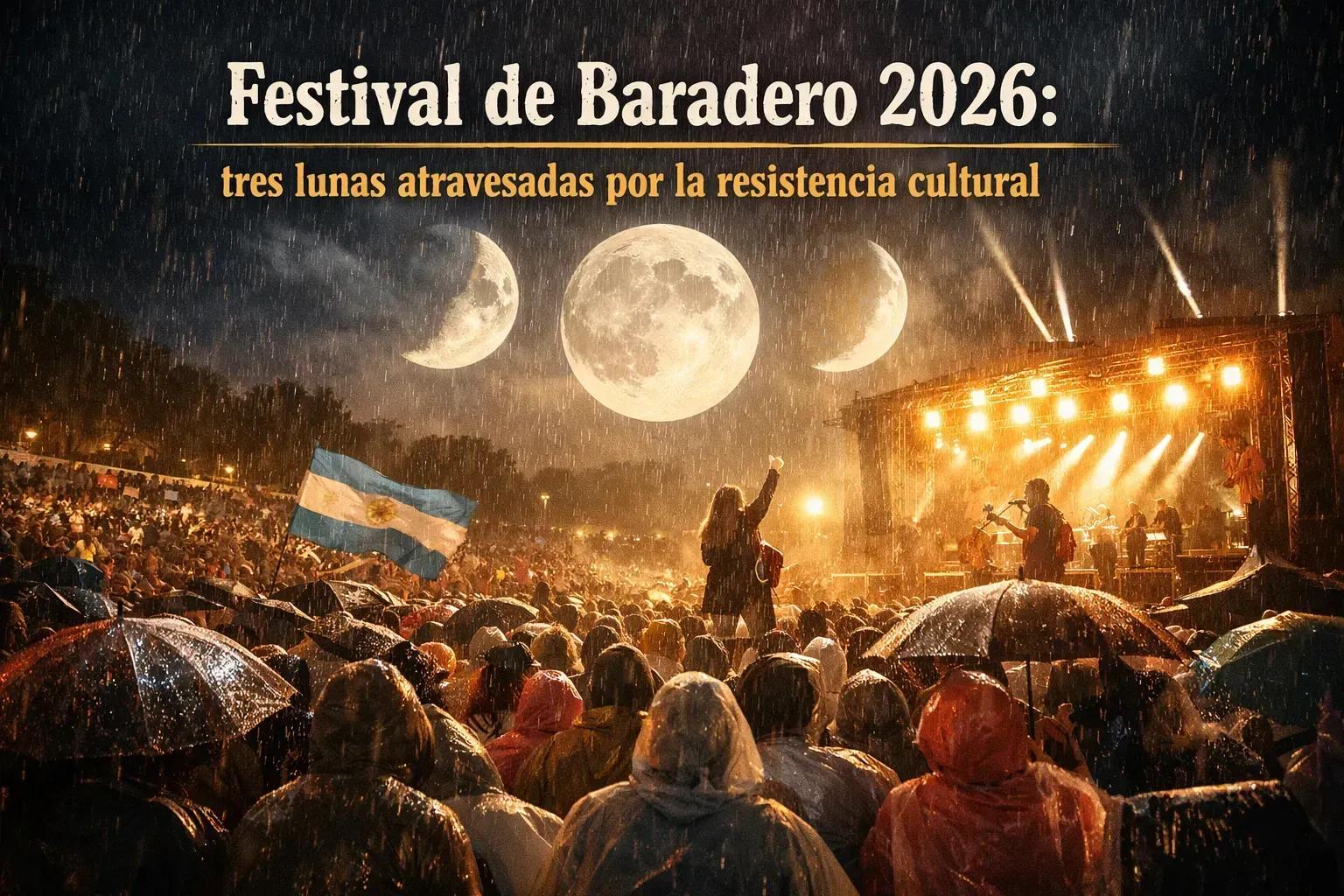
The sky was heavy from early on, as if it knew. In Baradero, the first moon of the National Festival of Argentine Popular Music began with that threat which in any other context could have emptied the amphitheater. But it didn't. The rain came, persistent, uncomfortable, at times intense, and the only thing it didn't manage was to move people from their places.
There were raincoats, improvised bags, soaked blankets, and still bodies. There were mates that kept spinning even though the water cooled them. There were entire families, groups of friends, couples embracing, solitary people who were still accompanied. No one seemed willing to give in. As if staying outside was, in itself, a way of saying something.
Baradero 2026 almost didn't happen. And that was felt.
For weeks, the festival teetered on the brink of not being held. The lack of economic resources left it in an uncertain, uncomfortable zone, where the symbolic weighs but doesn't suffice. It’s no news that culture goes through difficult times, but when the risk reaches a festival with more than half a century of history, the alarm stops being sectoral and becomes collective.
The way out came from the private sector, with a production company that decided to take charge of what seemed to be falling apart. This is neither a minor nor neutral detail. It is, in any case, a sign of the times. The festival took place, yes, but with the underlying feeling that sustaining these spaces is becoming increasingly costly, increasingly dependent on exceptional decisions, on willpowers that are not always guaranteed.
And yet, there were the people.
The first night was not tidy. It wasn't comfortable. It was, rather, honest. The stage lit up anyway, with artists who went on to play in the rain, with technicians running against the weather, with an audience that was not asking for perfection but presence. That generated something difficult to explain from the outside: a kind of silent pact between those who were on stage and those who were in the audience.
It didn't matter so much the list of songs, nor the order of the program, nor even the technical conditions. What mattered was being there. Resisting. Holding on.
In that sense, the rain ended up being almost another character. Not as an obstacle, but as a test. And Baradero passed it.
What was seen that first moon was, in essence, what defines folklore when it stops being a label and becomes an experience: belonging. An idea of community that doesn't need too much explanation, because it is exercised. Because it remains under the water when it would be easier to leave.
The second day found another climate. Literally and symbolically. The sun appeared, the ground began to dry, and the amphitheater regained that postcard that repeats every year: people everywhere, sold-out tickets, a constant murmur that mixes anxiety, joy, and a kind of shared calm.
The turnout was massive. Much more than some expected after such an uncertain prelude. But the festival, even in its fragility, continues to have something that draws people in. Something that isn’t explained solely by the names on the lineup.
Because yes, there are artists. There are renowned figures, those who fill stages, those with long careers and recognition. But Baradero is not just that. Or rather, it is not primarily that.
What happens there has more to do with what is generated among people.
There is something in the air, in the way people listen, in how circles are formed, in how applause is given, in how songs are sung even when they are not completely known. It is not passive consumption. It is active, emotional, collective participation.
Folklore, in that context, ceases to be a musical genre and becomes a language. A way of expressing who we are, where we come from, what matters to us. And that is felt in every chord, but also in every gesture of the audience.
Saturday was that: a confirmation that the festival, even with everything against it, remains a meeting point.
On stage, diversity was evident. Sounds from the coast, the north, the center of the country. Chacareras, zambas, chamamé, newer fusions, proposals that mix the traditional with the contemporary. There is no single way to make folklore, and Baradero knows that.
That mix does not generate noise. It generates dialogue.
The new generations do not come to break with the past, but to converse with it. To tension it, to transform it, to make it their own. And that is what allows folklore to stay alive. Not repetition, but constant reinterpretation.
In that crossroads, something interesting also appears: the audience accompanies. They do not stay only with the familiar. They listen to the new, they open up, they respond. And that is significant. Because without that openness, there is no possible renewal.
The night progressed with that sustained energy, with moments of euphoria and other more intimate ones, with songs that invite dancing and others that compel stillness. Everything coexists. Everything comes in.
By Sunday, the festival was already something else. Or better said, it had already built its own climate. That kind of bubble that forms when an event manages to settle beyond its initial conditions.
The third moon always carries a different weight. It is the closing, but it is also a synthesis. A way to condense what happened in the previous days.
And in Baradero, that was felt.
The amphitheater filled up again. People arrived with that mix of enthusiasm and anticipatory nostalgia that endings carry. As if knowing that something ends, but also that something remains.
On stage, the presence of historical figures reinforced that idea of continuity. Of tradition that does not break. Of a thread that comes from afar and continues to weave.
But the most interesting part was not just there.
It was in the way the audience responded. In how those moments of shared emotion were generated, where there is no difference between who sings and who listens. Where the distance between stage and audience becomes, at times, nonexistent.
That is difficult to build. And even more difficult to sustain over time.
Baradero has been doing it for more than fifty years.
Alongside everything that was happening on stage, there was another equally important dimension: the economic and social. Because a festival of these characteristics is not just a cultural event. It is also a motor for the city.
Full hotels, rented houses, businesses working at full speed, food stalls that do not stop, street vendors, independent workers. All of that is part of the fabric that makes the festival possible.
And in a context where many local economies are battered, that movement is not minor.
That is why, when talking about the difficulty of maintaining these spaces, it is not just a cultural debate. It is also an economic discussion. Understanding that culture is not an expense, but an investment that impacts directly at multiple levels.
Baradero 2026 made that evident.
But it also showed something deeper.
It showed that, even when the conditions are not the best, there is something that drives these spaces to exist. Something that cannot always be measured in numbers.
It might have to do with the need for connection. With the possibility of feeling part of something larger. With that idea, a little diffuse but very real, that there are experiences that cannot be replaced.
Folklore has that.
It has a root that is not visible, but that supports. That traverses generations, contexts, crises. That changes form but does not disappear.
In Baradero, that becomes visible.
It becomes song, but it also becomes body, becomes embrace, becomes permanence.
The image of the first night, with the rain falling and the people not moving, remains as a perfect synthesis of everything the festival was. Because there it all is: the difficulty, the insistence, the decision to stay.
It was not a perfect festival. And perhaps that is where its greatest value lies.
It was a real festival. Laced with concrete problems, tensions, limitations. But also with an enormous capacity to sustain itself.
And that makes it, in a way, more significant.
In times where many things seem fragile, where the immediate gains ground, where culture is often relegated, Baradero appears as a reminder.
That there are traditions that keep beating.
That there are communities that continue to meet.
That there is music that continues to say.
The three moons were not just three nights of shows. They were three moments where something was reaffirmed. Where, despite everything, folklore found its place.
And so did the people.
Because in the end, beyond the names, the production, the discussions about financing, what remains is that.
The experience.
Having been there.
Having been part of something that, for a while, made everything else fade a little into the background.
Baradero is still there.
Not as a guarantee, but as a possibility that needs to be nurtured.
Because if this edition left anything, it is the certainty that these spaces are not eternal by themselves.
They are sustained.
They are defended.
They are inhabited.
And as long as there are people willing to stay under the rain for that to happen, folklore will continue to have a place.
Even if it is hard.
Even if it hurts.
Even if, like this year, it almost doesn't happen.

Comments