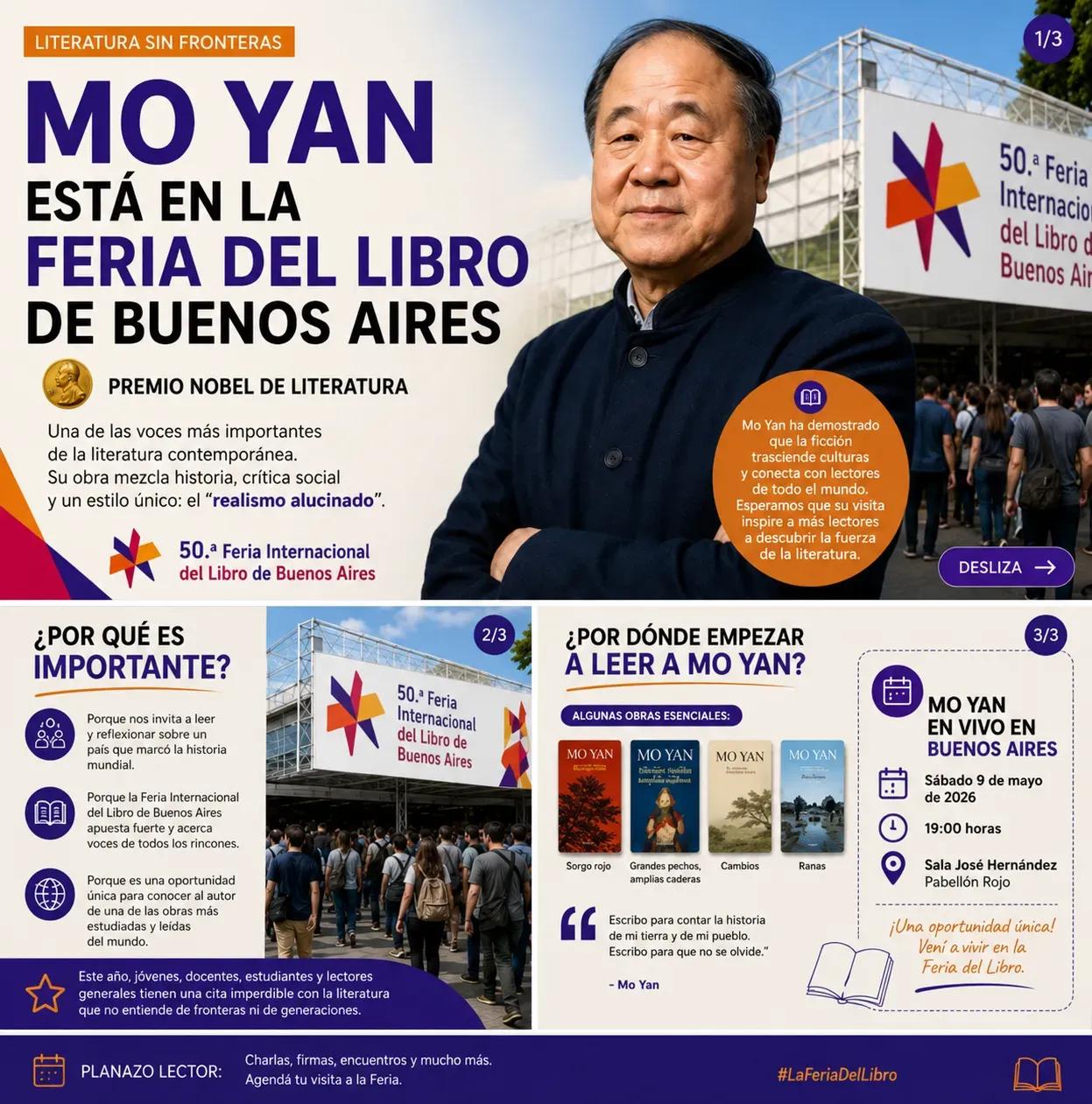
The Chinese Nobel Prize winner in Literature, Mo Yan, will participate for the first time in the International Book Fair of Buenos Aires on Saturday, May 9th at 7:00 PM, in the José Hernández room of the Red Pavilion. His presence renews interest in a vast and complex body of work that, for Spanish-speaking readers, can be difficult to approach without a roadmap.
The author's real name is Guan Moye, born in 1955 in Gaomi, Shandong Province. His pseudonym—which in Chinese means "don’t speak"—refers to the warnings he received from his parents during the Cultural Revolution to avoid political reprisals. After working in an oil factory and altering his birth certificate to join the People's Liberation Army, he began writing when he secured a position at the Army's School of Art and Literature.
The Swedish Academy defined his style as "hallucinatory realism": a fusion of folklore, history, and present that builds the unreal out of hunger, trauma, and obsession. His declared influences include García Márquez, Tolstoy, and Faulkner.
The recommended entry point is The Transparent Radish (1984), a short novel about an orphan boy during the collectivist period whose distorted perception of reality anticipates all of the author's poetics. The next natural step is Red Sorghum (1987), his most emblematic work: a reconstruction of anti-Japanese resistance narrated from the margins of the official account, featuring peasants and bandits as protagonists. The film adaptation by Zhang Yimou won the Golden Bear in Berlin in 1988 and propelled Mo Yan into the international literary circuit.
The Garlic Ballads (1988), based on a real peasant uprising, incorporates a blind bard as the choral narrator and denounces administrative corruption. For readers with more experience in experimental narrative, The Republic of Wine (1992) proposes a tripartite structure that blurs the boundaries between reality and fiction using cannibalism as a metaphor for moral exhaustion. Big Breasts and Wide Hips (1995), banned in China after its publication, covers the history of the country from the fall of the Qing dynasty to the post-Mao reforms through the lineage of one family. The journey closes with Frog (2009), which addresses the trauma of the one-child policy by combining epistolary form and theater.
A key factor that specialists consider is the quality of the translation. After the Nobel Prize in 2012, the Kailas publishing house promoted direct translations from Chinese by specialized translators, substantially improving access to his work in Spanish. His most recent title available in Spanish, The Reunion of Comrades in Arms, was published in 2024.

Marcos González Gava is the co-founder of Reporte Asia and a specialist in cultural issues and commercial and financial matters with the People's Republic of China. He lived in this country for four years and speaks Mandarin Chinese fluently.
Comments