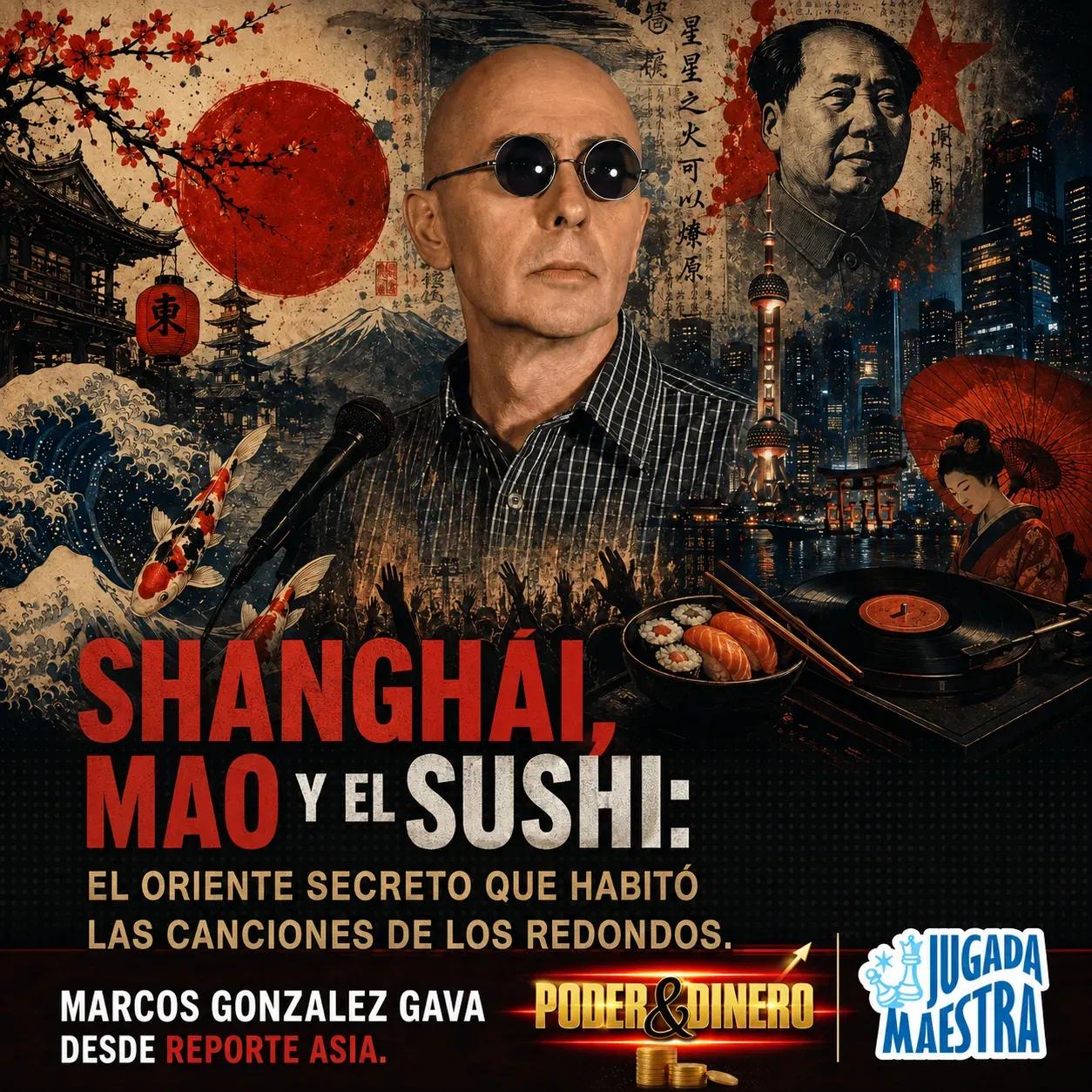
Long before Asia became a global agenda topic, Patricio Rey and his Redonditos de Ricota were already populating their lyrics with images of China, references to Mao Zedong, and nods to Japanese culture, building their own oriental imaginary, oblique and deeply ricotero.
In the lyrical universe of Indio Solari, Asia was not a destination or a political statement. It was a texture. A set of borrowed images from the East that the Parque Leloir poet used to name what everyday language could not capture: chaos, daydreaming, the revolution that never fully arrives, the body floating in a world it does not understand.
Reviewing the songbook of Patricio Rey and his Redonditos de Ricota with Asian eyes, what emerges is not a band with geopolitical interest in the region but something more interesting: a sensitivity that found in the symbols of the East a reserve of meaning to speak about Argentina.
Shanghai as a daydream
“Sorpresa de Shangai,” included in Lobo Suelto (1993), is perhaps the most transparent case. The title evokes the Chinese city without the lyrics explicitly mentioning it: what Shanghai brings to the song is not geographical content but atmosphere. The most cosmopolitan, chaotic, and fascinating city in Asia serves as a name for a state of mind: something surprising, dizzying, coming from afar and hitting without warning.
The same album includes “Sushi,” an instrumental piece of just a minute where Skay Beilinson performs a guitar riff that, according to the band's own documentation, is “a slow and direct flight to the East.” Without words, with pure music, Los Redondos closed the first volume of the album with a sound image of Asia: still, contemplative, alien to the electric roar of the rest of the album.
Indio himself explained that Lobo Suelto attempted to address the yin and yang of the human condition—a direct reference to Chinese Taoist philosophy—and that “Sushi” was the requiem of that balance.
The Mao of Indio
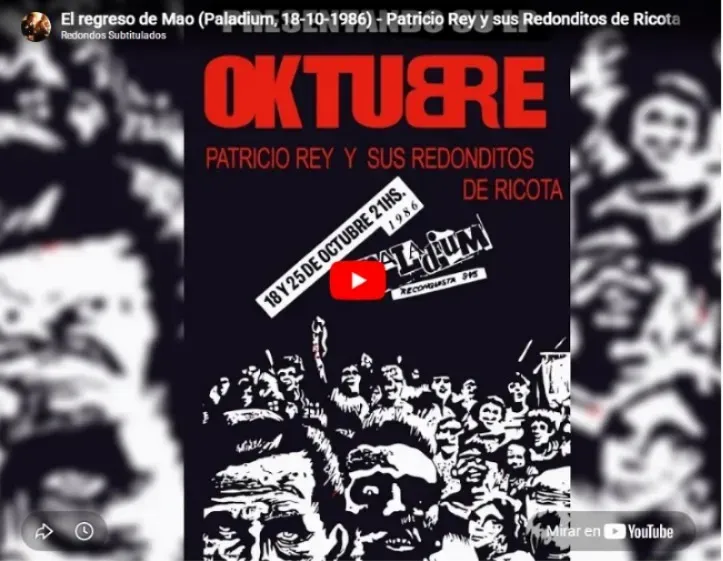
More dense and political is the reference to Mao Zedong in “El regreso de Mao,” an unpublished song performed live between 1984 and 1989 and never included in any official album. The song mixes images of Latin American guerrilla, drug trafficking, and revolution in a sampan floating between China and the Southern Cone: “Confuses the words ‘soldier’ and ‘bandit’ / floating in a sampan with women like / men like a wounded white”.
Indio himself explained the origin of the lyrics in his autobiographical book Recuerdos que mienten un poco: it was a description that aimed to mix guerrilla and drug trafficking in Latin America, with the secret hope that they were true revolutionaries. The fear that Peruvian military had of Sendero Luminoso—whose full name in Spanish is “Laja Cristalina,” a fact that appears verbatim in the song—fascinated him. Mao was the figure that named that diffuse hope, the return of something that had never fully arrived.
“China means ‘Middle Kingdom’ / Sendero Luminoso ‘Laja Cristalina’ / who anticipated the return of Mao”, says the lyrics, unusually mixing real geopolitical data with the revolutionary mythology of Argentine underground rock of the eighties.
An East of symbol, not of postcard
What distinguishes the use of Asia in Indio’s lyrics from the cheap exoticism that infects much of Western rock is that his references are not decorative. Shanghai does not appear as tourist scenery. Mao is not a poster. Sushi does not intend to be Japanese: it is the name of a state of stillness that closes an album on human ambiguity.
In the ricotero imaginary, the East fulfills the function that in other contexts was served by the wild west or Greek mythology: a repertoire of images that allow speaking of one’s own from a distance that makes visible what proximity hides. Indio used China to talk about Argentina, used Mao to talk about the Latin American left, used sushi to talk about beauty as a symbol of symbols.
That three Asian media covered his death may not be so paradoxical. Something in that work, built far from Asia but with many Asian elements deep inside, ended up traveling further than its author perhaps ever imagined.
Marcos González Gava is Co-Founder of Reporte Asia and a specialist in cultural, financial, and commercial matters with the People’s Republic of China.

Comments