
The Japan News, Bastille Post, and China International Radio reflected the passing of the leader of Los Redondos, while global search trends confirmed the phenomenon's scale: one million people in the streets and songs that returned to dominate international streaming.
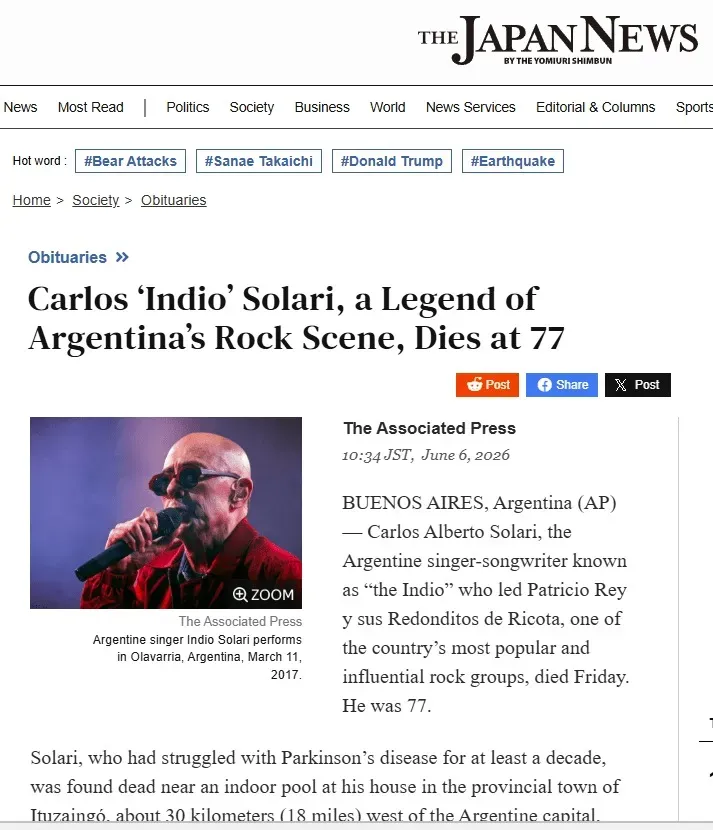
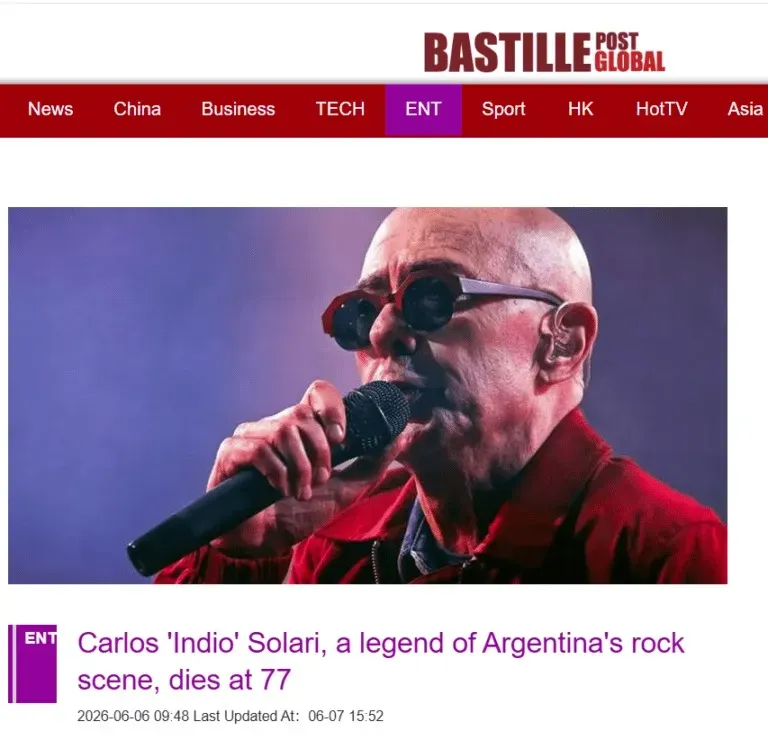
The death of Carlos Alberto “Indio” Solari on June 5 was not just news in Argentina. Thousands of kilometers from Avellaneda, where one million people gathered to bid farewell to the leader of Patricio Rey and his Redonditos de Ricota, three major Asian media outlets with global reach covered the event: The Japan News from the Yomiuri Shimbun group, Bastille Post based in Hong Kong, and China International Radio —CRI— through its CGTN platform in Spanish.
At the same time, search engines recorded a historic peak in digital traffic that revealed the true extent of the phenomenon's impact.
The digital world as a cultural thermometer
The global search trends that surged following the Indio's death provide a precise snapshot of which aspects of his figure captured international attention.
The first vector was the confirmation of the event and its immediate context: the years-long battle against Parkinson's, the farewell with a nine-kilometer queue lasting over sixteen hours, and the debate about the exact circumstances of his death dominated search engines in the early hours.
The second vector was musical. Streaming platforms recorded a massive surge in plays from his catalog: songs like Ji Ji Ji, Había una vez, Flight 956, and El tesoro de los inocentes returned to lead the charts, alongside Quemarás, his recent collaboration with Wos, which served as a gateway for listeners discovering the Indio for the first time. The phenomenon confirms an already known dynamic: the death of a massive artist turns their work into an urgent object of search for those who have never listened to them.
The third vector was about scale. Searches surrounding the historic concert in Olavarría in 2017 —with between 300,000 and 400,000 people— and the concept of “misa ricotera” reflected a genuine international curiosity to understand what kind of bond unites a musician with their audience when that audience numbers in the hundreds of thousands. For a global audience accustomed to large commercial-format festivals, the self-management and mystique of the Indio's concerts were difficult to categorize.
The fourth vector was economic. Analyses of the estimated wealth of the musician and the model of self-management he built over decades —without multinational labels, without external management, without concessions to the industry— also strongly positioned themselves in informative trends, highlighting that the Indio's legacy has a uniquely singular business and cultural dimension.
Three Asian media outlets, three different reaches
Against this digital backdrop lies the Asian coverage. The Japan News, the English edition of the Yomiuri Shimbun —the largest circulating newspaper in the world with over seven million daily copies— published the obituary in its Society section.
This is not a minor gesture: Japan has a connection with Latin American culture that few Asian countries can match, built on the nikkei community throughout the region, decades of musical exchange, and an aesthetic sensitivity that values in artists exactly what the Indio embodied: coherence, hermeticism, and distance from the entertainment industry.
Bastille Post, from Hong Kong, distributed the news to an audience encompassing Singapore, Malaysia, the Philippines, Vietnam, Indonesia, and Thailand.
In these markets, where the Latin American community is small but the consumption of global culture in English is growing among urban and professional classes, the medium served as a vector for introducing a phenomenon that would otherwise have remained invisible.
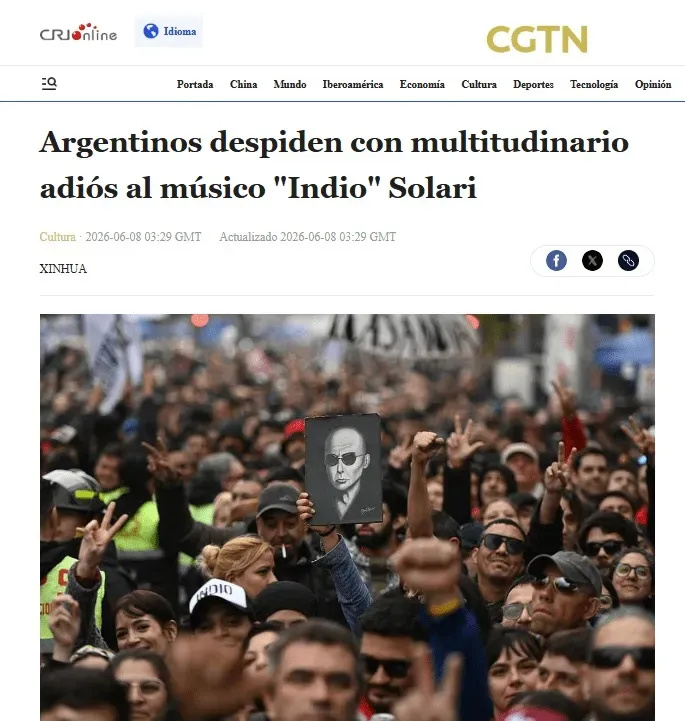
The broadest reach was provided by CRI-CGTN. The China International Radio, which broadcasts in 65 languages and is one of the media with the widest global distribution, published on June 8 in its Culture section in Spanish —via Xinhua— a note about the massive farewell in Buenos Aires.
That the international Chinese media apparatus covered the ricotero phenomenon says something about how Beijing monitors the cultural pulses of a region it considers strategic: Argentina is not just soy, lithium, and bilateral cooperation, and thus, it is valuable to give space in its media to those transcendent events that reflect the unique characteristics of South American societies with which China seeks to engage.
What Asia is beginning to see
Alongside coverage from media like The Washington Post, Billboard, France 24, and El País of Madrid, the Asian coverage shapes a map of international reception that few Latin American rock figures have reached.
Asia did not know Los Redondos, but it is beginning, slowly, to know that they existed. And that when their leader died, one million people took to the streets to bid him farewell.
Marcos González Gava is Co-Founder of Reporte Asia and a specialist in cultural issues, financial, and commercial relations with the People's Republic of China.

Comments