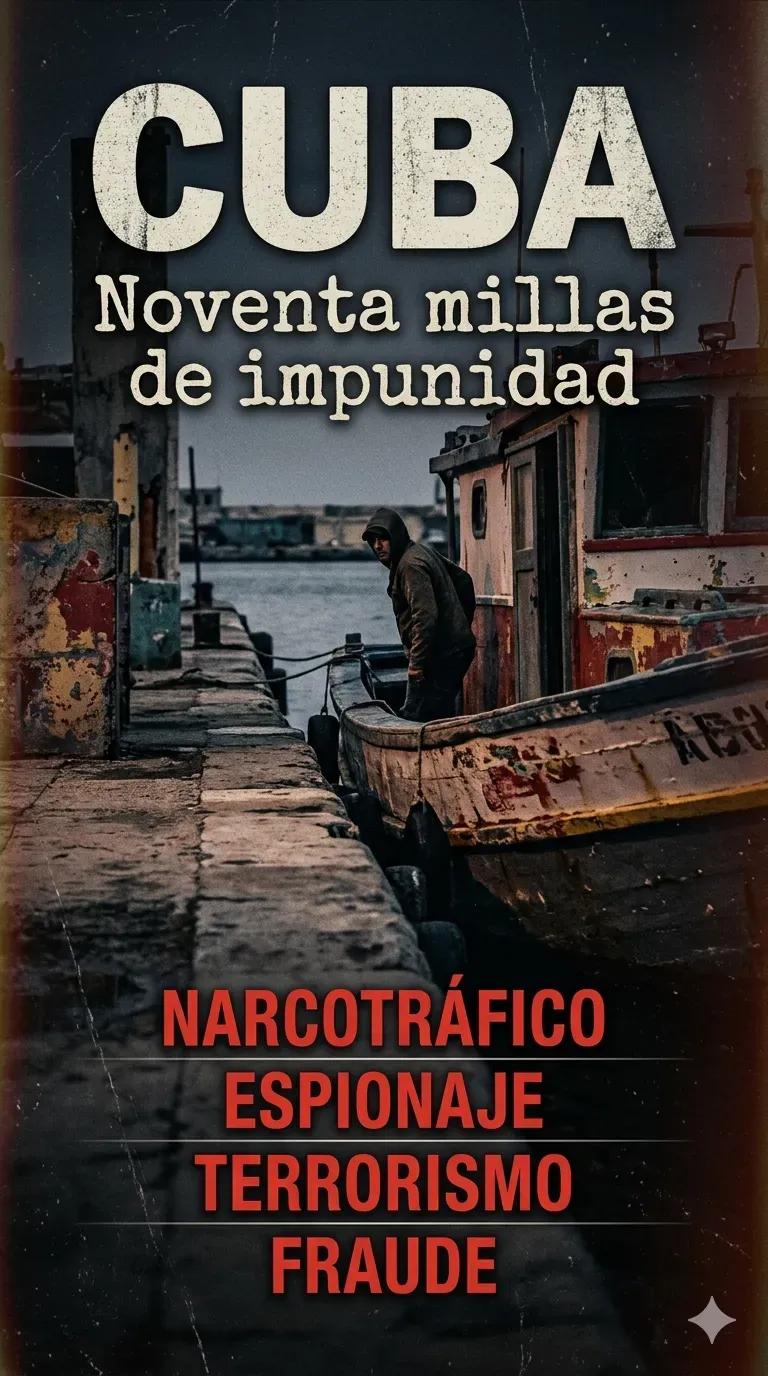
INTRODUCTION: THE STATE AS AN ACCOMPLICE
There are crimes that are committed in the darkness. And there are crimes that are committed in broad daylight, protected not by the absence of witnesses but by the presence of a diplomatic passport and the flag of a sovereign nation. Cuba has been in this second category for over four decades.
This report is neither a hypothesis nor a conspiracy theory. It is a documented reconstruction based on federal indictments, court rulings from the United States, verified journalistic investigations, reports from international organizations, and judicial testimonies. What that documentation shows, when read as a whole and without political concessions, is a pattern that goes far beyond passive complicity: a State that turned criminality into an instrument of foreign policy, that used its sovereignty as a shield for drug trafficking, that offered refuge to fugitives who drained billions of dollars from a federal health program, and that exported that same model to Venezuela with lethal consequences for tens of thousands of people.
The question this report seeks to answer is not whether Cuba was involved. The available evidence answers that question clearly enough. The question is more uncomfortable: why has that evidence existed for forty years, includes formal accusations before a federal grand jury and testimonies from convicted drug traffickers, and yet no Cuban official has stepped foot in a court outside the island?
The answer has a name: sovereignty. And the history of how Cuba used that sovereignty as an operational advantage for organized crime is what this report documents, case by case, year by year, from 1979 to the present.
THE HUMAN COST: A NATION HIJACKED, A PEOPLE CONDEMNED TO EXILE
Before continuing with the files, case numbers, and fraud schemes, it is necessary to pause for a moment. Because this report speaks about criminal structures, officials, and networks of impunity, but behind each of those words is a people. A people that chose none of this. A people that had their country stolen before they could defend it.
Cuba was, in the first third of the 20th century, one of the countries with the highest per capita income in Latin America (ASCECUBA Economic Studies, 2014, citing historical data from the World Bank). It had a robust middle class, top-level universities, architecture of a beauty that still stops anyone who looks at it, and a culture that radiated from the Caribbean to the entire continent. It was not a flawless paradise — it had inequality, corruption, and a history of foreign intervention that left deep wounds — but it was a country with a future, with its own movement, with drive. What the regime installed in 1959 did with that country was not a social revolution. It was a long-term plunder, executed with ideological manuals and bayonets.
Today, more than two million Cubans have left the island since 2021 alone. They did not flee from a hurricane or a conventional war: they fled from a State. Between December 2021 and December 2023, Cuba lost more than 10% of its population — from 11,181,595 inhabitants to 10,055,968, according to the Cuban National Statistics Office's own data, confirmed before the National Assembly in July 2024. Demographer Juan Carlos Albizu-Campos, using independent methodology, estimates that the real figure is closer to 18%: barely 8.62 million people left on the island by the end of 2023 (CEDA, July 25, 2024). In 2024, 251,221 more left, with the lowest birth rate in 65 years — 71,358 births compared to 128,098 deaths (CiberCuba, May 23, 2025). Those who leave are the youngest, the most capable, those who have the most to lose and those whom the regime fears the most: 77% of emigrants are between 15 and 49 years old (Global Affairs and Strategic Studies, University of Navarra, 2024, citing data from the Cuban ONEI).
The accumulated Cuban exile over more than six decades now totals more than three million people. It is one of the largest diasporas in the hemisphere in proportion to the population of origin, as documented in detail in the section "Broken Families" of this same chapter.
Those who could not or did not want to leave paid another price. Since July 2021, when thousands of Cubans took to the streets in the largest mass protests since the revolution — shouting "Homeland and Life" and "Freedom" in more than 60 municipalities simultaneously — the regime responded with a repression that international organizations documented in clinical detail: more than 1,400 people detained in the immediate days following the protests, more than 700 still imprisoned a year later, hundreds sentenced on charges of "sedition," "public disorder," and "disrespect" in summary trials that Human Rights Watch described as contrary to international law (HRW, "Prison or Exile," July 11, 2022). Some appeared before military courts. Several received sentences of up to 25 years. A protester, Diubis Laurencio Tejeda, 36 years old, died in police custody during the protests.
As of August 2025, Cuba had 1,185 political and conscience prisoners — the highest number ever recorded — according to Prisoners Defenders, an organization based in Madrid that conducts monthly verified counts (CiberCuba, September 11, 2025). Of that total, 472 are in serious medical conditions and 41 have severe mental disorders without proper treatment. At least 33 were detained as minors. 122 are women. From July 2021 to August 2025, the organization documented 1,882 individuals who have gone through the condition of political prisoners in Cuba — almost all citizens without formal political affiliation, imprisoned for protesting peacefully. In the first half of 2025, there were 24 deaths in state custody and 160 reports of torture, including beatings, deliberate denial of medical care, and psychological torture. Of the victims of these abuses, at least 56 were political prisoners (CiberCuba, September 2025).
Torture in Cuban jails is not an isolated excess: it is a method. Prisoners Defenders documented 15 distinct types of mistreatment and torture in their first comprehensive report on the subject, presented to the United Nations Committee Against Torture in March 2022 (Havana Times, June 2, 2023). The U.S. Department of State, in its 2024 human rights report, registered among the documented abuses: "arbitrary or unlawful executions, enforced disappearances, torture or cruel, inhumane treatment, arbitrary detention, transnational repression, and systematic restrictions on the freedom of expression" (U.S. Department of State, Country Reports on Human Rights Practices: Cuba, 2024). The Inter-American Commission on Human Rights concluded in 2023 that the Cuban government is responsible for the deaths of the democratic activists Oswaldo Payá and Harold Cepero in 2012 — deaths that for years the regime presented as a traffic accident.
Meanwhile, the regime's top brass does not suffer any of these shortages. GAESA — the military conglomerate that controls tourism, imports, dollar supermarkets, and a large part of the formal economy of the island, as documented in detail in this report — generates hundreds of millions of dollars a year that do not pass through any auditable public budget. Generals and high-ranking officials have access to special stores, differentiated medical care, state housing, and currencies that the average citizen cannot see or touch. The ordinary Cuban, on the other hand, faces daily electricity cuts of up to 20 hours, chronic shortages of food and medicine, and an average state salary equivalent to less than 20 dollars a month at the informal market exchange rate (CiberCuba, January 2025; confirmed by Reuters, July 2024).
About the Author
William L. Acosta is a graduate of PWU and Alliance University. He is a retired police officer from the New York Police Department, a former U.S. Army serviceman, as well as the founder and CEO of Equalizer Private Investigations & Security Services Inc., a licensed agency in New York and Florida with international projection. Since 1999, he has led investigations into drug cases, homicides, and missing persons, in addition to participating in criminal defense at both the state and federal levels. A specialist in international and multi-jurisdictional cases, he has coordinated operations in North America, Europe, and Latin America.

Comments