There was a time, not so long ago, when Manuel Adorni would step out every morning in front of the cameras of the world to confidently explain with a knowing smile why Javier Milei's government was different from all previous ones. Transparency, honesty, and the end of the privileges of the "casta" were the recurring themes of each press conference. Today, that same man is being investigated by federal justice for alleged illicit enrichment, with an apartment in Caballito and luxury properties that, according to the case, do not appear in any of his sworn declarations.
The irony would be comical if it weren't so serious.
What Justice Found
The case driven by prosecutor Gerardo Pollicita before judge Ariel Lijo is not the result of an anonymous complaint or a dubious opposition leak. It is the result of an investigation that detected specific and documented inconsistencies between the wealth declared by Adorni and the assets that—according to judicial sources—he actually possesses.
The file includes bank transfers that do not match the official's income, an apartment in the neighborhood of Caballito that does not appear in his sworn declarations, and alleged luxury properties whose ownership is still being traced. These are irregularities that, in any serious rule of law, warrant a thorough investigation. In Milei's Argentina, on the other hand, they warrant a presidential hug and a photo with Karina.
The same judicial sources indicated that Adorni is likely to be summoned for interrogation in May, once the statements of the others mentioned in the case conclude. That is to say, the main spokesperson for the Government, the face of the Executive before the national and international press, could be sitting in front of a judge in a few weeks to explain how he built his wealth while drawing a salary from the State.
The Argument of "Political Operation": the Always Available Wildcard
In light of the seriousness of the facts, the government's response was predictable to the point of exhaustion: "it's a political operation." The same phrase they used when investigating Cristina Fernández de Kirchner. The same they used when investigating Kirchnerist, Menemist, and Radical officials. In Argentina, every management scandal ends up becoming, by the work and grace of the accused, a conspiracy by the enemy.
The problem with that argument is that it explains nothing. It does not explain why the apartment in Caballito does not appear in the sworn declarations. It does not explain where the bank transfers under analysis come from. It does not explain why a public official who earned his salary from the State is associated with properties that exceed what that salary allows one to accumulate. Saying "I'm being persecuted" is not a refutation of the facts; it is a political alibi disguised as a legal argument.
Furthermore: if the government truly believed that this was a coordinated judicial operation, the logical response would be to demand that Adorni publicly present all his asset documentation to clear up any doubts. That did not happen. Instead, they opted for political shielding, joint acts, and a presidential hug. A decision that, far from generating tranquility, fuels suspicions.
Karina and Javier: the Politics of the Hug
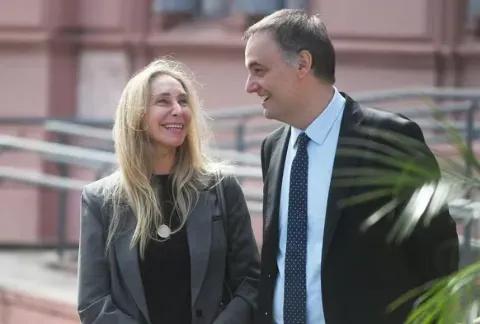
The reaction of the Milei siblings to the scandal deserves a separate analysis. Karina Milei, the most influential figure in the presidential circle and who tightly controls the timing and loyalties of the libertarian space, chose to appear publicly alongside Adorni at two high-profile events: one at the Malbrán Hospital and another at Vaca Muerta. The message was clear and deliberate: the official has the backing of the hard core of power.
The president, for his part, embraced him in front of the cameras in a gesture that the government itself defined as "loaded with political symbolism." And indeed, it was. In the week when the judiciary was advancing on his Chief of Cabinet, Milei chose to demonstrate affection over any other institutional considerations. There was no call for transparency, no invitation for Adorni to present his assets to the public, not even a statement that distinguished personal support from political endorsement for an official under judicial suspicion.
This attitude is not innocent. It is a signal to the libertarian space: we do not abandon our own, regardless of what the judiciary says. It is also a signal to the outside: the government has no intention of making concessions to media or judicial pressure, at least while the case does not advance to a point of no return.
The Spokesperson for Transparency
It's worth remembering who Manuel Adorni is and what his role was within the communication framework of the libertarian government. He was the one who, with surgical precision and a smile that many described as condescending, went out day after day to explain the benefits of austerity, the necessity of collective sacrifice, and the moral superiority of a government that—unlike its predecessors—did not steal, did not lie, and did not hide anything.
It was Adorni who defended every controversy of the Executive, who minimized every critique, and who constructed the narrative of a transparent and different government. He was the face of the break with the "casta." And now it is that same man who must explain to Justice why his wealth does not match his declared income.
The contrast could not be more brutal. Nor more revealing.
A Government That Cannot Afford More Wear and Tear
The Adorni scandal comes at the worst possible moment for La Libertad Avanza. With the presidential image falling to 35%—the lowest rating since Milei took office—with inflation in March above expectations, and with an increasingly difficult Congress to manage, the government is not in a position to absorb a new storm front without political costs.
Surveys already show the impact: 58.9% of those surveyed consider the Adorni case to be serious and it affects the credibility of the Chief of Cabinet. 11.8% of voters in the space said that the scandal raises doubts about continuing to support La Libertad Avanza. These are numbers that, in an election year, no political strategist can ignore.
And yet, the government decided not to sacrifice Adorni. The bet is to wait for the judicial case to advance—or stagnate—and to trust that political shielding is enough to sustain the official until the elections in October. It is a strategy that may work if justice does not accelerate and if the opposition does not find a way to turn the case into the focus of the electoral campaign.
But it is also a risky bet. Because every time Adorni appears on screen—every time he goes out to the press room to talk about transparency, austerity, and the differences between this government and previous ones—the contrast between the discourse and reality will become more unbearable.
The spokesperson for change has an undeclared apartment. And that, like it or not, is exactly what this government promised to end.

Comments