Agostina Vega was found by the dogs.
The phrase hurts because it seems to come from another time. Because it's hard to believe that a fourteen-year-old girl could disappear for days in a country crossed by cameras, smartphones, tracking systems, and a public conversation that has been discussing gender violence for more than a decade. However, it happened. And when the body appeared, the press conferences, official statements, promises of justice, and the usual analyses arrived.
First, death appeared.
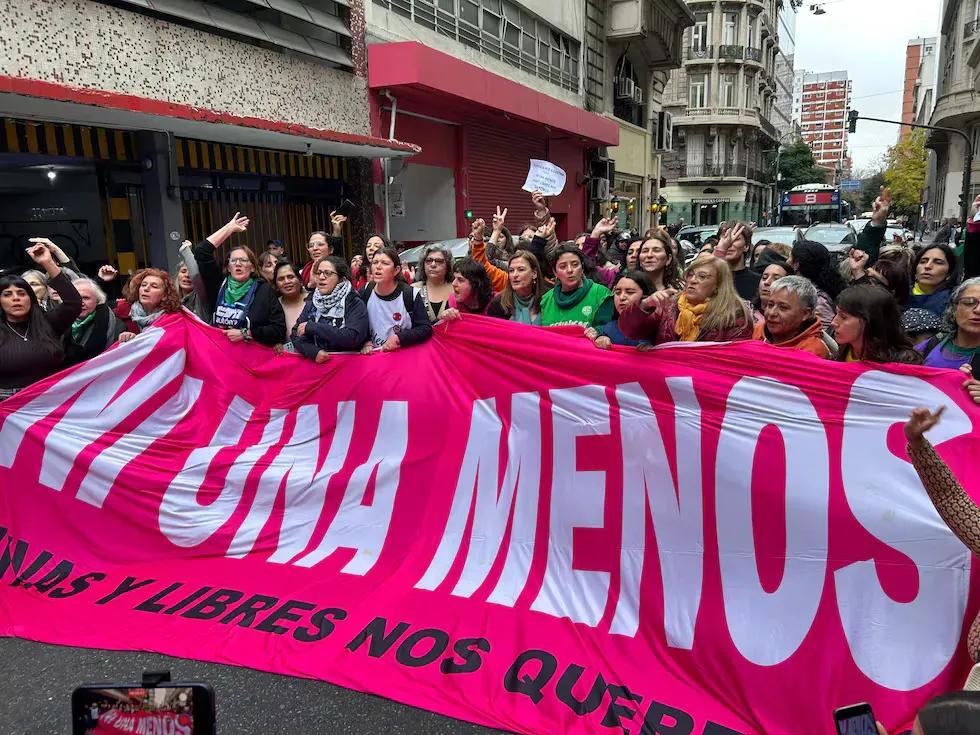
The news swept across Argentina just a few days before a new anniversary of Ni Una Menos. The coincidence was impossible to ignore. Eleven years earlier, another fourteen-year-old girl named Chiara Páez had been murdered in the province of Santa Fe. Her femicide sparked one of the most important mobilizations in recent Latin American history.
Between Chiara and Agostina, there are eleven years.
Eleven years of massive marches, parliamentary debates, legislative reforms, educational campaigns, academic research, observatories, judicial protocols, and cultural discussions that have crossed homes, schools, universities, media, and workplaces.
But there are also more than three thousand fatal victims of gender violence.
This figure summarizes one of the deepest contradictions of contemporary Argentina. The country that has managed to convert macho violence into a central issue on the public agenda is, at the same time, a country where women continue to be killed simply for being women.
Ni Una Menos transformed something that seemed unchangeable: language.
For decades, murders of women were narrated as crimes of passion, family tragedies, or isolated episodes. The victims were scrutinized more rigorously than their aggressors. Their clothing, where they went, who they hung out with, and what decisions they made were analyzed. Violence appeared disguised as fatality.
The movement altered that logic.
Naming femicides was a way to break a tradition of silence. Understanding that behind each case existed repeated patterns made it possible to observe something larger than individual facts: a structure of inequality capable of crossing generations, social classes, territories, and ages.
The revolution was cultural before it was institutional.
Thousands of women began to identify situations that had been naturalized for years. What previously seemed a discussion restricted to small militant circles became a collective conversation. Feminism stopped occupying the margins and began to contest the center of the public scene.
However, death continued to find paths.
The statistics reveal a persistence that is hard to ignore. Most aggressors belonged to the victims' intimate environment. Partners, ex-partners, family members, or acquaintances. The numbers dismantle one of the most widespread fictions: the main danger is not usually lurking in a dark street, but inside spaces where protection should exist.
Homes continue to be one of the most frequent venues of horror.
Behind each file are empty rooms, tables with one fewer chair, birthdays that are no longer celebrated, and children who grow up learning too early the meaning of absence. Thousands of daughters and sons have been left orphaned since that first mobilization in 2015. They are the least visible consequence of a violence that doesn't end when the cameras turn off.
Meanwhile, the political context has changed drastically.
Feminist organizations denounce the dismantling of state programs aimed at preventing, assisting, and supporting people in violent situations. They also alert about the rise of discourses that relativize, minimize, or directly deny the structural dimension of the problem.
The dispute is no longer solely about solutions.
Now, it is also discussed whether the problem exists in the terms it was defined in over the last decade.
The paradox is unsettling.
There has never been so much research, statistics, investigations, and conceptual tools to understand gender violence. Never has there been such a vast quantity of knowledge about its mechanisms, consequences, and forms of social reproduction. Never has there been such widespread public awareness on the issue.
And yet, deaths continue.
Perhaps because no cultural transformation is linear. Perhaps because the oldest structures tend to resist disappearing. Perhaps because advances coexist with reactions that seek to restore old orders. Or maybe because recognizing a tragedy does not necessarily equate to preventing it.
The truth is that eleven years after that first June 3, Argentine society faces an uncomfortable question: how do you measure the success of a movement that permanently changed the public conversation but has not made its own existence unnecessary?
The answer likely isn’t found in the statistics but in memory.
Before Ni Una Menos, many of these murders disappeared among brief police reports. Today, they generate social outrage, massive mobilizations, and a public demand for answers. It is not enough. It will never be enough. But it means that the comfort of indifference no longer exists.
Chiara Páez was fourteen years old.
Agostina Vega was too.
Between them, more than a decade of history, struggles, conquests, and setbacks unfolded. A large part of the contemporary conversation about violence against women in Latin America has been written between them.
And yet, we still keep pronouncing names.
Perhaps that is the most painful conclusion of all. Feminism has made a society learn to listen. It has managed to break centuries-old silences, change laws, and transform the common sense of millions of people. What the world has yet to achieve, however, is to stop producing the conditions that turn those girls into victims.
Eleven years after the first Ni Una Menos, the problem is no longer that no one hears the cry.
The problem is that we still have reasons to pronounce it.

Comments