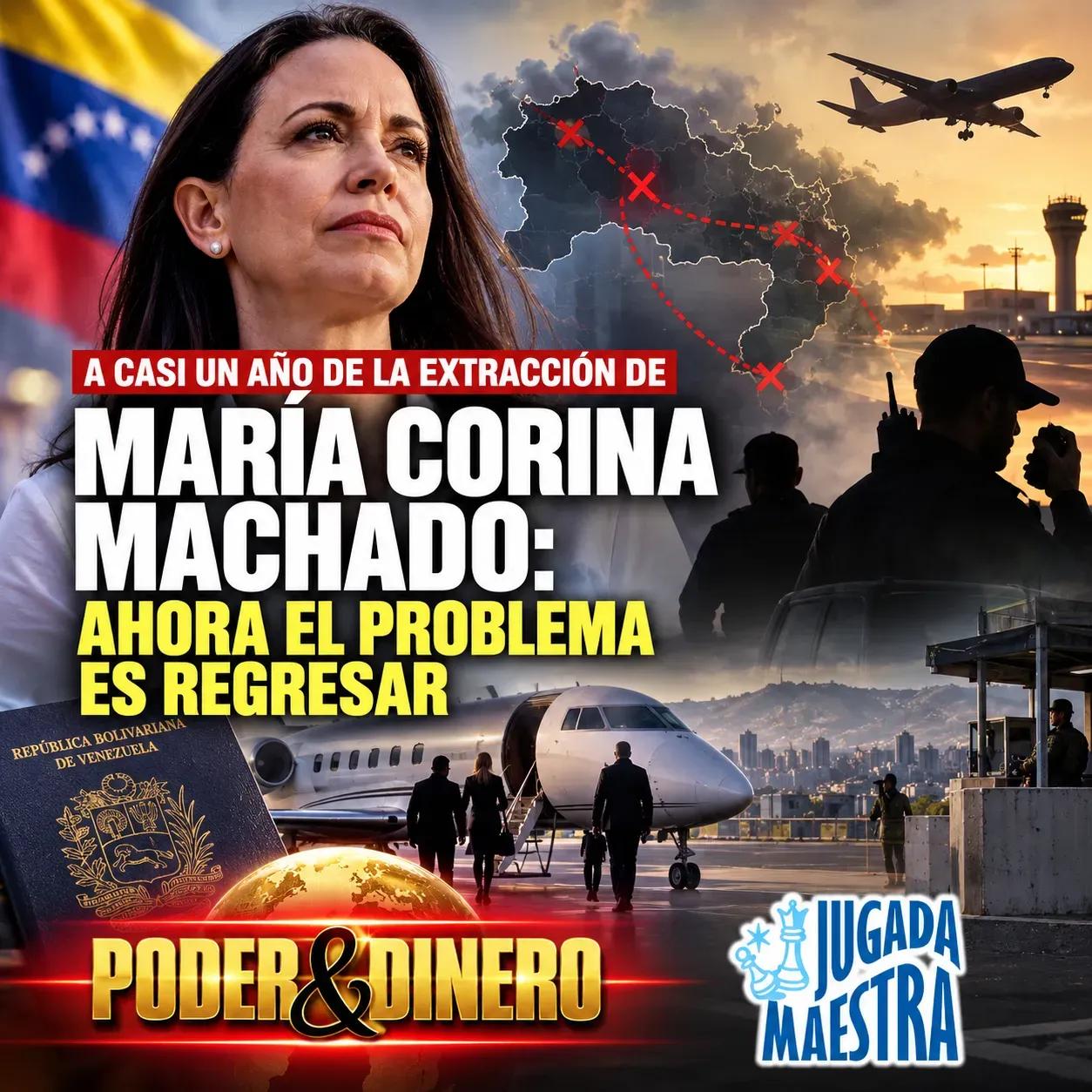
Almost a year ago, the problem was getting María Corina Machado out of Venezuela.
Today, the problem seems to be exactly the opposite, how to bring her back.
María Corina Machado must be physically in Venezuela, and the regime's impediment to preventing her return demonstrates that need.
And for someone who has worked in intelligence operations, that change of scenario deserves attention.
The extraction of María Corina was an extraordinary operation. Grey Bull Rescue called it Operation Golden Dynamite. There was surveillance, risk, secrecy, and very little margin for error.
It worked.
But there is one aspect of that operation that, from my point of view, has never been sufficiently clear:
Who paid Grey Bull for the extraction, and who paid for the charter jet that later transported María Corina to Oslo? It is also unclear to me who funds these efforts to reintegrate María Corina back to Venezuela.
We are told that they were simply donors. Only someone like the United States or President Trump himself could be behind those “donors.”
It's not a minor detail when we try to understand what happened then and compare it to what is happening now.
Because returning to Venezuela is proving to be much more complicated.
Since her departure, different alternatives for return have been explored. By air, land, and sea. Some reached concrete stages of planning; others were canceled or simply could not be executed. Her team assures that they already total at least seven attempts.
For me, the number matters less than the pattern.
One operation can fail.
Two can too.
But when different plans, routes, and methods repeatedly encounter obstacles, an intelligence professional must start asking questions.
Is there a problem with operational security?
Each new attempt requires coordination, communications, movements, documentation, and people who necessarily must know some part of the plan.
And here there is one aspect that particularly worries me: the integration of members of the press into still sensitive operations.
The journalist has a legitimate function to fulfill. But a clandestine operation requires compartmentalization and secrecy until it has concluded. Incorporating people who are not operationally essential inevitably increases the exposure of information.
There are also other possibilities, and I do not discount any.
My point is another. After repeated failed attempts, the lack of secrecy and the expansion of the circle of people with knowledge of a sensitive operation must be part of a serious review of that operational security.
Before organizing another attempt, we must ask ourselves who really needs to know, when they need to know it, and how much they need to know.
It's not just mechanical failures or administrative issues at the airport.
There is also a political dimension that we cannot ignore. Washington.
Caution has been reported within the Trump administration regarding María Corina's return. But caution does not necessarily mean opposition, much less does it show that Washington is responsible for every failed attempt.
Trying to hold President Trump's administration accountable by arguing that “it does not support” María Corina's return would be, in my opinion, a catastrophic blunder.
Washington may have reservations about the timing, conditions, and consequences of her return. That is very different from holding the White House accountable for an operation that could not be executed.
Washington also has the moral and legal responsibility to inform a candidate or political leader of existing threats against them.
Before seeking someone to blame, we must ask what is failing operationally.
Almost a year ago, it was possible to secretly extract María Corina Machado from Venezuela.
Today, after multiple plans through different avenues, returning is proving extraordinarily difficult.
The question can no longer be limited to:
When will María Corina return?
We must also ask ourselves:
Why is it failing?
Because in intelligence, when something fails repeatedly, we stop viewing each incident as an independent event.
We begin to look for the pattern.
But let it be clear. María Corina Machado should return to Venezuela through the main entrance of her country without any impediments, negotiations, or obstacles. It is the right of any Venezuelan.
Jesús Daniel Romero is a Commander (R) of Naval Intelligence of the United States and former Deputy Director of Intelligence of the Naval Forces of Southern Command, with over 37 years of combined service in military, intelligence, and diplomatic areas.
He has written three bestselling books: The Final Flight: The Queen of the Air and Deadly Silence: The Hidden World of Narco-Submarines
He is also the host of the successful YouTube channel "Intelligence & Power."

Comments