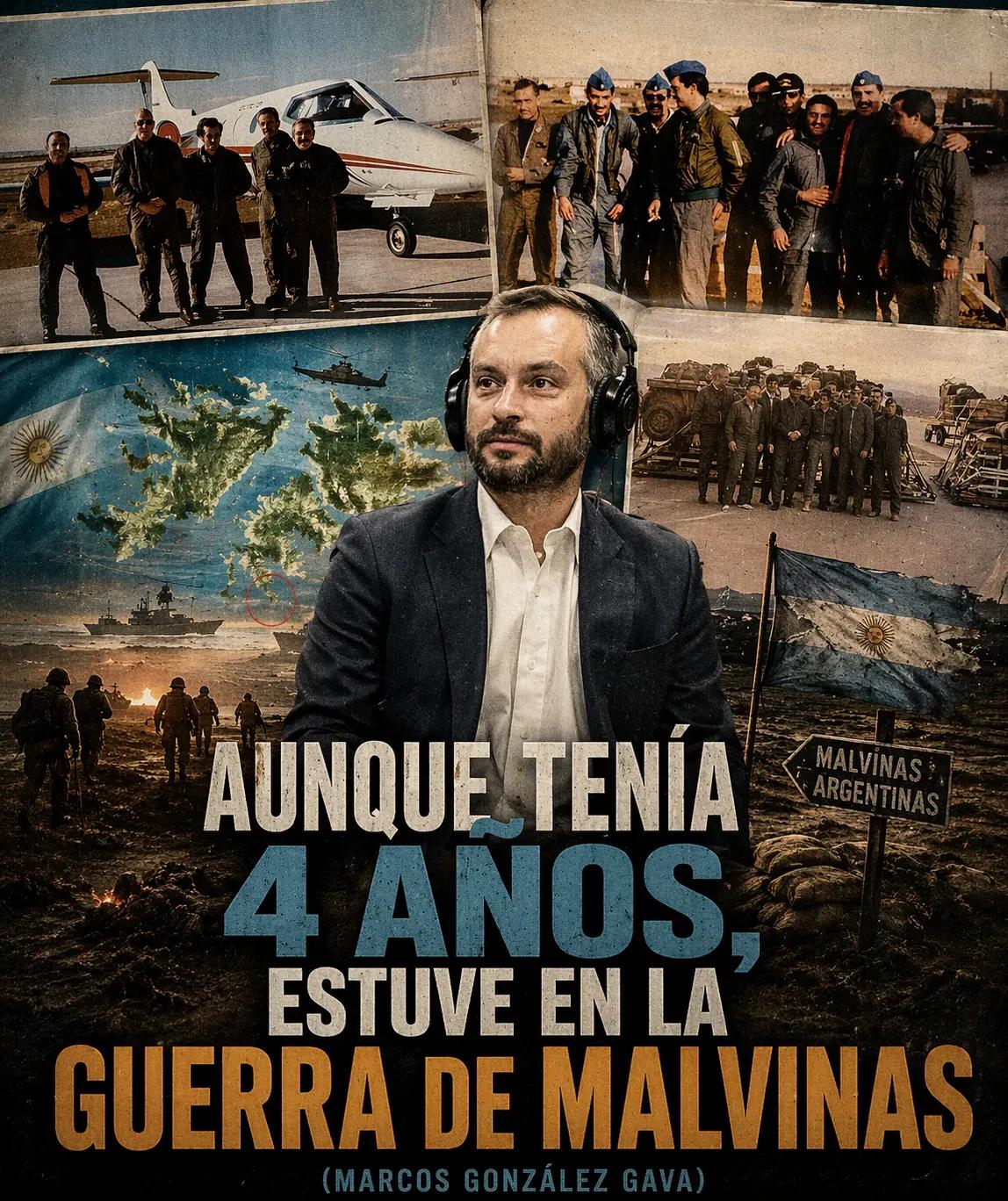
I cannot say that I was there in body, but in a way, I was there in spirit; when I was 4 years old, Lorenzo González, my father, was called to join the ranks of the civil aviation that would participate in the conflict in the South Atlantic for the Falkland Islands, between Argentina and England.
By then, Lorenzo was no longer a member of the Air Force: he had been discharged in 1979. His passion was flying, not military life, and he found in civil aviation the support he was looking for, under the guidance of a company that at that time was a symbol of an industrial Argentina. It was Astilleros Alianza, a corporation led by Arnaldo Martinenghi, a business group with subsidiaries in the oil sector: the type of company our country needs today. The company, which closed in 1991, then had a Swearingen Merlin III turboprop aircraft, a masterpiece of civil aviation, and a Hughes 500 C helicopter, another machine of strategic value for both civil and military use.
As I was saying, when the war came, Air Force pilots and civilians formed the Phoenix Squadron and flew non-military planes that were owned by companies such as Astilleros Alianza to carry out high-risk missions: guiding squadrons, diversion, communications retransmission, search and rescue, patrolling along the Patagonian coast, and transporting personnel and weaponry. On April 28, at the Morón airbase, this squadron of 133 members was established, including pilots, mechanics, and assistants, whose primary function was to complement military combat operations.
From that moment, I remember my mother, Regina Gava, who under the pressure of having her husband at war fell into a severe depression. By then, we were three children of that young couple: Lucas, 2 years old; Maxi, 7; and I, 4, and Lorenzo's departure to the Theatre of Operations in the South Atlantic must have been a tremendous blow for her. Filled with fear and stress, her body collapsed. If I remember correctly, she was affected by Ménière's Syndrome: she had constant ringing in her ears and dizziness; in fact, she could not fend for herself. My grandmother, Elsa, was there with us, helping her during that extreme time.
I imagine that something similar must have been experienced by the families of all those involved, because war transcends the combat zone and particularly enters the homes of the combatants. From their homes, family members wait for news all the time, with hopes, but with the possibility that that person may never return. Regina, an Italian immigrant who arrived in Argentina by boat after World War II, found herself once again caught up in the war, and I imagine she felt her world was in constant upheaval.
In fact, the fear she felt was not irrational: one of the planes from the Phoenix Squadron was shot down on June 7 during exploration and reconnaissance tasks. It was a Lear Jet, registration T-24, part of the Argentine Air Force, in which all its military crew members died: the commander, vice commodore De la Colina; the co-pilot, major Falconier; the military photographer, captain Lotufo; the communications non-commissioned officer, assistant non-commissioned officer Luna; and the aircraft mechanic, assistant non-commissioned officer Marizza. They all belonged to the II Air Brigade, based in the city of Paraná. So, although they were civilian planes, the danger of being shot down was real, especially due to the hazardous nature of the missions they undertook, with unarmed planes and no possibility of ejecting.
Regina spent two months in bed, fearful of losing her husband and the father of her children, which would have been devastating for her, being under 30 years old at the time. I remember that my siblings and I kept her company most of the time, watching TV, listening to news about the War, and the March of Malvinas, which was repeated several times a day in broadcasts or programs like “The 24 Hours of Malvinas.”
Our house was at war: although we were far from the conflict zone, we supported Lorenzo and all those involved in spirit; the women and children of the members of the Phoenix Squadron and the Air Force were our friends. We had shared family gatherings in the Aeronautical neighborhood of El Palomar and in other areas of the Western Zone of Buenos Aires; we lived at that time in a humble neighborhood in Castelar, with dirt streets, not far from the Morón airbase.
Once the military conflict was over, Lorenzo returned home. I do not remember much of that moment, but in the following years, the War somehow continued. Regina maintained the symptoms of Ménière's Syndrome for years and had some episodes of epilepsy, even long after 1982. The ringing in her ears, however, lasted her entire life. I am not sure how the War affected my father: I can say that he returned from the Falklands more euphoric and more military than he was, more severe. Family life was affected in many ways, and a certain sadness settled in the home from that moment on. The emotions had been very intense, the sensations of life and death, of all or nothing, and it was not easy to eradicate them.
As time passed, I began to understand more about the Falklands War, although my father spoke little about everything he experienced. It took a long time for recognition for the War Veterans to arrive, who had been silenced and hidden from political life for many decades: they went to war in support of no government, only in defense of territory and their patriotic conviction.
Their vindication came along with the awareness of the heroic feat they had accomplished in the southern Atlantic, like a lost memory that the people began to recover. I remember the meetings that took place at home during the 1980s and 1990s, trying to organize the Phoenix Squadron as a group of veterans, which ultimately happened but not without challenges. The ideas that the war had been unnecessary and that, moreover, it had been lost, did not allow for political and civil support for many years, while the Executive's efforts towards the Malvinas Cause were also erratic and often nonexistent.
Over the years, I also saw photos of Lorenzo in those days of war: young, with a life project ahead of him; that man from Formosa who dreamed of flying seemed calm, accompanied by a consolidated human group, unafraid. I understand that he must have had, like his companions, constantly in his mind and heart, his family: in those photos that reached me, and that I now share, that love for those waiting for them at home can be perceived in the face of each one of them.
Marcos González Gava is co-founder of Reporte ASIA and a specialist in business management and cultural affairs with the People's Republic of China and the Asian region in general.

Comments