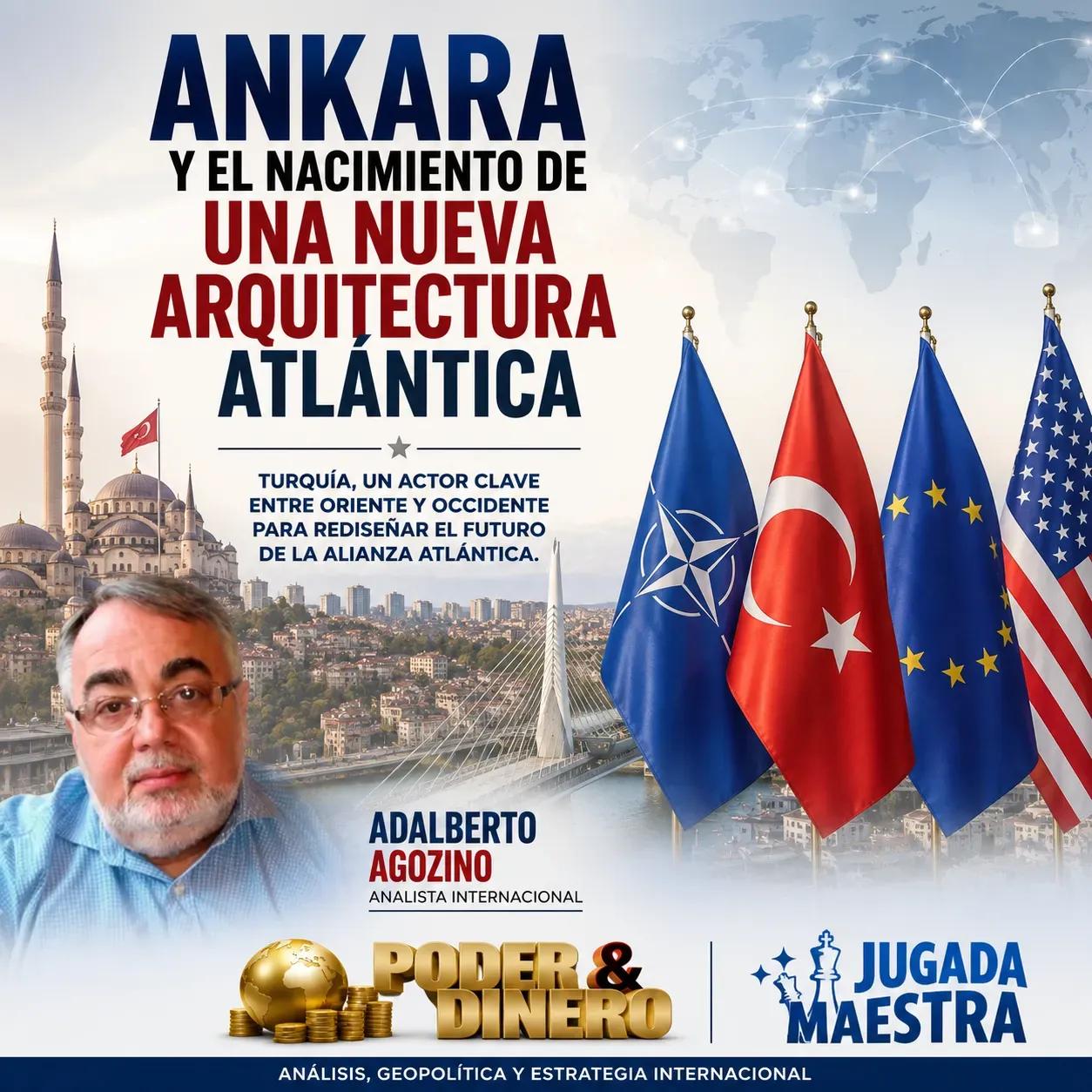
Ankara was not just another summit of the North Atlantic Treaty Organization. Although it was formally conceived as a meeting intended to evaluate compliance with commitments made in previous encounters, the political outcome ended up being much more significant than the content of the terse final communiqué. Far from producing grand doctrinal statements, the meeting held on July 7 and 8, 2026 confirmed a deep transformation process of the Atlantic Alliance whose scope is just beginning to be perceived. The NATO that emerged from the Cold War has initiated a structural mutation that alters the balance of responsibilities between the United States and Europe, redefines Turkey's strategic role, and forces European capitals to confront a reality they have sought to avoid for years: Washington is no longer willing to indefinitely guarantee, or under the same conditions, the security of the European continent.
For decades, the functioning of the Alliance rested on a tacit principle. The United States provided the majority of military, technological, industrial, and nuclear resources, while European allies contributed with relatively limited conventional forces, under the certainty that the U.S. guarantee constituted the true core of Western deterrence. That model, consolidated after 1949 and reinforced after the disappearance of the Soviet Union, began to erode slowly during Barack Obama's presidency, accelerated during Donald Trump’s first term, paused under Joe Biden, and has now, with Trump's return to the White House, entered a phase of irreversible transformation.
The Ankara meeting did not formally alter the foundational principles of the North Atlantic Treaty. The commitment contained in Article 5 was reaffirmed, and the final declaration insisted on the validity of collective defense as an essential foundation of the organization. However, behind this legal continuity, a political revolution of extraordinary dimensions unfolded. The issue is no longer whether the United States will continue to be a member of NATO, but rather to establish how far its gradual operational pullback will go and what capabilities Europeans will need to assume to fill the strategic void that Washington will inevitably leave.
In this sense, the summit constituted an extraordinary demonstration of political realism. No European leader publicly questioned the U.S. demands. There was also no open confrontation about the new division of burdens within the Alliance. What prevailed was a careful diplomatic staging intended to avoid a rupture with the U.S. president while simultaneously convincing him that Europe was finally ready to respond to the demands Washington has been making for over a decade.
This collective effort was notably directed by NATO Secretary General Mark Rutte, who understood that the true political objective of the meeting was not merely to approve new military spending programs but to prevent Donald Trump from leaving Ankara announcing a massive reduction of U.S. military commitment in Europe. The preparatory documents for the summit show to what extent this possibility was considered real by numerous European governments. Even within the U.S. administration itself, the eventual withdrawal of up to a third of the forces permanently deployed in European territory had been studied, a measure that would have profoundly altered the security architecture of the continent.
The tension was understandable. In the preceding months, Trump had multiplied his criticisms towards European allies. He accused them of taking advantage of U.S. military efforts, repeatedly questioned the low level of defense investment by several members of the organization, reproached the lack of European solidarity during military operations against Iran, and reiterated his claims over Greenland, a territory belonging to the Kingdom of Denmark whose geostrategic importance for Arctic control has gained increasing relevance due to competition with Russia and China.
The issue of Greenland ended up symbolizing much more than a territorial dispute. It reflected the emergence of a conflict of interests between the United States and some of its own allies. For the first time since the end of World War II, NATO's main power publicly voiced strategic aspirations that directly affected the territorial sovereignty of another member state of the Alliance. Although no one in Ankara seriously contemplated a military confrontation between the two countries, the episode underscored that the political cohesion of the organization can no longer be taken for granted. Atlantic solidarity continues to exist, but it coexists with increasingly profound strategic divergences.
In this extraordinarily delicate context appeared the figure who likely ended up being the political big winner of the meeting: Turkish President Recep Tayyip Erdoğan.
Rarely has a leader transformed the role of host into such an effective tool for building international power. Erdoğan understood that the political survival of the summit depended as much on military agreements as on the psychology of the U.S. president. For months, he carefully prepared a diplomatic staging aimed at creating a favorable environment for Trump, combining state ceremonies, demonstrations of hospitality, displays of Turkey's growing industrial power, and a rigorously designed organization to avoid political incidents that could provoke an unpredictable reaction from the U.S. president.
The strategy produced visible results. Trump arrived in Ankara deeply irritated by the evolution of the conflict with Iran, by the refusal of some European allies to fully back his decisions, and by discussions regarding military spending. However, he left Turkey calling the meeting a success and publicly expressing a renewed commitment to the Alliance, although without renouncing his demands for a much broader redistribution of strategic responsibilities.
This shift in political climate was not casual. It constituted the product of a complex diplomatic operation simultaneously directed by Erdoğan and Rutte, who understood that the priority was to avoid an irreversible deterioration of transatlantic relations. Both leaders managed to convince the U.S. president that Europe had finally begun to take the path he had been demanding for years: to take on the economic cost of its own defense.
Paradoxically, this apparent diplomatic victory for Europe concealed a much more uncomfortable reality. It was not the Europeans who changed the U.S. position. It was the United States that succeeded in getting Europe to accept a historic change in how NATO operates.
Ankara did not represent the triumph of traditional Atlantic consensus. It represented, on the contrary, the European acceptance of a new correlation of forces in which Washington retains political and nuclear leadership of the Alliance but demands that the European continent finance, organize, and sustain an increasing part of its own security. This transition, barely hinted at during previous summits, was definitively institutionalized in Ankara.
The historical significance of the meeting lies precisely in that silent transformation. While media attention focused on Trump's gestures, discussions about military spending, or controversies related to Iran and Greenland, a new conception of Western security began to consolidate that will likely define NATO's evolution over the next decade. Europeans still need the United States, but the United States is no longer willing to play the same role it has played for the last seventy-five years. This realization constitutes the true political legacy of the Ankara Summit and the starting point for understanding all the decisions made during those two decisive days.
Adalberto Agozino holds a PhD in Political Science, is an International Analyst, and is a Lecturer at the University of Buenos Aires.

Comments