
The national government rescinded all bids for works on the Belgrano Cargas that were being carried out with financing from the Chinese CMEC. The measure affects 11 contracts in six provinces in the north and center of the country and comes weeks before the opening of envelopes for the privatization of Trenes Argentinos Cargas.
A block rescission
According to official documents exclusively accessed by the portal enelSubte, national authorities decided to unilaterally rescind, for force majeure, all current contracts of the Recovery and Improvement Project of the General Belgrano Railway. These works were being executed under the agreement with China Machinery Engineering Corporation (CMEC), a Chinese state-owned company.
The cancellation involves 11 bids that were under the jurisdiction of the Railway Infrastructure Administration (ADIF) in Chaco, Jujuy, Salta, Santa Fe, Santiago del Estero, and Tucumán. The work covered branch lines C, C3, C6, C8, C12, C15, C18, C28, and CC.
The agreement with CMEC, signed in 2013 and extended several times, financed infrastructure works and the purchase of locomotives and wagons that allowed the recovery of the cargo volume transported by Belgrano.
The context: privatization
The decision is linked to the privatization of Trenes Argentinos Cargas, the state-owned company that operates the cargo services of the Belgrano, San Martín, and Urquiza lines. According to enelSubte, the opening of envelopes is scheduled for November 11.
The process contemplates a concession for 50 years and the sale of state-owned rolling stock. Successful bidders will be required to carry out a package of mandatory works and may add optional ones. These works will be financed with a trust that will receive the proceeds from the sale of the rolling stock, in addition to external funds: according to the same media, the Inter-American Development Bank (IDB) and the World Bank expressed their willingness to finance interested parties.
The affected works
One of the most significant projects is the railway bypass of the city of Santa Fe, designed so that cargo trains traveling between Salta and the ports of Gran Rosario avoid the urban area. The work was bid out in 2019, awarded in July 2021, and reached nearly 70% completion before being halted with the change of government. It included the renewal of about 45 kilometers of tracks, a new link of about 15 kilometers, a railway bridge over the Salado River, and three road bridges.
The contracts with the three consortia in charge, Vial Agro, UTE Pietroboni–Merco Vial–Sabavisa, and UTE Ferromel–Herso, were rescinded. The bypass is the only one of the canceled projects that was included in the privatization documents as mandatory: it will take 75% of the funds from the trust allocated to the Belgrano line.
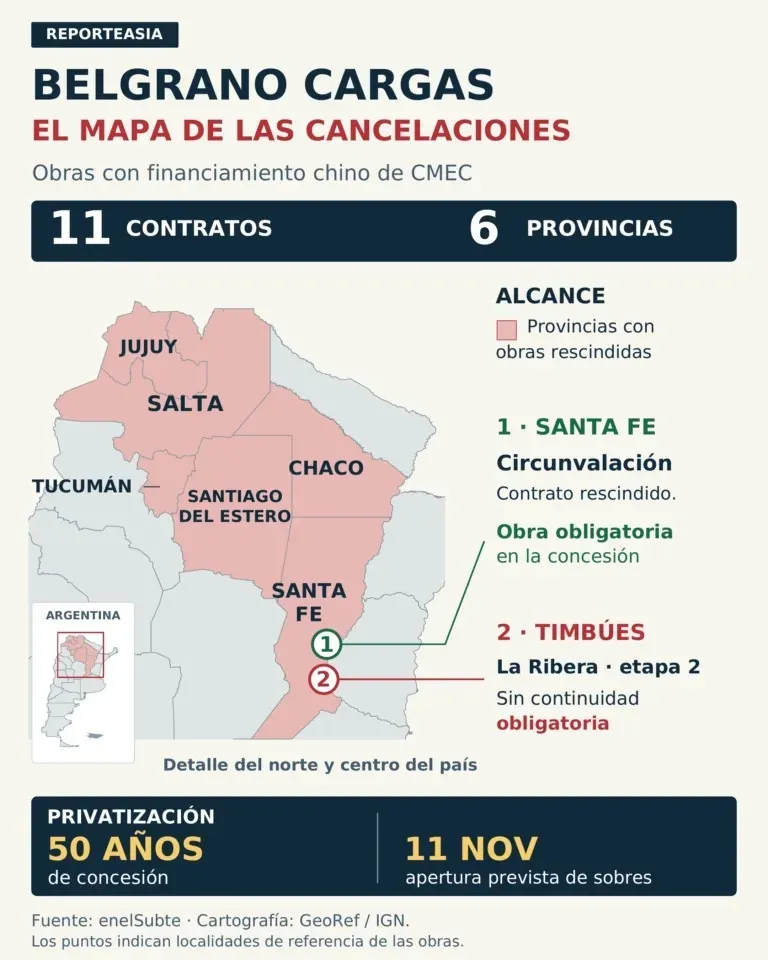
The second stage of the La Ribera railway yard, linked to rail access to the port of Timbúes, north of Rosario, where terminals of AGD, the Chinese Cofco, ACA, Renova, and Dreyfus operate, was also canceled. This yard was designed with ten tracks for up to 450 wagons, but only the first stage, of three tracks, was built, opening in 2020. Its continuation is not listed among the mandatory works.
The list is completed with track renovations in different branches of the north, works on bridges, drainage, and culverts, such as those on branch line C8 between Rosario de la Frontera and Las Cejas, and the repair of the bridge over the Cabeza de Vaca stream in Salta. Additionally, the improvement of the forming yards in General Pinedo and Joaquín V. González, the construction of the new Laguna Paiva Norte yard, and the installation of derailment detectors were canceled. None of these works are part of the mandatory package for the concession.
The future of the relationship with China
According to enelSubte, the decision implies abandoning future stages of the project with CMEC, which had already been removed from the national budget. Addendum 4, signed in 2021, contemplated the renewal of 1,200 kilometers of tracks in branch lines C, C3, and C12 and improvements in another 230 kilometers.
Addendum 5, agreed upon in 2020 but never ratified, contemplated financing of 800 million dollars to renew 911 kilometers of tracks in eight provinces and purchase more locomotives and wagons, some of which were to be manufactured in the country by Fabricaciones Militares.
The provinces' demands
Several provinces question the conditions of the privatization. The governor of Salta, Gustavo Sáenz, requested that works on the branch lines in his province be included as mandatory and not optional, and Salta senators Carolina Moisés and Flavia Royón presented projects in that sense for the C14 and C15 branch lines.
The Minister of Infrastructure of Jujuy, Carlos Stanic, and the governor of Tucumán, Osvaldo Jaldo, also demanded that these two branch lines, which connect the Argentine network with Chile and Bolivia, have mandatory works. The president of the Industrial Union of Jujuy, Federico Gatti, warned that the scheme does not consider the cargo potential coming from eastern Bolivia.
The rescission of the contracts closes, at least for now, one of the main infrastructure projects financed by China in Argentina, initiated in 2013. Following privatization, the continuation of works on the Belgrano Cargas will be in the hands of the future concessionaires: only the Santa Fe bypass is listed as mandatory, while the rest of the canceled works will depend on the decisions of the bidding companies.
The opening of envelopes, scheduled for November 11, will show who is interested in operating the northern Argentine freight network for the next 50 years.
Marcos González Gava is Co-Founder of Reporte Asia and a Specialized Analyst in Commercial and Financial Business, and Cultural Affairs with the People's Republic of China
Comments