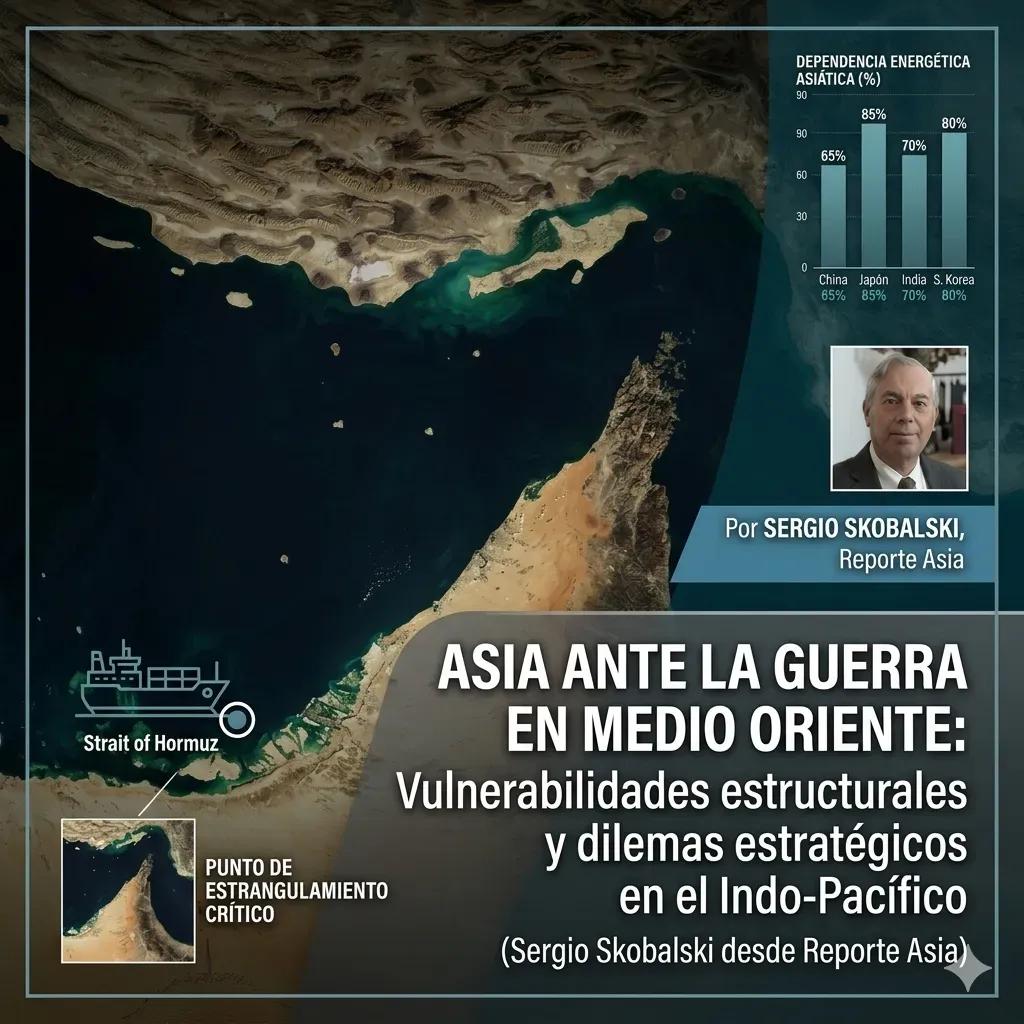
The escalation of the conflict in Iran has immediately reconfigured economic expectations and geopolitical calculations in Asia. The high energy dependence on the Middle East exposes structural fragilities that transcend the current situation. Beyond short-term impacts—inflation, logistical disruptions, and financial volatility—the crisis reactive strategic debates of greater depth linked to autonomy, energy security, and the reliability of alliances. In this context, the duration of the conflict emerges as the critical variable that will determine whether the impact will be transitory or systemic.
Energy dependence and macroeconomic fragility
The closure of the Strait of Hormuz has highlighted the high exposure of Asia-Pacific economies to disruptions in energy supply. Japan, whose energy matrix relies on approximately 80% of imports from the Middle East, faces a particularly delicate scenario. The rise in oil prices intensifies risks of stagflation in an economy that already presents structural limitations in its growth.
The responses adopted—release of strategic reserves, currency interventions, and price containment measures—partially cushion the immediate effects but do not resolve the underlying problem: a persistent energy dependence that conditions economic stability to external shocks.
South Korea presents a similar pattern. With about 70% of its crude oil imports coming from the conflict region, energy volatility directly impacts its financial markets, the depreciation of its currency, and the downward revision of its growth projections. Additionally, there is a critical factor: the vulnerability of the semiconductor sector, which is highly energy-intensive and a pillar of its insertion in global value chains. A prolonged disruption could project systemic effects beyond the national scope, affecting the global tech industry.
Alliances, strategic autonomy, and security dilemmas
The conflict not only stresses economic variables but also strategic balances. The United States has increased pressure on its allies to ensure the security of maritime routes in the Persian Gulf, placing Japan and South Korea in complex decision-making situations.
In the Japanese case, the request for naval deployment directly confronts constitutional restrictions and a public opinion reluctant to participate in external conflicts. This creates a dilemma between preserving the alliance with Washington and maintaining internal political stability, reopening the debate on the limits of the security framework in place since the post-war period.
South Korea, for its part, faces an additional concern: the reassignment of U.S. military capabilities—including key missile defense systems—towards the Middle East. This dynamic raises questions about the credibility of extended security guarantees against North Korea and reinforces discussions about greater strategic autonomy.
In both cases, the crisis has revitalized a particularly sensitive debate: the sufficiency of current deterrence strategies. The inability of Iran's nuclear posture to prevent the conflict raises doubts about the effectiveness of latent capabilities as a deterrent tool, which could encourage, in the medium term, reconsiderations of its own nuclear options.
Southeast Asia: fragmentation, vulnerability, and limits of regional cooperation
In Southeast Asia, the impact of the conflict manifests heterogeneously, reflecting structural differences among ASEAN member states. With energy dependence levels ranging between 60% and 70% regarding the Middle East, the region faces inflationary pressures, rising import costs of fuels, and fiscal tensions derived from the need for subsidies.
Countries like Vietnam, Thailand, and the Philippines are experiencing significant increases in energy costs, while economies such as Indonesia and Malaysia face additional budgetary constraints. The limited storage capacity—reduced in some cases to a few weeks of consumption—amplifies vulnerability to prolonged disruptions.
The responses adopted—price controls, energy-saving policies, and the search for alternative suppliers—show limited effectiveness against sustained shocks. Politically, the crisis again underscores the structural difficulties of ASEAN to articulate coordinated responses. Divergences in capabilities, interests, and exposure levels hinder the implementation of integrated regional strategies, even in critical areas such as energy security.
While initiatives like the ASEAN Power Grid offer a potential framework to improve regional resilience, its development remains slow and conditioned by persistent political and economic constraints.
Strategic reconfiguration in a prolonged uncertainty environment
The conflict in the Middle East has acted as a catalyst that exposes and accelerates preexisting tensions in Asia. Energy dependence, the fragility of certain key sectors, and the perception of variability in security guarantees create a scenario of structural vulnerability.
In the short term, the available tools allow for mitigating the most immediate effects. However, the evolution of the conflict will determine the depth of its impact. A quick resolution would limit the damage to a momentary level; on the other hand, an extension of the confrontation could lead to stagflation dynamics in advanced economies and even greater financial pressure on emerging economies.
In this context, the ability of Asian states to diversify their energy matrices, strengthen their economic resilience, and redefine their strategic priorities will be decisive for their positioning in an increasingly unstable international system.


Comments