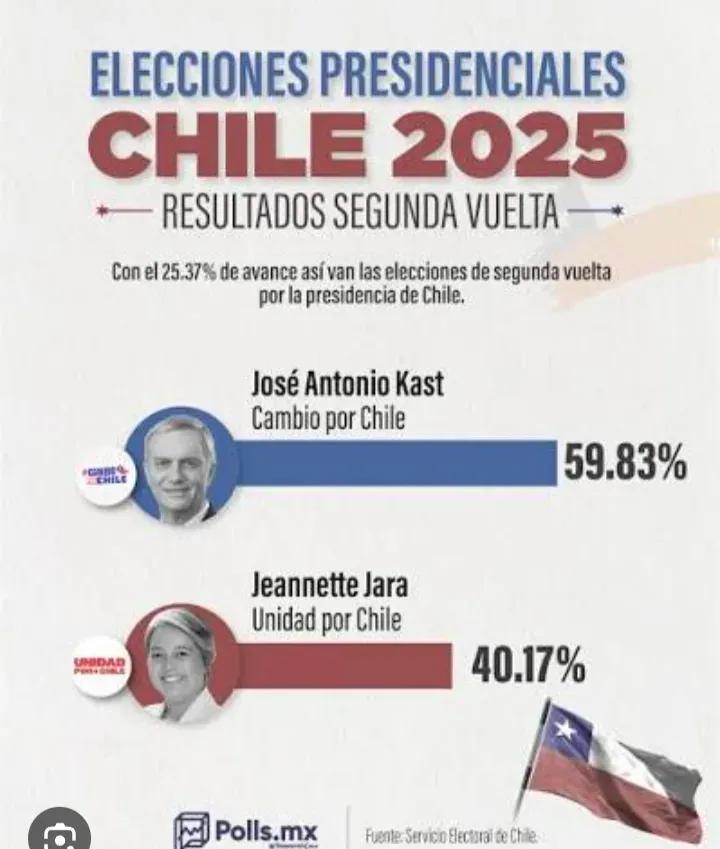
This Sunday, December 14, the second round of elections was held in the Republic of Chile. As predicted by the polls, the conservative candidate Antonio Kast won the Presidency. Structural reforms, the neighboring country's relationship with Argentina, and debates about the historical memory of the Pinochet dictatorship are some topics to be analyzed during Kast's presidential term.
At 6 PM Chilean time, the first results showed an insurmountable trend in favor of José Antonio Kast, the right-wing candidate who was nearing 60 points by that time.
Kast, heir to a Chilean family of German descent, has been embroiled in a great deal of controversy due to his family past. It turns out that his father, Michael Kast, was a sympathizer and member of the Nazi Party in his youth. Having been involved in party politics for many years, Kast’s case seems to position him as one of the few politicians outside Germany who managed to engage in politics despite the Nazi past of his ancestors.
Situated to the right of the traditional Chilean Christian democracy, an admirer of Pinochet and close to libertarian figures like Axel Kaiser, Kast's government is shaping up to be conservative, with a neoliberal orientation in the economic sphere; similar to that of Javier Milei in Argentina.
After some tensions with Gabriel Boric, this new era seems to inaugurate a new cycle of friendly relations with the neighboring country. Forty years after the signing of the Treaty of Peace and Friendship with the Republic of Chile, this new phase promises several approaches in the realm of bilateral relations.
However, it is also true that Kast's victory over the communist candidate Jeannette Jara raises alarms about the situation in which liberal democracies currently find themselves.
In a context of democratic regression, the assumption of an openly Pinochetist candidate proves problematic for a democracy as young as Chile. Moreover, considering that, unlike Argentina, Chile did not judge dictator Pinochet.
In recent years, a denialist sentiment began to emerge in the neighboring country. In 2023, when 50 years have passed since the coup d'état and the start of the dictatorship, many right-wing legislators decided not to participate in the commemorative events.
Ultimately, Chile is preparing for a conservative turn in governance, very much in tune with the pendular behavior that characterizes its electorate.

Comments