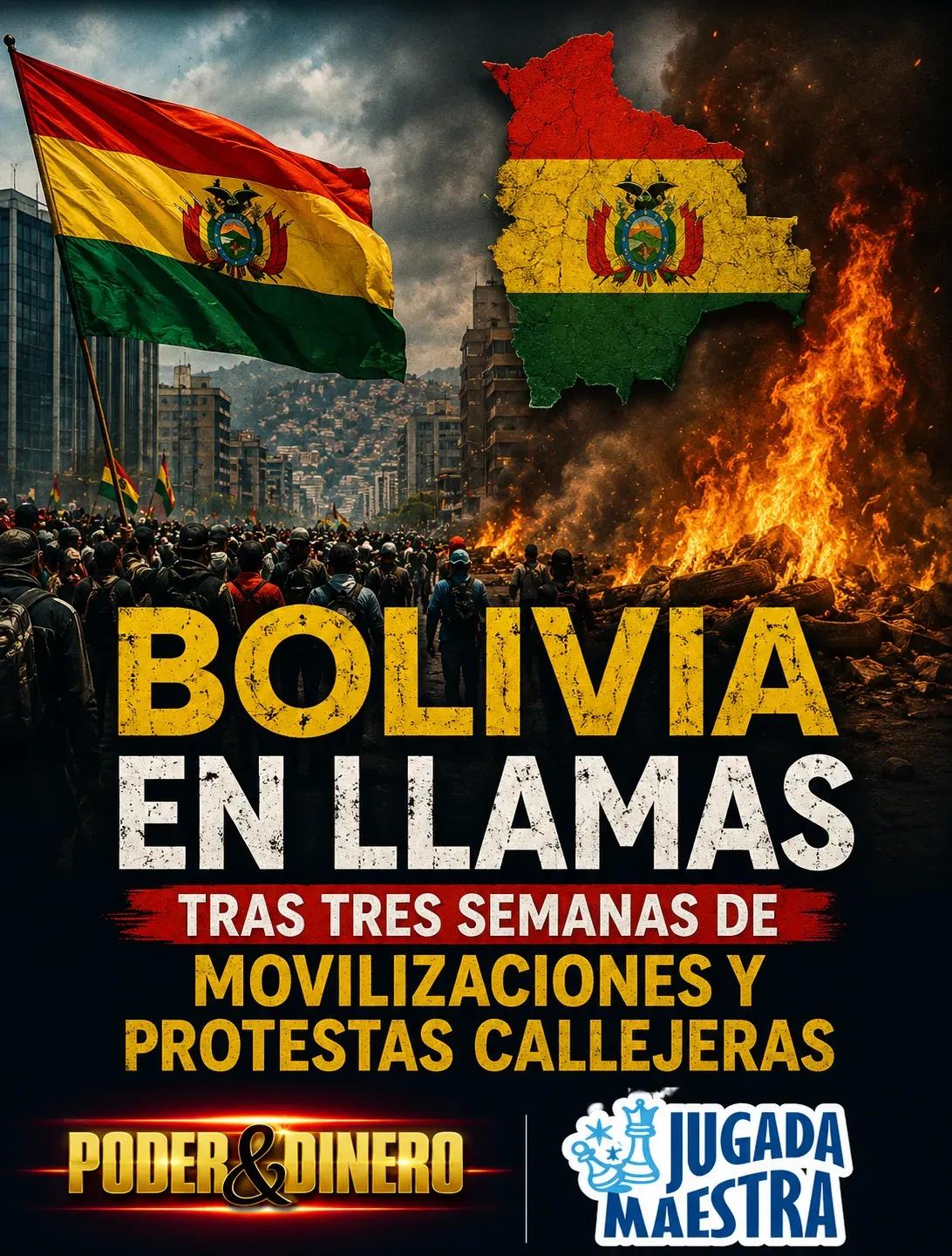
The smoke from burning tires and tear gas still hangs over Plaza Murillo as evening falls. Thousands of protesters, armed with stones, sticks, firecrackers, and, in some cases, dynamite, have tried for hours to break through the police and military cordon protecting the Government Palace. The Bolivian capital, besieged by blockades at its access points, is experiencing one of the most violent days in recent weeks in a country that seems on the brink of institutional collapse. President Rodrigo Paz, the man who promised a "capitalism for all" after two decades of hegemony of the Movement for Socialism (MAS), now faces the greatest test of his brief mandate: a popular insurrection demanding his immediate resignation.
The crisis that erupted almost three weeks ago is not an isolated explosion. It is the predictable result of an accumulation of economic, political, and social frustrations that have turned Bolivia into a powder keg. What began as sectorial protests over wages and fuel has transformed into a frontal challenge to the established order, echoing the upheavals that overthrew governments in the recent past of Latin America.
An economy on the brink of collapse
Bolivia has reached this point after years of silent deterioration that dramatically accelerated in recent months. Heir to a state with depleted international reserves —which fell from more than $15 billion in 2014 to critical levels—, Paz took office in November 2025 with a country shattered by the decline in natural gas exports, chronic dollar shortages, and inflation that already exceeded 20% annually in projections. His government opted for austerity measures: partial elimination of fuel subsidies, which led to increases of up to 86% in gasoline and more than 160% in diesel, budget cuts, and a timid opening to private investment.
The results have been devastating for the population. In the markets of La Paz and El Alto, the prices of basic food have skyrocketed. Entire families are reducing meals, transporters are spending fortunes on repairs for engines damaged by adulterated fuel, and hospitals are facing shortages of oxygen and medicines. The blockades —estimated at over 60 active points throughout the country, with particular intensity around La Paz— have worsened shortages to the point of creating a humanitarian crisis. Stranded trucks, empty pumps, and endless queues complete a picture of scarcity reminiscent of the worst rationing times in the region.
On top of this, there is discontent over unmet promises. Paz came to power with the support of sectors that voted for a moderate change, tired of the MAS but fearful of radicalism. However, his administration has been perceived as a neoliberal turn: the elimination of wealth taxes, laws facilitating the commodification of communal lands (though later repealed), and a rapprochement with international organizations like the IMF. "People did not believe it was a right-wing government. They thought it would be centrist,” summarized an analyst. This perceived betrayal has united unions, miners, Aymara farmers, and indigenous organizations in a common front against what they call "Milei-type adjustment."
The role of Evo Morales: from exile in Chapare to the forefront of the protest
At the heart of this storm, once again, is the omnipresent figure of Evo Morales. Sheltered in his coca-growing stronghold of Chapare, with an outstanding arrest warrant for a case of alleged minor corruption that he claims is political persecution, the former president is directing from afar the "March for Life." His supporters —coca growers, miners, the Bolivian Workers' Central (COB), and the radical Ponchos Rojos— have been key in the escalation.
Morales, who governed Bolivia from 2006 to 2019 with an extractive and redistributive model that lifted millions out of poverty but left weak institutions and dependence on gas, has capitalized on the discontent. His allies reject the constitutional reform promoted by Paz, demand an end to judicial processes against him, and denounce a betrayal of the popular bases. The government, for its part, accuses him of orchestrating a conspiracy financed by organized crime —drug trafficking, illegal mining, smuggling— that seeks to destabilize the Executive. Videos of supposed members of the Ponchos Rojos displaying weapons and calling for "civil war" have fueled the official narrative.
The ethnic and regional polarization aggravates the situation. While Santa Cruz, the historical opposition stronghold, remains relatively calm, the Andean highlands —with a strong indigenous and Aymara presence— are ablaze. The 2009 Constitution, which emphasized plurinationality, has left a legacy of fragmentation that is now exploding.
Escalation of violence and first fatal victims
What began with peaceful blockades has led to brutal clashes. This Monday, May 18, thousands of protesters armed with improvised shields faced riot police in downtown La Paz. Tear gas, stones, firecrackers, and explosions of dynamite turned the streets into a battlefield. Protesters looted the Departmental Justice Tribunal, cable car stations, and public offices. One protester was reported injured by a bullet or blunt objects, according to reports; police officers were beaten, and journalists assaulted complete the toll.
The authorities estimate at least four indirect deaths since the protests began: patients who could not reach hospitals due to roadblocks. The Prosecutor's Office has issued arrest warrants against leaders like Mario Argollo, of the COB, and reports dozens of arrests. Vice President Edmand Lara, in an open letter, has criticized the use of justice as a tool of pressure and has called for a "serious and unconditional" dialogue. The government, meanwhile, reinforces Plaza Murillo with military personnel and rejects any resignation.
Regional effects: contagion and instability
The Bolivian crisis is not an internal matter. In a South America marked by instabilities —with Argentina implementing drastic adjustments, tensions in Peru, and a vigilant Brazil—, the collapse of La Paz generates shockwaves. CONMEBOL has already moved Copa Libertadores and Sudamericana matches to Paraguay due to blockades and insecurity. Neighbors like Argentina and Brazil watch with concern the possible flow of migrants or the impact on border trade. The United States has expressed support for the democratically elected government and condemned destabilization attempts, while figures like Gustavo Petro in Colombia have spoken of “popular insurrection.”
The risk that the conflict internationalizes through organized crime networks —drug trafficking from Chapare— or inspires similar movements in countries with vulnerable economies is real. The region, still recovering from the pandemic and external shocks, does not need another focal point of instability.
Where is Bolivia headed?
The immediate future is uncertain. The Paz government insists it will not resign, promises dialogue with those who end the violence, and seeks international support with visits from the OAS. However, without a clear parliamentary majority and with a cabinet perceived as elitist, its room for maneuver is narrow. If it cannot quickly alleviate shortages and offer credible salary concessions, the pressure from the streets could become unsustainable.
On the opposition side, Morales and his allies are betting to wear down the Executive to force an early exit or an electoral call. But a potential fall of Paz could open a dangerous power vacuum in a country with a history of coups and democratic interruptions.
Bolivia is at a historical crossroads. Behind the stones and smoke, there are not only demands for wages or fuel: there is a profound questioning of the inherited economic model, of the political representation of popular sectors, and of the State's ability to manage a structural crisis. The resolution of this conflict will define not only the fate of President Paz but the direction of a nation that, once again, is betting its stability on the streets of La Paz. Time is of the essence: the current calm in the center of the city is just a fragile truce before the next day of mobilizations.

Adalberto Agozino holds a PhD in Political Science. Professor at the National Gendarmerie University Institute and the National Defense Faculty of Argentina. Director of the Argentine Institute of Geostrategic Studies. Editor of Alternative Press Agency. Expert on Maghreb issues.

Comments