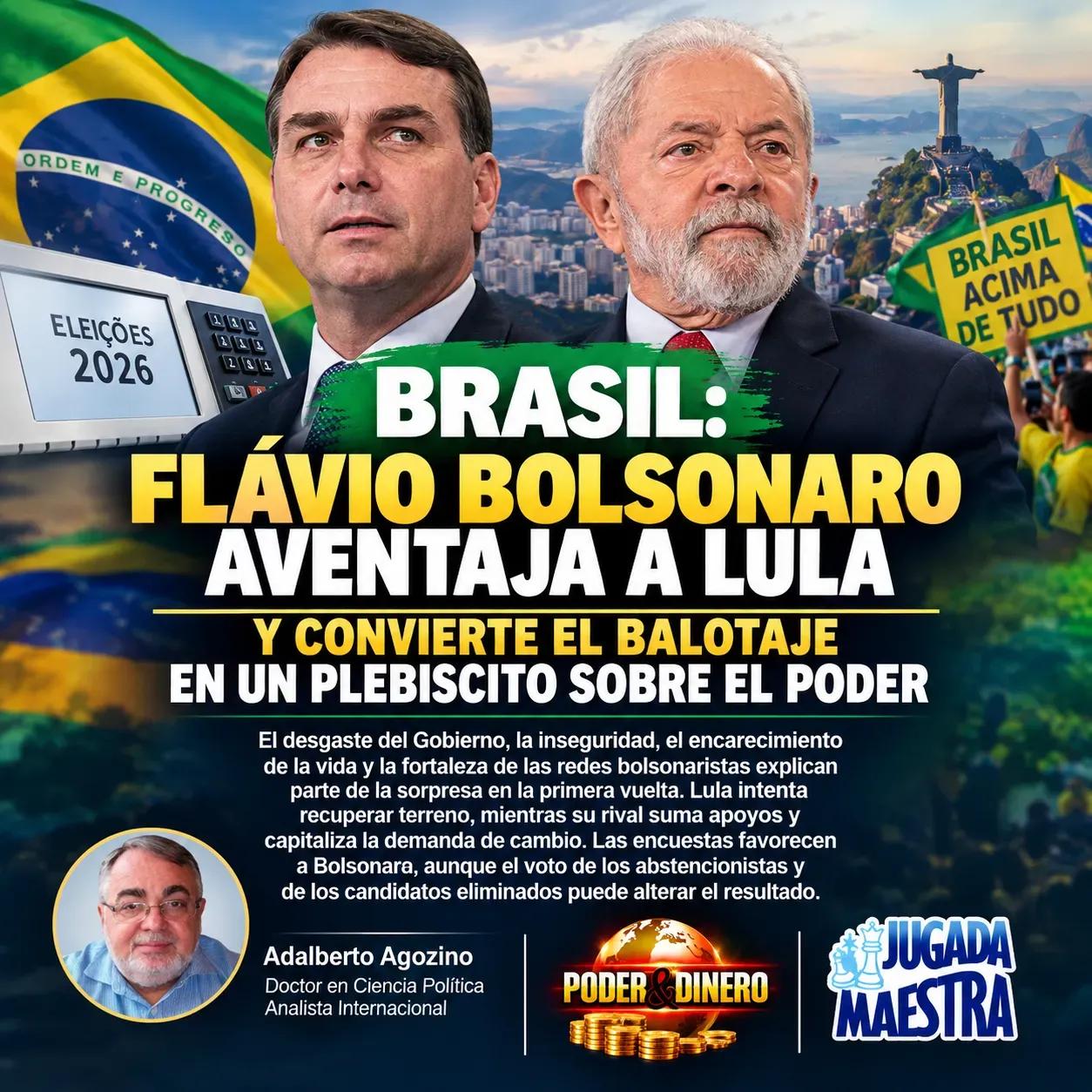
The Brazilian presidential election has entered a decisive phase. Luiz Inácio Lula da Silva, the leader who returned to power in 2023 with the promise of rebuilding social policies and restoring institutional normality, now faces a threat that just a few weeks ago seemed less likely: losing the presidency to Flávio Bolsonaro, a 45-year-old senator, son of former president Jair Bolsonaro and representative of a right that has shown a mobilization capacity greater than many polls anticipated.
On October 4, Flávio obtained 47.03% of valid votes, compared to 45.16% for Lula. The difference was 2,227,651 ballots, enough to change the political climate of the campaign, but not enough to resolve the election. The Superior Electoral Court confirmed that both would contest the second round on October 25, after neither reached the required absolute majority.
The political magnitude of the result surpasses the numerical difference. The ruling party had arrived at the election day with more favorable expectations, while Flávio, who was not among the main contenders at the beginning of the year, managed to turn the surname Bolsonaro into a competitive candidacy and, ultimately, into the most voted option.
The second round will be, therefore, more than just an election between two economic projects. It will test Lula's ability to renew his legitimacy, the social roots of Bolsonarism, and the willingness of a considerable part of Brazilians to support a conservative alternative despite the judicial controversies surrounding the former president's environment.
A first round that disproved forecasts
The official results show a more balanced competition than some studies published before the vote suggested. The surprise was not only that Flávio finished ahead, but that the president could not turn his status as favorite into an effective electoral advantage.
The Superior Electoral Court recorded 56,104,268 votes for Bolsonaro and 53,876,617 for Lula. Additionally, there were 2,300,781 blank votes, equivalent to 1.84%, and 3,674,149 null votes, or 2.93%. In total, nearly six million votes did not translate into valid support for any candidacy.
The relative defeat of the ruling party cannot be explained by a single factor. The Brazilian economy presents indicators that the government considers favorable, especially in employment and activity, but these aggregate results have not necessarily transformed into a widespread perception of well-being. For many households, everyday experience is determined by the cost of food, fuel, housing, debt, and the quality of public services.
CNN Brazil journalist Caio Junqueira has precisely pointed out the gap between presidential discourse and the concerns expressed by citizens. According to his analysis, Lula focused part of his messages on issues such as national sovereignty over strategic minerals, while many voters were more concerned about the cost of living and institutional controversies affecting public trust.
Sociologist Alberto Carlos Almeida, for his part, attributed the result to the negative evaluation of the presidential management and asserted that the government had not acted with sufficient foresight to improve it. His diagnosis points to a characteristic difficulty of ruling parties: good macroeconomic indicators lose electoral effectiveness when citizens do not perceive an equivalent improvement in their incomes and expectations.
Public safety has reinforced this dynamic. Bolsonarism has turned the increase in crime and the feeling of unprotection into central elements of its discourse, presenting itself as the force willing to restore order through stricter policies. Although Brazilian insecurity has structural causes that no government can resolve immediately, the perception of threat constitutes a powerful political resource, especially when citizens consider official responses insufficient.
In addition, there is the weariness of a presidency that once again asks for trust after having governed for a good part of the last two decades. Lula maintains an exceptional trajectory and a consolidated social base, but his experience also makes him the principal responsible, in the eyes of discontented voters, for the problems that persist.
Flávio's candidacy has exploited that contradiction well. His message of change allows him to gather ideologically conservative voters, citizens disenchanted with the Workers' Party, and voters who do not necessarily share all positions of Bolsonarism but wish to punish the government.
Abstention and blank votes: a warning for the entire political system
One of the most concerning data points from the first round was the absence of 33,469,244 voters, 21.08% of the electorate. This is the highest level of abstention in a first presidential round since 1998, according to data collected in the electoral material and information published after the elections. In addition to that figure, there are almost six million blank and null votes.
Abstention does not automatically mean rejection of Lula or potential adherence to Bolsonaro. It hides diverse motivations: disinterest, difficulties in going to vote, distrust in institutions, disenchantment with parties, and the conviction that none of the candidates can substantially modify living conditions. In Brazil, where voting is mandatory for literate citizens aged 18 to 70 years, the magnitude of absence acquires additional political relevance.
The president of the Superior Electoral Court, Kassio Nunes Marques, acknowledged after the vote that abstention above 20% was undesirable and raised the need to improve mechanisms to reduce it. Lula, for his part, asked his team to investigate the reasons for electoral disengagement, rather than attributing the defeat exclusively to errors in his campaign.
Testimonies collected by Associated Press illustrate the problem. Some citizens reject the association between religion and politics promoted by conservative sectors; others distrust the left due to corruption scandals. There are also voters who feel that both candidates represent unsatisfactory options. Political scientist Carolina Almeida de Paula from the State University of Rio de Janeiro has warned about the risk of interpreting polarization as if the entire society were committed to one of the two sides.
Blank and null votes have a partially distinct logic. The first may express the decision not to support any candidacy; the second may be due to a deliberate protest or a mistake in casting the vote. Aggregate data do not allow determining how many voters acted for each reason. Therefore, attributing them as a block to a supposed third political force would be incorrect.
The final campaign faces a paradox: candidates need to mobilize those who remained on the sidelines, but some of those citizens may prefer to keep their distance. Furthermore, the almost six million blank and null votes do not constitute an electoral deposit available for either of the two contenders.
The behavior of abstentionists will be especially important if participation changes significantly on October 25. An increase in mobilization could benefit Lula if he recovers former voters from the Workers' Party; but it could also favor Bolsonaro if the right manages to activate voters who stayed home in the first round.
Lula changes the script and seeks to reclaim the street
The president has reacted to the defeat with a reorganization of his campaign. The first modification is political: Geraldo Alckmin, vice president and former governor of São Paulo, has gained prominence as an interlocutor with businesses and moderate voters. His presence aims to counteract the image of a government too focused on its traditional base and convey a greater willingness to dialogue with productive sectors.
The second modification is communicational. Lula, who has repeatedly expressed his distrust of mobile phones, has started recording selfie-format videos for Instagram and TikTok. The initiative seeks to humanize the candidate, bring him closer to young voters, and reduce the distance that the ruling campaign has maintained in relation to digital platforms, where Bolsonarism has built a particularly active community.
The president admits that the accumulated experience and traditional communication are no longer enough to compete for the attention of a society permanently connected to networks.
The reorganization also responds to internal criticisms. According to information published by Reuters, the team aims to replace excessively abstract messages about sovereignty and strategic minerals with more direct communication about prices, family incomes, and the risks that a conservative victory could pose to social programs.
The PT seeks to reinforce its territorial presence in regions where the difference was narrow and among citizens who abstained. The Northeast, traditionally an electoral stronghold of Lula, will remain fundamental, but the party needs to improve its performance in large urban centers and among young voters. In São Paulo, the largest electoral college in the country, Alckmin can play an important role in reclaiming moderate voters.
The strategy has an evident difficulty: Lula must defend his management while also recognizing that he has not responded sufficiently to some citizen concerns. If he limits himself to denouncing the dangers of Bolsonarism, he risks confirming the impression that the ruling party does not listen. If he devotes too much space to acknowledging mistakes, he may weaken the trust of his own supporters.
Nevertheless, the president has assets that his opponent still does not possess: government experience, a consolidated political identity, and a party structure capable of mobilization. His challenge is to convert them into additional votes, not merely reaffirm the loyalty of those who have already supported him.
Flávio Bolsonaro consolidates the conservative alliance
The senator has approached the second round from a more favorable position. His main advantage is political: he has managed to transform the outcome of the first round into a sequence of endorsements that reinforce the perception that his candidacy represents the alternative with the greatest chances of victory.
Ronaldo Caiado, former governor of Goiás, and Romeu Zema, former governor of Minas Gerais, have backed Bolsonaro after competing against him. Writer and psychiatrist Augusto Cury, the third most voted candidate, also announced his support. Cury obtained 2.89% of valid votes, about 3.4 million votes, a quantity greater than the difference that separated the two main candidates.
Cury's support is particularly interesting because his campaign had attempted to present him as an alternative to polarization. However, his backing does not imply an automatic transfer of all his voters. The writer himself clarified that his support did not constitute a blank check and linked his decision to commitments regarding fiscal responsibility, protection of women, transparency, and respect for institutions.
Flávio has also garnered support from important center-right formations, including Republicans, Novo, Podemos, and the federation made up of Union Brazil and Progressives. These endorsements provide territorial structure, local leaders, and mobilization capacity, although they do not guarantee that all voters from those parties will follow the indications of their leaders.
His campaign revolves around three ideas: security, rejection of the Workers' Party, and political change. Bolsonaro attempts to present Lula as the representative of an exhausted cycle and advocates for stricter administration against crime. He also seeks to reassure voters concerned about social policies, assuring them that he does not intend to eliminate programs like Bolsa Família.
The candidate has moderated part of his tone to attract citizens who reject the rhetorical excesses of his father, without breaking with the ideological core of Bolsonarism. His challenge is to broaden his base without losing the more militant sectors that made his initial victory possible.
The relationship with Jair Bolsonaro remains decisive. The former president retains a huge mobilization capacity among his supporters, but his condemnation for the coup plot and his clash with judicial institutions also pose a risk. Flávio needs to inherit his father's political capital without the election becoming a referendum on his most controversial legacy.
Polls favor Bolsonaro, but the election is not decided
The first polls following the first round confirm that the senator has taken advantage of the momentum from his win. The gap between the two candidates is sufficiently consistent to consider Flávio the favorite, but it still does not allow for dismissing a recovery by the president.
The electoral snapshot of October 9
Voting intention for the second round: 52.8% for Flávio and 47.2% for Lula. Sources: UOL, AtlasIntel/Bloomberg and Folha de S.Paulo, Datafolha.
Both consultancies place the senator ahead. However, the results should be interpreted cautiously. A survey is a snapshot of preferences at a given moment, not an infallible prediction of the final outcome.
The most important data is not only Bolsonaro's lead, but his ability to maintain
la mientras la campaña de Lula intenta modificar el clima político. Si la diferencia se mantiene en las próximas mediciones y se reproduce en el comportamiento de los votantes, el presidente afrontará una tarea especialmente difícil.Una elección que trasciende las fronteras brasileñas
El desenlace tendrá repercusiones más allá de Brasil. Lula ha defendido una política exterior multilateral, con protagonismo en los BRICS, cooperación con China y una relación con Estados Unidos que preserve la autonomía brasileña. Flávio, por el contrario, ha expresado una mayor afinidad con Donald Trump y ha defendido un acercamiento político a Washington.
La diferencia no implica que un eventual Gobierno conservador pueda prescindir de China. El gigante asiático es el principal socio comercial de Brasil y mantiene inversiones relevantes en energía, industria e infraestructura. Cualquier presidente deberá conciliar sus afinidades ideológicas con esos intereses económicos. Reuters ha señalado que el acceso a los minerales críticos brasileños, las relaciones comerciales y la competencia entre Washington y Pekín figuran entre las cuestiones estratégicas que podrían cambiar de orientación después de la elección.
La política económica también será determinante. Los mercados han reaccionado favorablemente a las expectativas de mayor disciplina fiscal asociadas a Bolsonaro, pero las promesas de reducción de impuestos, inversión en infraestructura y mantenimiento de los programas sociales deberán enfrentarse a las restricciones presupuestarias y a la necesidad de negociar con el Congreso.
El economista Paulo Dutra Constantin, profesor de la Universidad Presbiteriana Mackenzie, ha advertido que ambos candidatos mantienen diferencias ideológicas importantes, pero comparten una dependencia significativa de la inversión pública para impulsar el desarrollo. Su análisis plantea una cuestión que la campaña ha dejado en segundo plano: quien gane tendrá que resolver las tensiones entre gasto social, inversión y equilibrio fiscal.
La elección también puede afectar al funcionamiento de las instituciones brasileñas. Una victoria de Flávio fortalecería a las fuerzas conservadoras que buscan revisar el papel del Supremo Tribunal Federal y la situación judicial de Jair Bolsonaro. Una reelección de Lula, por su parte, no eliminaría la influencia de una derecha que ha demostrado contar con un respaldo social y parlamentario considerable.
El pronóstico para el 25 de octubre
A dos semanas de la votación, Flávio Bolsonaro parte con ventaja. Ha ganado la primera vuelta, ha reunido apoyos importantes de la centroderecha y aparece por delante en los dos principales sondeos publicados después del 4 de octubre. Su mensaje de cambio conecta con una parte del electorado que no considera suficientes los resultados económicos del Gobierno y reclama respuestas más contundentes frente a la delincuencia.
Lula conserva, sin embargo, posibilidades reales de remontar. La elección todavía depende de la participación, de la capacidad de atraer a los votantes moderados y de la transferencia efectiva de los sufragios obtenidos por los candidatos eliminados. El presidente necesita demostrar que puede escuchar las preocupaciones económicas cotidianas, recuperar la confianza de los electores jóvenes y convencer a quienes se alejaron de las urnas de que una nueva presidencia suya puede ofrecer resultados diferentes.
Su principal dificultad es el tiempo. La reorganización de la campaña y la incorporación de Alckmin y de nuevos responsables de comunicación pueden mejorar su mensaje, pero no garantizan que cambie la evaluación de su gestión. Bolsonaro, por su parte, debe evitar que la consolidación de su ventaja derive en exceso de confianza y demostrar que puede atraer a electores que no comparten todas las posiciones del bolsonarismo.
El pronóstico, con la información disponible al 10 de octubre, es una victoria de Flávio Bolsonaro el 25 de octubre, probablemente por un margen moderado. Los sondeos sitúan su ventaja entre cuatro y seis puntos porcentuales en votos válidos, una distancia que lo convierte en favorito, pero que todavía puede reducirse. No considero prudente proyectar una victoria arrolladora ni dar por cerrado el resultado.
Si las tendencias actuales se mantienen, Bolsonaro podría obtener entre el 51% y el 53% de los votos válidos, frente a un Lula situado entre el 47% y el 49%. Se trata de una estimación analítica, no de un resultado asegurado: una movilización superior a la prevista de los abstencionistas o una recuperación del voto moderado por parte del presidente podrían estrechar considerablemente la diferencia.
La paradoja de esta elección es que Lula no se enfrenta únicamente a un rival más joven, sino a una demanda de cambio que ha conseguido imponerse incluso allí donde el Gobierno reivindica resultados económicos y sociales positivos. Flávio Bolsonaro ha transformado esa insatisfacción en una oportunidad histórica para su familia política. El 25 de octubre se sabrá si esa oportunidad basta para devolver el poder al bolsonarismo o si Lula consigue, una vez más, convertir una campaña adversa en una victoria.
Adalberto Agozino es Doctor en Ciencia Política, Analista Internacional y Docente de la Universidad de Buenos Aires
Comments