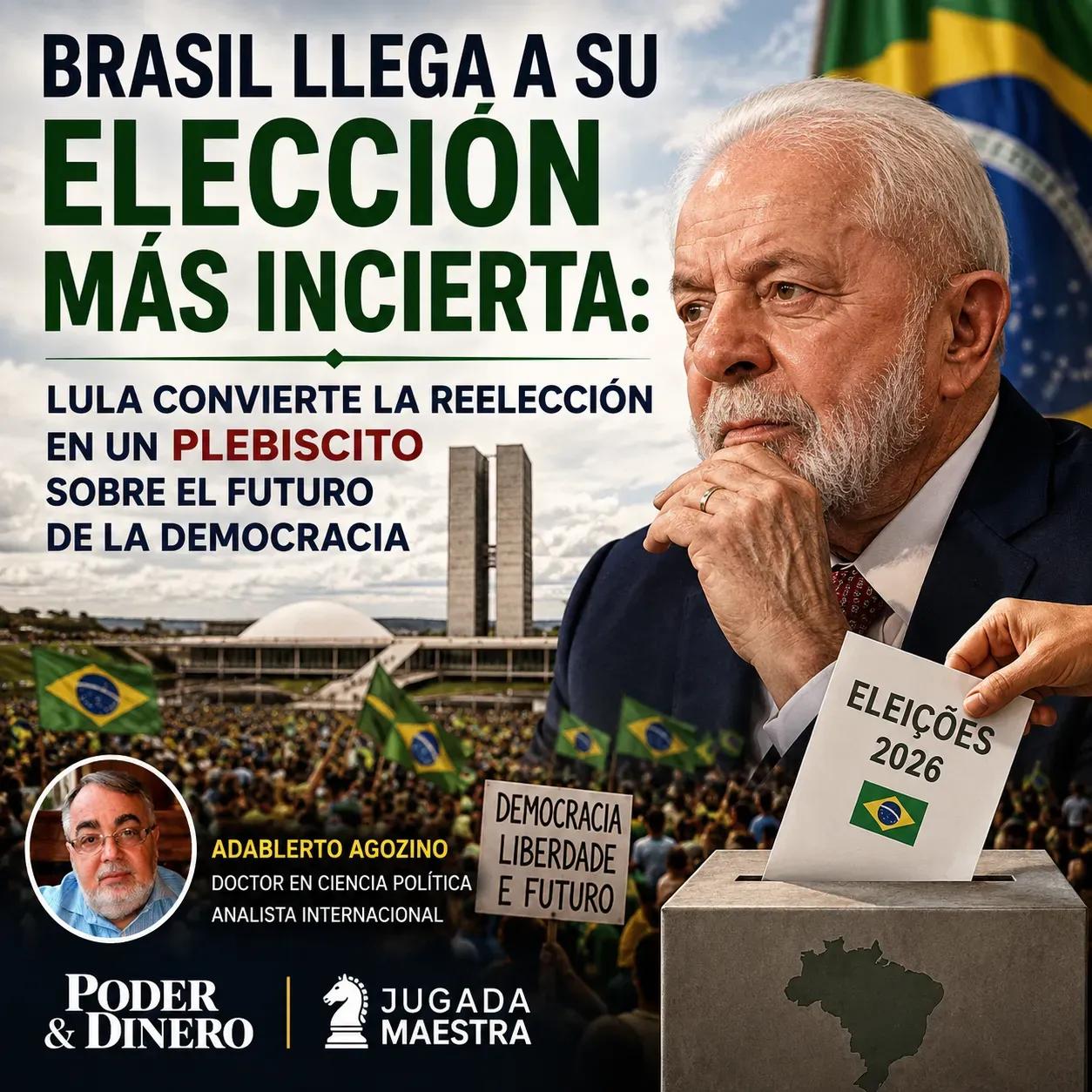
The Brazilian politics once again revolves around an old antagonism. Three years after returning to the Palácio do Planalto, Luiz Inácio Lula da Silva seeks a fourth presidential term in a country that remains divided into two large political and cultural blocks. On the other side appears Flávio Bolsonaro, senator and eldest son of former president Jair Bolsonaro, now the political heir political of the conservative movement after the conviction and disqualification of his father. Although the generational change modifies the protagonists, the axis of confrontation remains practically unaltered: two country projects that offer diametrically opposed responses regarding the role of the State, the economy, the institutions, and Brazil's international insertion.
The campaign has acquired an unusual intensity from its early days, even by Brazilian standards. Not only because the ideological differences between both sides are deep, but also because polls show that either could reach the Palácio do Planalto. The margin between the government and the opposition has progressively narrowed in recent months, creating a technical tie scenario that keeps the contest open and makes every campaign move potentially decisive.
Measurements agree that Lula retains a limited advantage in the first round, but they also indicate the constant growth of Flávio Bolsonaro, whose candidacy has expanded beyond the traditional core of bolsonarism. None of the remaining candidates surpasses voting intention percentages sufficient to break the bipolar logic that has dominated Brazilian politics for nearly a decade. The so-called “third way”, encouraged for months by business and moderate sectors, seems to have been reduced to a testimonial role.
The advance of the senator from the Liberal Party is not solely due to the loyalty of the conservative electorate. It also reflects the gradual deterioration of government evaluation on issues that historically condition Brazilian electoral behavior: inflation, rising food costs, public safety, and the perception that economic growth is beginning to lose dynamism. Although Lula's administration continues to exhibit positive indicators regarding employment and poverty reduction, a significant part of the citizenry believes that improvements are not enough to compensate for the rising cost of living and persistently high interest rates.
Conscious of this reality, the government has decided to shift the axis of electoral discussion. Instead of limiting itself to defending the economic results of the management, the Workers' Party seeks to present the election as a historic decision about the Brazilian democratic model. The campaign has been reorganized around historical party leaders, political communication specialists, and a wide digital strategy aimed at contending on the territory where the right has demonstrated notable mobilization capacity.
The opposition, meanwhile, attempts to build a different image from that which accompanied Jair Bolsonaro during his presidency. Flávio Bolsonaro has moderated the tone of his public interventions, avoids the most strident personal confrontations, and focuses his criticisms on economic, administrative, and security issues. His goal is to broaden support among independent voters without losing the backing of the conservative electorate that continues to identify with his father's political legacy. In economic matters, he proposes a tax reduction agenda, fiscal discipline, and less state intervention, while insisting that Brazil needs to regain the dynamism of private investment and strengthen the fight against crime.
In this context of extremely balanced competition, Lula's proclamation act, held on August 2 in São Paulo, took on an importance that transcended the party ritual. The president did not use the ceremony to present a catalog of new government promises. His intervention followed a different logic: building the political and intellectual framework from which he intends for Brazilians to interpret the entire campaign.
The speech was carefully organized around a dominant idea. Lula proposed to understand the election in October not as an ordinary competition between candidates, but as a decision about the very nature of the Brazilian State. From that perspective, the confrontation does not simply oppose left and right, but two different conceptions of democracy, national sovereignty, and the place that Brazil should occupy on the international stage.
The first major argument was the claim of democracy as a collective heritage. Lula recalled the institutional crisis that followed the 2022 elections and argued that the country managed to preserve constitutional order thanks to the strength of its institutions. This evocation of the recent past had not only a historical purpose. It constituted, above all, a political warning addressed to an electorate that the president invited to associate the continuity of his government with the institutional stability achieved in recent years.
The second axis of the speech was dedicated to the management balance. Lula defended the recovery of employment, the expansion of social policies, and Brazil's return as a relevant actor in international diplomacy. The presentation avoided a triumphal tone and focused on presenting these advances as proof that the country had resumed a development path interrupted during the previous period. Rather than reclaiming statistics, the president sought to reinforce the idea of continuity: the implicit promise was that a new term would allow for the consolidation of a process already initiated.
The social dimension also occupied a central place. Lula insisted that economic growth only gains legitimacy when it effectively improves the daily lives of the population. Under this premise, he reaffirmed his commitment to expanding social programs, investing in public education, strengthening the healthcare system, and a more progressive tax structure. It was not simply a programmatic enumeration, but a reaffirmation of a political identity built since his first presidential campaigns.
Perhaps the most novel aspect of the intervention was the prominence given to the concept of national sovereignty. Lula linked the defense of territory, strategic resources, and independent foreign policy with the need to strengthen Brazil's state defense capabilities.
In an international context marked by increasing geopolitical rivalries and disputes over critical minerals and natural resources, the president presented strategic autonomy as an indispensable condition for preserving the country's decision-making capacity. The proposal to increase defense investments must be understood precisely within this logic: not as an expression of militarization, but as a tool to guarantee national independence.
This claim of sovereignty was accompanied by a critique of external support manifestations toward his main adversary. Without constantly resorting to proper names, Lula questioned any attempt to influence the Brazilian electorate's decision and reaffirmed the diplomatic tradition of autonomy that historically underlined the country's foreign policy. At the same time, he defended the continuation of an international strategy based on strengthening Mercosur, deepening ties with China, and Brazil's role as one of the main voices of the so-called Global South.
From the political standpoint, the speech reveals a significant conclusion: the government believes that the election will not be defined exclusively around economic variables. Lula's campaign aims to mobilize a broad electoral coalition, composed of leftist voters, moderate sectors, and citizens concerned about institutional stability. The president seeks to convert his political experience and personal trajectory into an electoral asset against an adversary who represents generational renewal, but also continuity with the legacy of bolsonarism.
With less than three months until voting, the outcome remains uncertain. The high polarization, the significant rejection faced by both candidates, and the existence of a substantial segment of voters still willing to revise their decision allow for an intense campaign to be anticipated until the last day. Brazil once again faces an election that exceeds the transition of a government. What is at stake is the model of development, the balance between State and market, the quality of its democratic institutions, and the role that the largest Latin American economy aspires to play in an increasingly competitive and fragmented international system.
Adalberto Agozino holds a Ph.D. in Political Science, is an International Analyst, and a Professor at the University of Buenos Aires.

Comments