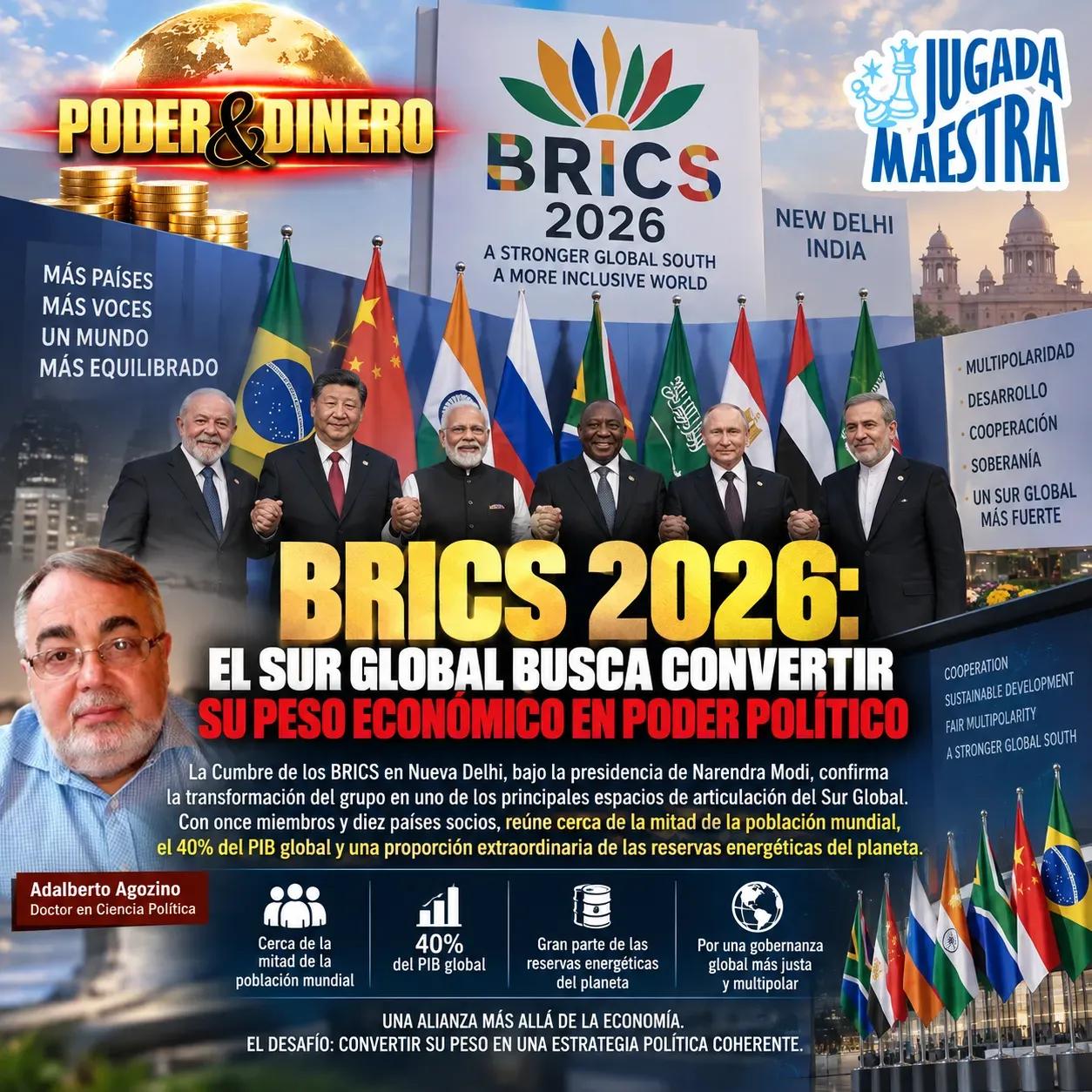
The XVIII BRICS Summit was held on September 12 and 13 at Bharat Mandapam, the large international convention center in New Delhi, under India's presidency and with a slogan that summarizes the ambition of the new stage: "Building for Resilience, Innovation, Cooperation, and Sustainability". The meeting took place during a time of extraordinary international tension, marked by the war between the United States and Israel and Iran, the war in Ukraine, trade disputes, and the growing fragmentation of the multilateral system.
BRICS originally emerged as an association of Brazil, Russia, India, and China. The name comes from the acronym coined in 2001 by Goldman Sachs economist Jim O'Neill to identify large emerging economies with the greatest potential for growth. The first political meeting took place in 2006, and the first presidential summit was held in Yekaterinburg in 2009. South Africa later joined, transforming BRIC into BRICS. The major transformation came with the expansion agreed upon in Johannesburg in 2023 and formalized during 2024 and 2025.
Currently, official sources consider Brazil, Russia, India, China, South Africa, Egypt, Ethiopia, Iran, Indonesia, the United Arab Emirates, and Saudi Arabia as members. However, the situation in Riyadh deserves some clarification: although it is included in the official lists of the bloc, the Saudi government has not publicly confirmed its formal incorporation in the same terms as the other members. BRICS documentation itself keeps Saudi Arabia within the eleven.
In addition, ten partner countries have joined them: Belarus, Bolivia, Cuba, Kazakhstan, Malaysia, Nigeria, Thailand, Uganda, Uzbekistan, and Vietnam. This category was created at the 2024 Kazan summit and allows for a significant expansion of the organization's influence without automatically turning all its participants into full members.
The New Delhi summit also incorporated a significant component of international openness. Representatives from Bahrain, representing the Gulf Cooperation Council; Burundi, representing the African Union; the Philippines, representing ASEAN; and Uruguay, representing the Community of Latin American and Caribbean States participated as outreach guests. Kazakh President Kassym-Jomart Tokayev also participated as a leader of a partner country and a representative of the Eurasian Economic Union. Among international organizations were the United Nations, represented by António Guterres; the World Health Organization, by Tedros Adhanom Ghebreyesus; the World Trade Organization, by Ngozi Okonjo-Iweala; the New Development Bank, headed by Dilma Rousseff; and the Asian Infrastructure Investment Bank.
The economic significance of this architecture is hard to exaggerate. BRICS gathers approximately 49% of the world's population and around 40% of global GDP. The figure is particularly relevant when the product is measured using purchasing power parity, an indicator that allows for the comparison of the actual volume of goods and services produced, taking into account differences in internal prices. The IMF estimates that emerging and developing economies generate around 61% of global GDP measured by PPP.
The intersection between nominal GDP and PPP reveals the true dimension of the phenomenon. China ranks first in the world by PPP, with around $44.3 trillion international dollars; the United States is second, with approximately $32.4 trillion; India comes third, with nearly $18.9 trillion; Russia fourth, with about $7.5 trillion; Indonesia seventh, with approximately $5.45 trillion; and Brazil eighth, with about $5.23 trillion. In other words, five members of BRICS—China, India, Russia, Indonesia, and Brazil—concentrate alone an economic mass equivalent to more than $81 trillion in terms of PPP.
The comparison with the G7 is particularly revealing. While BRICS represent around 40% of global GDP in PPP, the G7 stands at around 30%. Additionally, in terms of growth, BRICS have acquired increasing weight in the expansion of the global economy. Vladimir Putin stated at the New Delhi Business Forum that BRICS generated more than 40% of global GDP in the last five years and contributed nearly half of global growth during that period, compared to 18% from the G7. These figures are politically utilized by Moscow and should be interpreted with caution according to the statistical methodology employed, but they illustrate the central argument of the bloc: the center of global economic gravity is shifting toward Asia and other emerging regions.
The comparison with the European Union offers another perspective. The EU has an integrated economy, a common currency in much of its members, supranational institutions, and a single market—characteristics that BRICS do not possess. They also do not constitute a military alliance comparable to NATO. Their structure is deliberately more flexible: decisions are made by consensus, and states retain full autonomy in foreign policy, defense, and economy. That institutional weakness is, paradoxically, one of its strengths: it allows democracies like India and Brazil, monarchies like Saudi Arabia and the Emirates, authoritarian regimes, and powers in conflict to sit at the same table.
The energy weight constitutes another essential dimension. According to estimates gathered in the material used for this analysis, BRICS members hold approximately 41% of the world's proven oil reserves if Saudi Arabia is included, and more than half of the proved natural gas reserves. Saudi Arabia, Iran, the United Arab Emirates, and Russia hold enormous oil reserves, while Russia and Iran are central in gas. China and India add to that equation the status of large consumers, while Brazil contributes a growing Atlantic energy dimension through its pre-salt deposits.
Of course, it is not that BRICS possess those reserves as a supranational entity. Each state retains sovereign control over its resources, and its energy interests do not always align. But the geographical concentration has geopolitical consequences: within the same cooperation space coexist some of the world's main hydrocarbon exporters with China and India, two of the largest consumers. This combination makes the group a particularly relevant actor for global energy security. The Energy Institute further confirms the extraordinary importance of Russia, Iran, and China in global gas production.
The strategic dimension is completed by the nuclear factor. Three BRICS members—Russia, China, and India—are recognized de facto nuclear powers and possess nuclear arsenals. Russia and China are also permanent members of the United Nations Security Council. India has an independent nuclear arsenal and has been demanding greater representation in the Council for years. Iran does not possess declared nuclear weapons and does not belong to the group of nuclear-armed states, although its nuclear program is one of the main factors of international tension. This composition grants BRICS a strategic density that no conventional economic grouping can ignore.
India sought to ensure that the summit did not transform into an openly anti-Western platform. Yale professor Sushant Singh warned before the meeting that New Delhi would not feel comfortable with an explicitly hostile stance toward the West due to its defense ties with the United States and its trade links with Europe and North America. Mihaela Papa, director of the BRICS Lab at MIT, noted that India's particular position could make it a mediator between rival powers.
This tension was reflected in the final declaration. The eleven members unanimously approved the New Delhi Declaration, a lengthy document with 140 points that seeks to reconcile very different national positions. The text claims a "more representative and just" international order, reform of multilateralism, and greater presence of Asia, Africa, and Latin America in global institutions. China and Russia again expressed their support for Brazil's and India's aspirations to play a more important role in the United Nations and its Security Council.
The document also condemns terrorism in all its forms, supports the peaceful resolution of disputes through dialogue and diplomacy, and rejects unilateral tariff and non-tariff measures that, according to the bloc, distort trade and contradict WTO rules. On financial matters, it reaffirms the goal of developing faster, cheaper, and safer cross-border payment systems and expanding settlements in national currencies. This is not yet a common currency or an immediate replacement of the dollar but rather an architecture aimed at reducing dependence on US-dominated financial mechanisms.
The most delicate issue was the Middle East. The declaration expresses "deep concern" over the escalation and calls for "maximum restraint," as well as the protection of civilians and infrastructure, including nuclear facilities. The consensus was significant because Iran is part of BRICS while the United Arab Emirates holds different positions, and the United States is allied with several Gulf countries. Reuters highlighted that the agreement between Tehran and Abu Dhabi to support the joint call represented a diplomatic advance within an organization marked by profound divergences.
The document also dedicated substantial attention to Palestine, Gaza, and Lebanon, while it avoided explicitly mentioning the war in Ukraine—a significant omission when compared to the declaration of the Rio de Janeiro summit of 2025. This decision appears to respond to the need to preserve internal consensus and prevent the European conflict from becoming a breaking factor between Russia, China, India, Brazil, and the other members.
In economics, technology, and energy, New Delhi aimed to project a BRICS that is less rhetorical and more operational. The declaration supports cooperation in artificial intelligence, digital economy, supply chains, innovation, agriculture, food security, and energy transition. The text simultaneously acknowledges the need to reduce emissions and the still decisive role of fossil fuels, advocating for an energy transition that is "just, orderly, equitable, and inclusive" and a neutrality of technology.
Xi Jinping proposed advancing towards a "Greater BRICS" through greater industrial and technological integration, stability of supply chains, a more connected market, and an open cooperation zone in artificial intelligence. Putin, for his part, presented the group as one of the engines of the shift towards a multipolar order and highlighted the need to develop its own payment, investment, and trade infrastructure.
The paradox of BRICS appears precisely where its greatest strength resides. No other forum simultaneously gathers such a population, economic volume, energy reserves, industrial capacity, and nuclear powers. But it is also not easy to find another grouping where so many conflicting interests coexist: China and India compete for Asian influence; Iran and some Gulf states maintain profound differences; Russia faces the West; India retains close strategic ties with the United States; Brazil seeks to maintain an autonomous foreign policy; and Saudi Arabia balances its relations between Washington, Beijing, and Moscow.
Therefore, the XVIII New Delhi Summit did not turn BRICS into a new institutional superpower. It did something more important: it consolidated the existence of an international space that can no longer be considered peripheral. Its true importance lies not only in statements against unilateralism or the aspiration to reduce the dollar's dominance. It is in the accumulation of population, production, energy, technology, territory, and military capacity that begins to modify the global distribution of power.
The open question is whether this critical mass can transform into a common strategy. For now, the answer remains uncertain. But the New Delhi meeting demonstrates that the emerging world can no longer be explained exclusively from Washington, Brussels, or Tokyo. BRICS aims for the 21st century to have more than one center of gravity. And its numbers indicate that this ambition has ceased to be a hypothesis and has become a geopolitical reality.
Adalberto Agozino is a Doctor of Political Science, International Analyst, and Lecturer at the University of Buenos Aires.
Comments