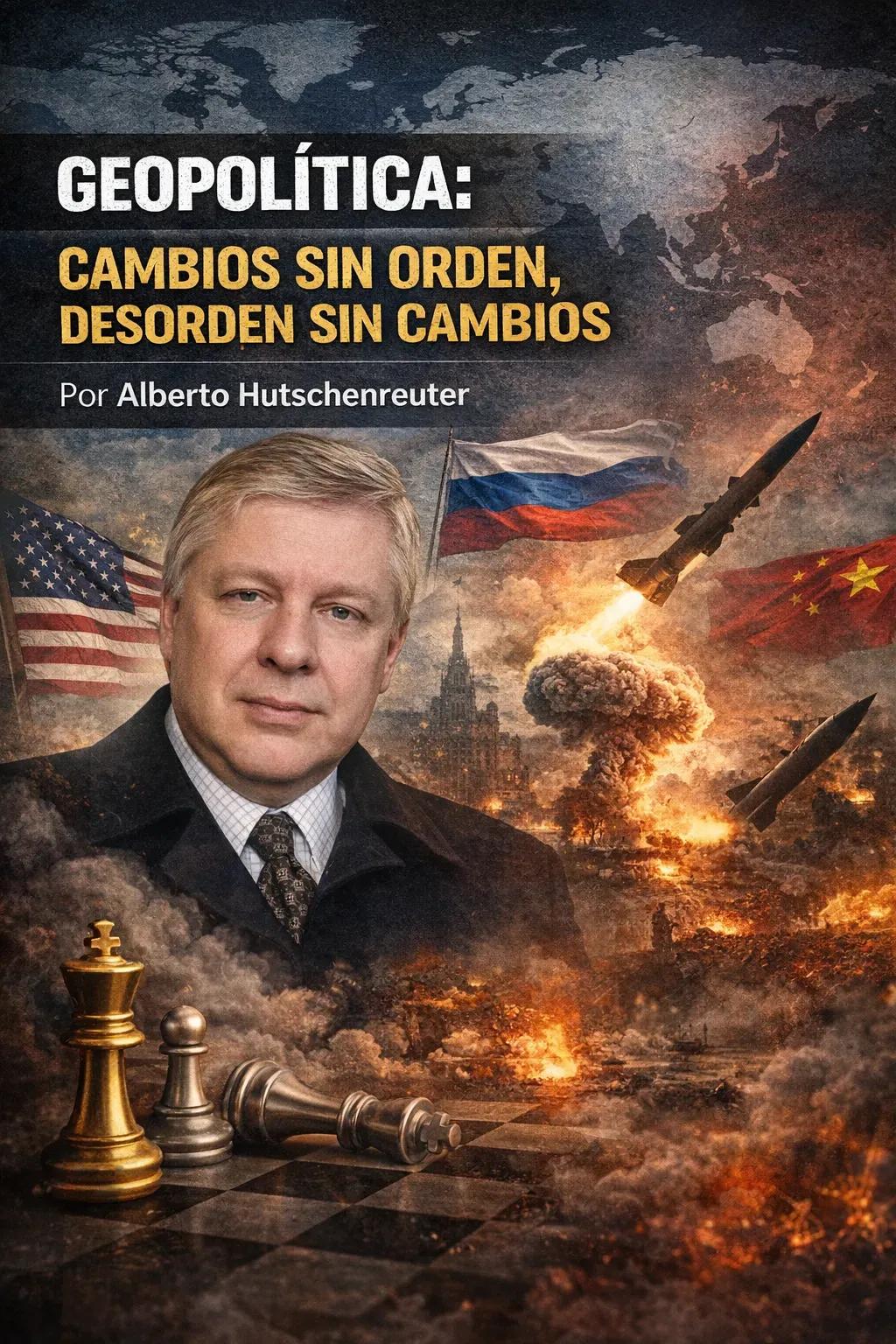
As of 2026, a series of events and announcements have greatly impacted international relations, to the point that, while not resulting in a large-scale change in such relations, they have possibly implied a situation close to an inflection point.
On one hand, geopolitics, which contrary to previous beliefs did not disappear with the Cold War or with the advent of the globalization regime, has suffered a strong acceleration as a consequence of decisions made by the U.S. presidency regarding selective strategic locales, that is, areas that are part of the "near neighborhood" of the only great, wealthy, and strategic superpower in the world.
The forceful operation to extract the then-president of Venezuela, Nicolás Maduro, was in response to an arrest warrant issued by a court in New York. However, this played a decisive role in preventing Venezuela, located within the first ring of geopolitical and geoeconomic interests of the greater power, from asserting an increasingly defiant pattern against the superpower, while also increasing ties with rival powers of the United States, mainly China.
Likewise, citing geopolitical, strategic, and national interest matters, the U.S. president claimed that Panama, Canada, and Greenland should be part of the United States. This was not a new announcement, as in 2024, as an elected president, he referred to it, only to revisit the topic with more vigor as president.
Outside the close neighborhood, the geopolitics framed in a clear territorial and power sense could be seen in conflicts like that of Morocco-Western Sahara, for which Trump maintained a logic centered on territorial continuity.
If we consider these extreme geopolitical statements that would surprise even the German general Karl Haushofer, along with global offensive tariff policies, Trump practically militarized geoeconomics, the only international counterbalance when the geopolitical model becomes dangerously predominant.
Finally, the "conservative-revolutionary" president urged Europe, his ally, to "worry and take care" of its own matters and interests and to resolve them economically; closing the agenda with a vague proposal for international order framed in a "castocratic" key, that is, a presumable order of strength based on policies of might, enhanced capabilities, and subordinates.
All these situations imply a change in the speed of international politics, but without even a hint of order being registered. An acceleration of events and announcements in a context of predominance of the pole model in relational terms. That is to say, everything is done based on interstate power relations.
Therefore, disorder continues, though with "new realities" that increasingly associate disorder with decomposition, as "novelties" may clear a classic principle of power relations, the uncertainty of intentions, but imply a strengthening of self-help on the part of states, ironically: a state of "recharged" international suspicion.
In this context, the so-called "customary policies," which have been consolidating for nearly the last two decades, have overloaded geopolitics and extend into geoeconomics, turning this segment or substitute for order, that is, relative peace, into a competitive field that could drag the world toward a major strategic blackout, that is, channeling international politics toward red scenarios with nothing to mitigate it.
In the face of this unsettling scenario, voices arise considering that the new actors in international politics, namely, the large technology companies and artificial intelligence (both general and generative), could moderate or soften the assertion of an international disorder under confrontation like the current one. In other terms, the application of AI to conflicts, for instance, could mean the application of very calibrated diplomacy that, clearing suspicions regarding hidden intentions, provide gains to the parties involved.
However, there may be some excess of hopes regarding the dawn of an era of "inter-AI" relations, that is, what the American Ian Bremmer has called technopolar relations.
It is true that today the future is more uncertain than before, as for the first time there is a horizon with possibilities of transcending the human. But it is pertinent to keep in mind that in the 1970s it was considered that the "technotronic era" and the growing phenomenon of interdependencies would "relocate" and even blur the capacities and abilities of states.
Half a century later, this has not only not occurred, although it is true that globalization crossed state protection barriers and impacted the social situation of different countries, but there has been a revitalization of the state, as evidenced in some speeches made at the last meeting in Davos.
There will surely be a significant margin of cooperation in terms of technological capacities among states. But it is also certain that states will not only utilize large-scale technology to improve their governance functions but will seek to optimize their skills to enhance capabilities in order to concentrate more power and thus gain advantages over other competitors. The United States and China today offer us a preview of this.
In this context, the reflections provided by Henry Kissinger, Eric Schmidt, and Daniel Huttenlocher in their indispensable book "The Age of Artificial Intelligence and Our Human Future" are very interesting:
"The dynamic and emergent qualities of AI generate ambiguity in at least two aspects. First, AI can function as we expect, but generate outcomes that we do not foresee. With these outcomes, it can lead humanity to places unanticipated by its creators. Just as the statesmen of 1914 failed to recognize that the old logic of military mobilization, combined with the new technology, would lead Europe to war, the deployment of AI without careful consideration could have serious consequences. These could be localized, as in the case of an autonomous car making a decision that endangers life, or transcendental, like a significant military conflict. Second, in some applications, AI can be unpredictable and its actions may prove completely surprising. Consider AlphaZero, which, in response to the instruction 'win at chess', developed a style of play that, in the millennia of game history, humans had never conceived. Although humans can carefully specify the objectives of AI, as we give it more freedom, the paths it takes to achieve its goals may surprise us and even alarm us.”
Perhaps it is best not to continue too far into prognostic exercises concerning a phenomenon of uncertain margins. Machiavelli stated that he did not reflect on “realms he had not known.” Let us consider the limits of the great Florentine thinker and reflect on what happens and, with or without nostalgia, not leave the experience of the past behind.
Alberto Hutschenreuter holds a PhD in International Relations. He has a postgraduate degree in Control and Management of Public Policies. Former tenured professor of Geopolitics at the Higher Air War School. Former professor at the University of Buenos Aires and the Argentine National Foreign Service Institute. Contributor to national and international specialized magazines and websites. Author of the books "Russian Foreign Policy after the Cold War: Humiliation and Repair" and "Geopolitics Never Left," among others.

Comments