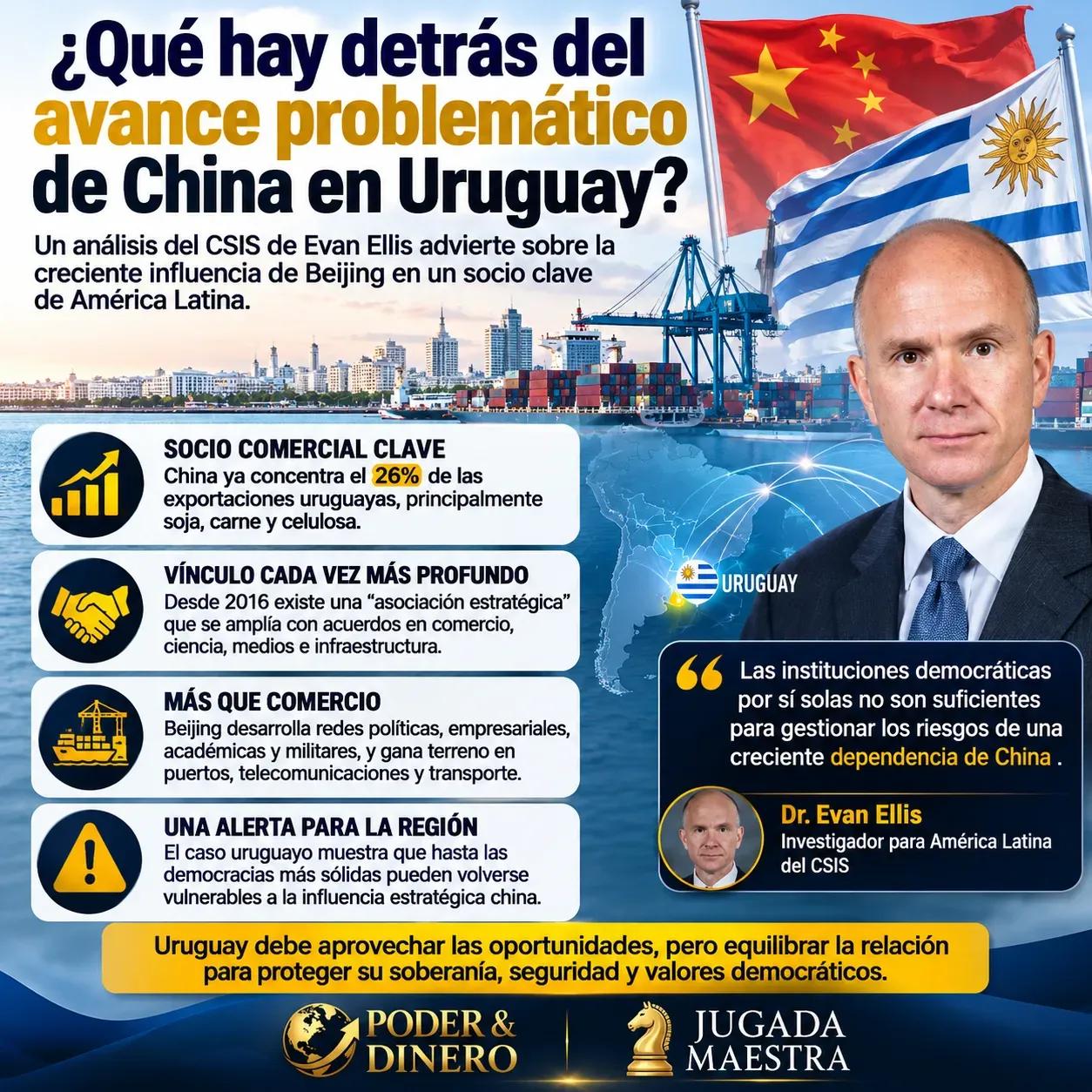
Uruguay occupies a particular place in the South American geopolitical map. It is a small country, with barely 3.4 million inhabitants, but it has strong democratic institutions, a long tradition of political stability, and a strategic location between Argentina and Brazil, along a river corridor essential for the trade of several countries in the region.
Precisely because of these characteristics, the growing bond with China acquires an importance that, according to Evan Ellis, goes far beyond the volume of commercial exchange.
From trading partner to strategic partner
The relationship between Uruguay and the People's Republic of China has progressively deepened over the last few decades. Both countries established diplomatic relations in 1988; in 2016 they moved towards a strategic partnership; in 2018 Uruguay joined the Belt and Road Initiative; and in 2023 the relationship was elevated to a comprehensive strategic partnership.
During President Yamandú Orsi's visit to Beijing in February 2026, both governments signed numerous agreements aimed at expanding cooperation in areas such as trade, meat, fish meal, science, and media. Ellis notes, however, that many of these agreements were not public and that some are linked to sectors considered sensitive.
The result is a relationship that can no longer be analyzed exclusively from a commercial perspective.
A growing commercial dependence
China has become the main destination for a significant part of Uruguayan exports. 26% of the country's exports are destined for the Chinese market, while Uruguay imports a wide variety of manufactured and technological goods from China.
The trade pattern is also significant: Uruguay primarily exports primary and agro-industrial products—including soybeans, cellulose, and meat—while it imports manufactures, technology, and services.
In terms of volume, bilateral trade appears relatively balanced: around US$3.5 billion in Uruguayan exports to China compared to US$3.3 billion in imports. However, Ellis warns that the nominal balance of the trade does not eliminate a structural dependency arising from the concentration of Uruguayan exports in the Chinese market.
The eventual deepening of negotiations between China and Mercosur could further increase this dependency.
The influence is not limited to trade
One of the central aspects of Ellis's analysis is that Beijing uses different instruments simultaneously: trade, investment, diplomacy, political ties, educational cooperation, media, and military relations.
In Uruguay, for example, there is a parliamentary friendship group with China composed of key legislators in the International Relations committees of the Senate and the Chamber of Deputies. Exchanges have also developed between Uruguayan political leaders and organizations of the Chinese Communist Party.
The media dimension is also part of this strategy. Xinhua and Uruguayan state audiovisual media have established content exchange agreements, while Uruguayan journalists have participated in activities and trips related to China.
The objective, according to the analysis, should not necessarily be interpreted as evidence of direct political control, but rather as the progressive construction of networks of influence and relationships that may acquire strategic value.
Infrastructure, technology, and data
The Chinese presence also extends to strategic sectors of the Uruguayan economy.
In telecommunications, Chinese companies such as Huawei and ZTE have a significant presence. ZTE participated in the deployment of Antel's 5G network, while Huawei obtained important contracts in the telecommunications sector.
Ellis notes that this situation raises concerns related to data security, particularly because Chinese legislation establishes obligations for national companies regarding cooperation with the country's security and intelligence authorities.
The issue takes on geopolitical dimensions because telecommunications are no longer merely a commercial activity: digital networks are part of the critical infrastructure of any modern state.
Ports, transport, and economic presence
The Chinese influence is also evident in the logistics and port sector. Companies from the country have submitted projects to develop infrastructure aimed at processing and storing fishery products, while Chinese companies participate in dredging work at the Port of Montevideo.
In transport, the presence is even more visible. Electric vehicles and buses from Chinese companies have an increasing share in Uruguay, while companies like BYD are developing operations related to electric mobility.
For Ellis, these sectors must be viewed from a strategic perspective because logistical and technological infrastructure can gain additional importance in situations of regional crisis or competition among great powers.
The military dimension
Perhaps one of the lesser-known aspects of the bilateral relationship is the military one.
China has provided Uruguay with vehicles, equipment, and other materials for its armed forces, as well as training and educational programs for Uruguayan officers. In 2018, Beijing made a military donation valued at approximately US$5 million, and in 2024 a new delivery of equipment was agreed upon.
In January 2026, moreover, the Chinese hospital ship Silk Road Arc made a four-day stop in Montevideo. It was the first visit of a Chinese military vessel to Uruguay and was accompanied by various contacts between the armed forces of both countries.
Ellis argues that these links do not necessarily mean that China is building a permanent military presence in Uruguay. However, they do allow for the generation of institutional relationships, knowledge, and personal ties that could acquire strategic value in the future.
The political factor: when trade becomes influence
One of the examples cited by Ellis occurred in March 2026, when the governor of Durazno, Felipe Algorta, canceled a trip planned to Taiwan after meeting with then Chinese ambassador Huang Yazhong.
The episode is presented as a demonstration of Beijing's ability to leverage its diplomatic and economic weight to influence Uruguayan political decisions related to Taiwan and the policy of "One China".
According to the CSIS researcher, this type of episode is particularly relevant because it demonstrates that Chinese influence does not solely depend on the existence of a formal political relationship.
Uruguay as a case study for Latin America
The Uruguayan case presents, according to Ellis, a fundamental issue for all of Latin America.
If China can significantly expand its influence in a country with established democratic institutions, an open society, and a tradition of political independence, the region should wonder what may happen in countries with weaker institutions or higher levels of economic dependency.
The problem, therefore, does not lie in trading with China or maintaining diplomatic relations with Beijing. The central question is how to manage that relationship without allowing economic dependency to lead to political, technological, or strategic vulnerabilities.
Washington is also facing a challenge
The United States is paying close attention to the evolution of this relationship. Uruguay has a strategic geographic position and is at the heart of the Southern Cone's commercial system.
However, Ellis warns that Washington faces limitations in offering alternatives to Chinese influence, even due to Uruguay's economic characteristics and the existing restrictions on certain mechanisms of U.S. assistance.
Thus, the American challenge should not be reduced to asking Uruguay to limit its ties with China. According to the analysis, Washington needs to offer economic, technological, educational, and security alternatives that are sufficiently attractive for Latin American countries to diversify their relationships without being forced to choose between Beijing and Washington.
A warning for the entire region
Ellis's conclusion is particularly relevant: China has become a commercial partner and an influential political, military, and social actor in Uruguay despite the small size of its market.
The Uruguayan case demonstrates that strong institutions and democratic traditions are not necessarily enough to manage the risks derived from a growing dependence on an external power.
The answer, then, does not necessarily involve closing the doors to China. It involves establishing clear limits, diversifying markets, protecting critical infrastructure, preserving data security, and ensuring that the country's strategic decisions continue to reflect national interests and not external pressures.
Uruguay can benefit enormously from its relationship with China. But from a geopolitical perspective, the fundamental question is another:
Can Uruguay deepen its economic ties with Beijing without that dependency ultimately transforming into political and strategic influence?
The answer to that question will not only define the future of the relationship between Uruguay and China. It may also become a witness case for the rest of Latin America.
Full article by accessing https://www.csis.org/analysis/whats-behind-chinas-problematic-advance-uruguay
Evan Ellis is a senior associate (non-resident) in the CSIS Americas Program at the Center for Strategic and International Studies in Washington, D.C.

Comments