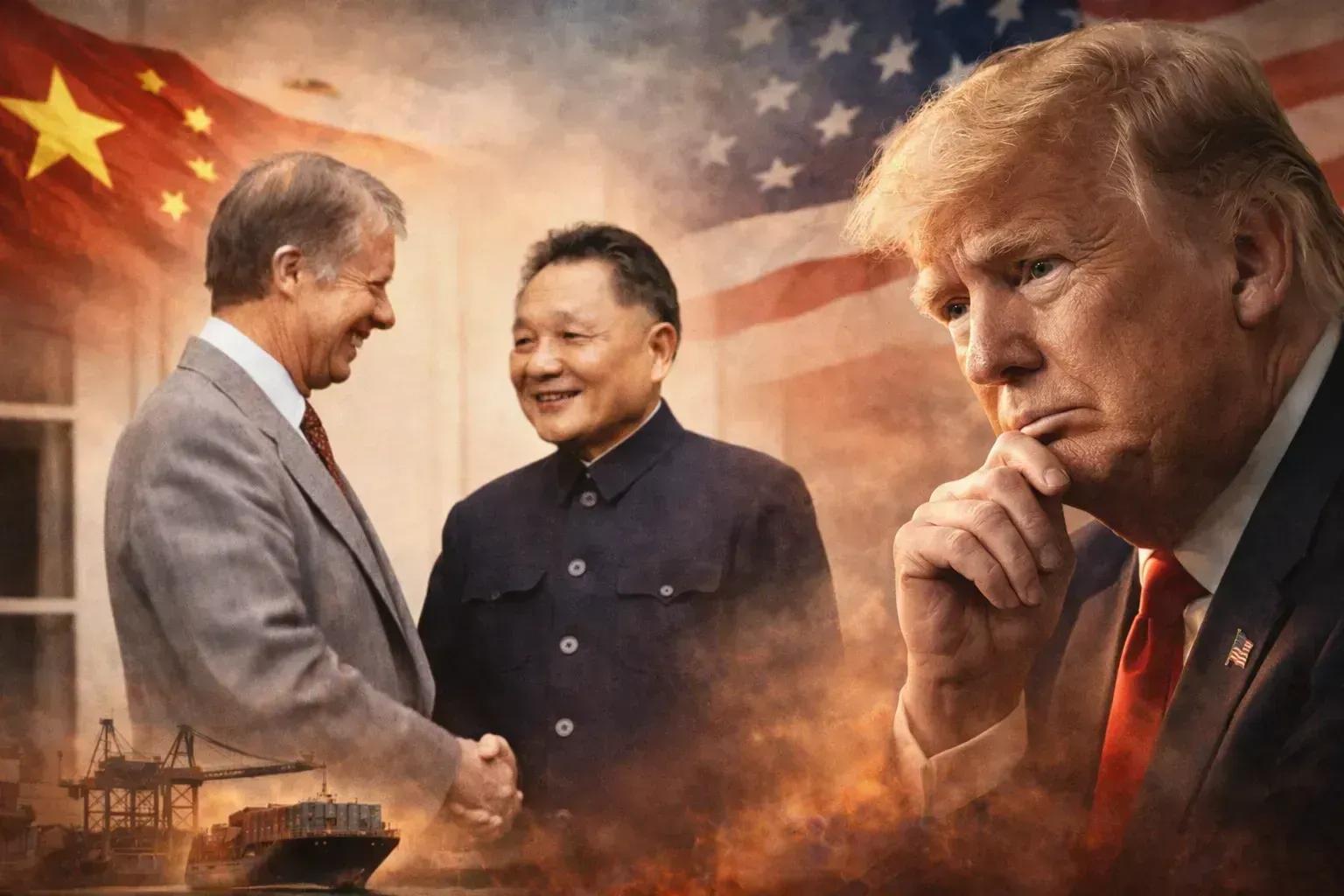
For decades, China's growth was presented as an exclusively personal feat: discipline, state planning, abundant labor, and a millennia-old culture oriented toward the long term. However, there is an inconvenient fact that is often left out of the epic narrative: the Chinese economic rise cannot be understood without a key decision by the United States in 1979.
That year, President Jimmy Carter granted the People's Republic of China the status of Most Favored Nation (MFN). In technical terms, it was a trade decision. In historical terms, it was the starting point of the largest transfer of economic power of the 21st century.
1979: The Turning Point
When China received that status, its economy was marginal: it represented less than 2% of global GDP, with income levels typical of a rural and underdeveloped country. Under the leadership of Deng Xiaoping, Beijing quickly understood the opportunity: preferential access to the largest market in the world, Western technology, foreign investments, and stable trade rules.
The United States believed it was exporting capitalism and democracy. China understood that it was importing time, scale, and market.
From the World's Workshop to Superpower
Between 1980 and 2024, the Chinese economy grew at an average rate close to 9% per year. In four decades, it went from being a peripheral economy to becoming the second global economic power, with a GDP today around 18% of the global total, far surpassing Europe individually and challenging the leadership of the United States.
China became, for the world, the great space for cheap production.
Abundant labor, low wages, state subsidies, infrastructure funded by the Communist Party, and a managed exchange rate.
Western countries gained cheap products. China gained something much more important: capital accumulation, technological transfer, and structural power.
American companies relocated production to reduce costs. Western governments celebrated the drop in prices. Meanwhile, China was building an industrial network that is now almost impossible to replace.
Sun Tzu and the War Without Bullets
There is a phrase by Sun Tzu that surgically summarizes the Chinese strategy:
“The supreme excellence does not consist in winning all the battles, but in defeating the enemy's resistance without fighting.”
That is exactly what China did. It did not confront the United States militarily. It overwhelmed it economically.
China built a productive, commercial, and financial superiority while deploying a pragmatic, flexible, and persistent foreign policy. Investments, credits, infrastructure, trade, diplomatic seduction, and, when necessary, economic pressure. No mechanism was left out of the manual.
The result: global dependency on Chinese production. Without firing a shot, China displaced the United States from key strategic positions.
Trump Confronts the Monster Created by Washington
Today, Donald Trump faces the consequences of those decisions. His diagnosis is clear: the United States strengthened its main rival. Trump understands that the root of the problem lies in decisions like the one made in 1979. That is why his recent policy aims to:
Reindustrialize the United States.
Raise tariffs on Chinese products.
Limit Chinese access to sensitive technology.
Press allies to reduce their dependence on Beijing.
Reorganize global production chains.
But there is a fundamental problem: it cannot be undone in a few years what was built over four decades.
Trump is not fighting Mao's China. He is fighting a economic, military, and nuclear superpower, deeply integrated into global trade and with a real capacity to dispute world leadership.
The story of China's rise is not just a story of Asian discipline or state planning. It is also - and above all - a story of decisions made in Washington.
Carter Opened the Door. China Crossed It, Learned, and Stayed. Trump Tries to Reverse History.
Today, the United States is trying to close it, but on the other side, there is no longer a developing country, but a systemic rival. And as Sun Tzu taught, when the battle is won without firing a single shot, the true winner no longer needs permission to advance.

Comments