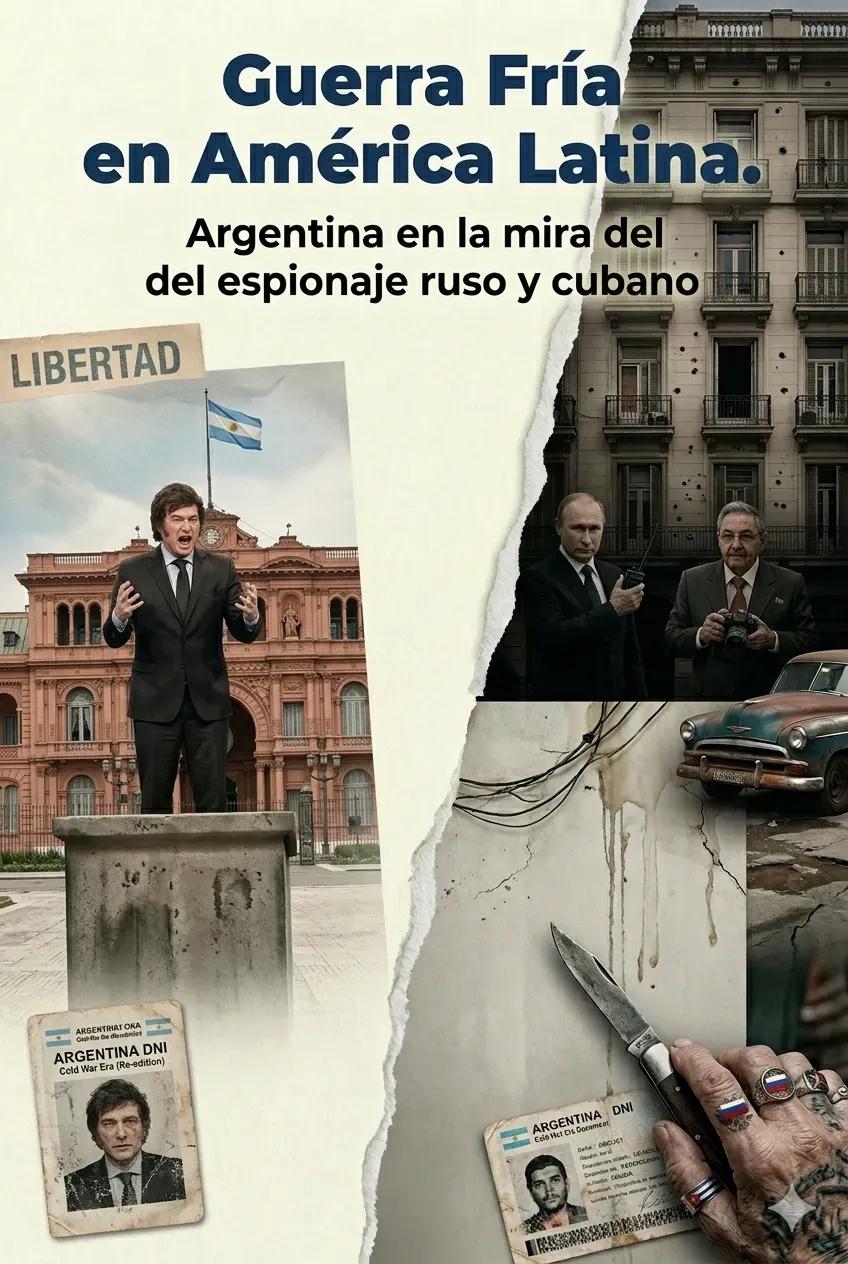
Judicial file — Case "The Company" / Russian disinformation.
The investigation is led by federal judge Jorge Ramos and prosecutor Ramiro González, based on a criminal complaint filed on April 3, 2026, by attorney Jorge Monastersky, founded on a report from the SIDE dated April 2 of the same year. The legal framework invoked includes the National Intelligence Law, money laundering, and violation of institutional sovereignty. The SIDE had reported the operation to the Public Prosecutor's Office in October 2025, and Minister Patricia Bullrich was warned by her U.S. counterpart Kristi Noem in mid-year. At the close of this edition, the file is in the investigative stage, without formal defendants. Source: Judicial Diary, April 6, 2026.
Cuban Espionage: Manuel Rocha and the G2 in Buenos Aires
The most illustrative case of Cuban reach in Argentina involves Víctor Manuel Rocha, former U.S. ambassador to Bolivia, arrested in December 2023 and sentenced on April 12, 2024, to 15 years in prison for having worked as an agent for Havana since 1981. Attorney General Merrick Garland described him as responsible for "one of the most extensive and long-lasting infiltrations in the U.S. government by a foreign agent" (La Nación, December 7, 2023).
Judicial file, Case Víctor Manuel Rocha.
Rocha was prosecuted before the U.S. District Court for the Southern District of Florida, under Judge Beth Bloom, file 23-cr-20464. The charges were conspiracy to act as an agent of a foreign government and conspiracy to defraud the United States by acting as an agent of Cuba without legal notification. On February 29, 2024, he entered a guilty plea. On April 12, 2024, he was sentenced to 15 years in prison, a fine of $500,000, and three years of supervised release. Investigations determined that he had been working for Cuba since approximately 1981, for nearly forty years. Source: U.S. Department of Justice.
Rocha was stationed in Buenos Aires between 1997 and 1999, where he developed an influence over Eduardo Duhalde that exceeded usual diplomatic boundaries. Subsequent investigations after his arrest suggest that he may have guided Argentina's political transition in 2003: he allegedly called Carlos Reutemann to decline the presidential candidacy and recommended that Duhalde select Néstor Kirchner as his successor, presenting him to Washington as "a trustworthy man." If confirmed, Havana would have influenced, through its infiltrated agent, the most significant political decision in Argentina in decades (El Debate, December 31, 2025). On the current front, intelligence reports cited by former Vice President Carlos Ruckauf during the protests in March 2025 indicate the presence of Cuban agents within the organizations of protesters. President Milei expressed it unambiguously: "There is zero possibility of a social uprising occurring, unless there are foreign infiltrators... Disguised as photographers" (CiberCuba, March 2, 2024). The pattern replicates what was documented in Chile during the social outbreak of 2019.
Why Argentina: Three Structural Factors
The first is strategic: Vaca Muerta contains the fourth largest unconventional gas reserves and the second largest oil reserves in the world, an asset that alters the global energy map and represents a direct threat to the Russian economy, structurally dependent on hydrocarbons. It is no coincidence that the Dultsev had among their documented objectives the gathering of information about that sector (MercoPress, April 4, 2026).
The second factor is political and institutional. Argentina has a long tradition of polarization, cyclical crises, and intelligence agencies with limited resources, creating optimal conditions for long-term influence operations, where changes in government hinder investigative continuity. The third is geographical and diplomatic: the country borders Bolivia and Paraguay, transit zones for networks linked to ALBA service, and maintains a history of trade relations with Russia and China, which gives Moscow and Havana access to diplomatic and economic channels that do not exist in countries with more defined positions against the West.
About the Author
William L. Acosta is a graduate of PWU and Alliance University. He is a retired police officer from the New York police, a former U.S. Army veteran, and the founder and CEO of Equalizer Private Investigations & Security Services Inc., a licensed agency in New York and Florida, with international reach. Since 1999, he has led investigations in narcotics, homicides, and missing persons cases, as well as participating in criminal defense at both state and federal levels. A specialist in international and multi-jurisdictional cases, he has coordinated operations in North America, Europe, and Latin America.

Comments