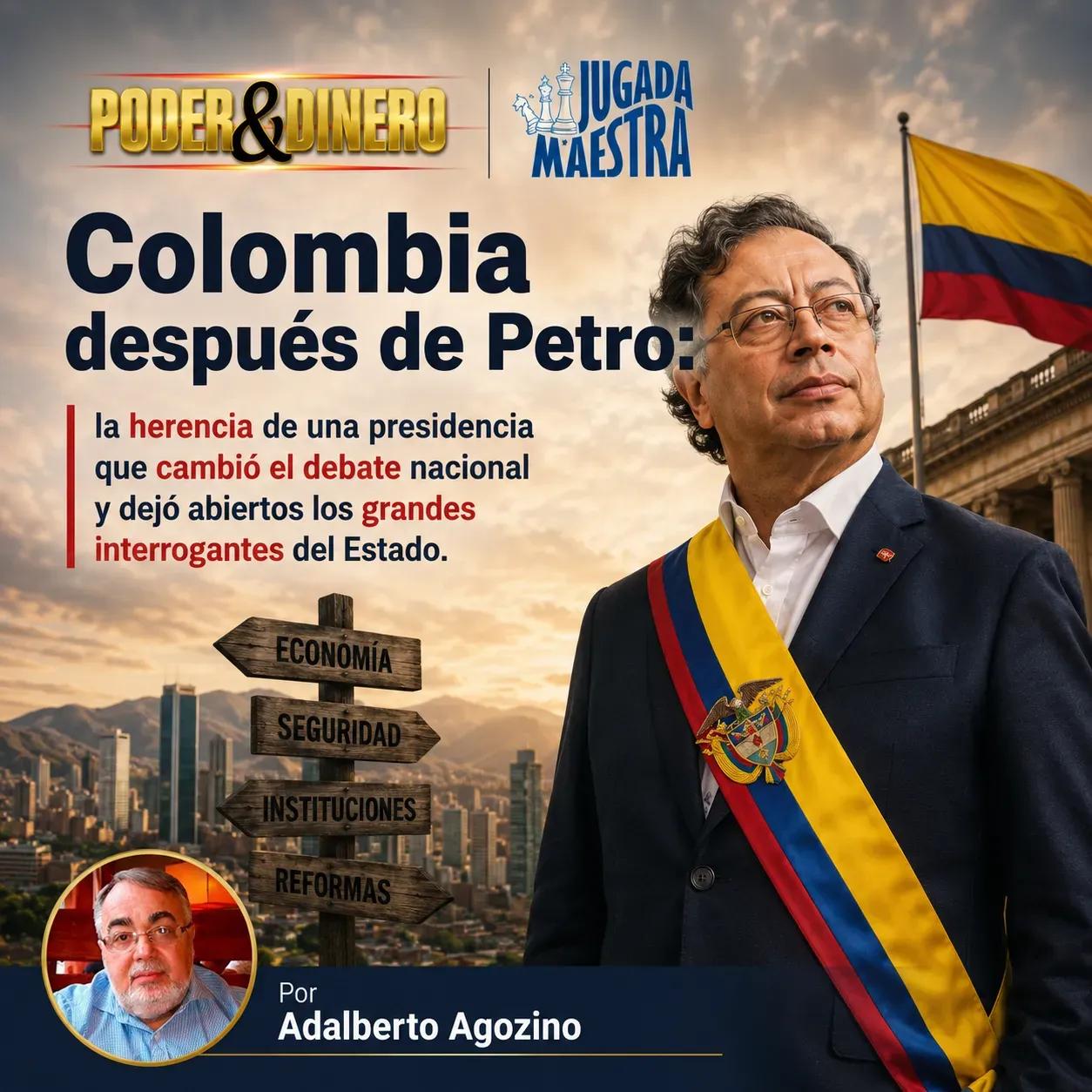
When the next president of Colombia takes office at the Casa de Nariño, they will inherit a country that is profoundly different from the one Gustavo Petro encountered in August 2022. Different in its political priorities, in its public language, in the nature of its national debates, and in how it perceives itself within Latin America. But they will also receive a nation marked by structural contradictions that remain unresolved and represent some of the greatest challenges of recent Colombian history.
Gustavo Petro's presidency has constituted, probably, the most ambitious political experiment Colombia has experienced since the promulgation of the 1991 Constitution. Not only because it marked the arrival of the left to power for the first time in the country’s contemporary history but also because it attempted to simultaneously modify some of the fundamental pillars on which the Colombian model has rested for decades: security policy, the organization of the healthcare system, the tax structure, the energy matrix, the relationship with the United States, and the very historical narrative of the armed conflict.
However, the magnitude of the announced transformations ended up clashing with the institutional complexity of the Colombian state, with the resistance of broad political and economic sectors, and with the limitations inherent to a democratic system designed precisely to prevent abrupt changes and excessive concentrations of power. As a result, the next president will inherit a country in transition, where many reforms were left incomplete, others were partially approved, and some never managed to overcome legislative obstacles.
The economic legacy: social advances and fiscal fragility
The economy will undoubtedly be one of the areas where the new president will find the greatest challenges. Petro's economic balance is difficult to classify through simple categories because it combines positive social indicators with growing concerns about the sustainability of public finances.
During the mandate of the leader of the Historic Pact, Colombia managed to avoid a recession and maintained positive growth rates. The Gross Domestic Product grew by 2.6% in 2025 after expanding by 1.5% in 2024, modest figures for an emerging economy but sufficient to preserve basic macroeconomic stability.
More significant were the social advances. Inflation, which exceeded 10% when Petro came to power, fell to around 5.8%. Unemployment dropped below double digits, and multidimensional poverty continued to decrease. Sustained increases in the minimum wage, the expansion of social subsidies, and transfers aimed at the most vulnerable sectors helped improve the well-being indicators of a broad segment of the population.
Economist Luis Fernando Mejía, one of the most respected voices in Colombian economic analysis, recognizes these social advances but warns that the next government will face an extraordinarily complex fiscal situation. According to his estimates, the fiscal deficit approaches 6.5% of GDP, a level significantly higher than the country's historical averages.
Public debt constitutes another cause for concern. The increase in state expenditure aimed at financing social programs coincided with a slowdown in private investment and lower revenues from the energy sector. Foreign direct investment showed signs of weakening, especially in oil and mining, sectors that continue to be fundamental for Colombian exports and for obtaining foreign currency.
The energy transition driven by Petro clearly symbolizes this tension between strategic objectives and economic realities. The decision to limit new oil exploration contracts sought to position Colombia as an international climate leader and accelerate productive diversification. However, numerous economists argue that the country still lacks an alternative economic structure capable of fully replacing the tax revenues generated by hydrocarbons.
The next president will have to solve a particularly difficult equation: to maintain the social advances achieved in recent years without further deteriorating public accounts or discouraging private investment. This will probably be the central economic issue of the next four years.
A less unequal society but deeply polarized
In social terms, Petro's legacy also presents both strengths and weaknesses. Even some of his opponents acknowledge that he succeeded in changing the priorities of the national debate. Issues such as inequality, territorial inclusion, social justice, environmental protection, and wealth redistribution gained political centrality that had not been seen for decades.
Analyst Óscar Montes argues that one of the president's main achievements was precisely to center the social issue on the public agenda.
However, this cultural shift came alongside extraordinary political polarization. Petro governed in constant confrontation with broad sectors of the political, business, and media establishment. His critics accuse him of turning ongoing conflict into a method of governance. His supporters argue that he merely challenged power structures that had remained practically intact for decades.
Political scientist Hernando Gómez Buendía summarizes this paradox by pointing out that the main transformation of the period was symbolic and discursive rather than structural. According to his analysis, Colombia experienced an intense narrative battle that altered perceptions, political identities, and forms of representation, even though many deep structures remained relatively unchanged.
The crisis in the healthcare system constitutes another of the significant challenges inherited. The operational difficulties of many Health Promotion Entities, delays in medical care, and uncertainty regarding healthcare reform have generated increasing public concern. Although the government attributes the crisis to pre-existing structural problems and the functioning of private EPS, broad social sectors perceive an actual deterioration in health services.
The most urgent challenge: security and the partial failure of Total Peace
If there is one area where the next president will face immediate pressures, it is security.
The policy of “Total Peace” was probably Petro's most ambitious initiative and, at the same time, one of the most controversial. Its objective was to negotiate simultaneously with guerrillas, dissidents from the FARC, drug trafficking groups, and criminal organizations, under the premise that the Colombian conflict could no longer be addressed through watertight compartments.
The idea represented a significant conceptual innovation. However, its results have been the subject of strong questioning.
Although some official statistics reflect improvements in certain violence indicators, extensive regions of the country continue to be under the influence of illegal armed actors. Departments like Cauca, Arauca, Norte de Santander, Guaviare, and various areas of the Pacific continue to register clashes, population displacements, and illegal economies linked to drug trafficking.
The dissidents of the former FARC remain fragmented into multiple armed structures with diverse interests. Some maintain dialogue channels with the state; others have intensified their military and criminal activities. The National Liberation Army continues to be a relevant actor in several border regions, while numerous drug trafficking groups take advantage of vacuums of state authority to expand their territorial control.
The expansion of coca crops adds complexity to the landscape. Colombia remains the world's leading producer of cocaine, and drug trafficking continues to finance a significant part of illegal armed organizations.
The next president will have to decide whether to maintain Petro's negotiating approach, correct it, or return to strategies closer to the logic of democratic security promoted during the governments of Álvaro Uribe Vélez.
Tensioned institutions and uncertain governance
Another fundamental aspect of Petro's legacy is the relationship between the Executive and institutions.
Throughout much of his term, Petro maintained open conflicts with Congress, sectors of the Judiciary, control bodies, media outlets, and regional leaders. Various analysts believe that these tensions hindered the construction of consensuses essential for approving structural reforms.
At the same time, the president retained relatively high levels of popularity by Colombian standards, demonstrating that a significant part of society continues to support his political objectives even while questioning some aspects of his management.
The result is a fragmented political system where no force has a sufficient hegemony to govern without broad agreements. The parliamentary strengthening of the Historic Pact ensures that Petro's political movement will remain a central actor in Colombian politics even after Petro leaves the presidency.
Colombia in the world: two possible paths
The country's international orientation will largely depend on the ideological direction of the next government.
If the presidency is in the hands of a left-wing figure close to Petro's project, like Iván Cepeda Castro, Colombia is likely to maintain its commitment to autonomous diplomacy, a foreign policy focused on climate change, Latin American integration, and a more balanced relationship with major powers. Additionally, it would continue the rapprochement with progressive governments in the region and seek cooperation spaces with China and other emerging actors.
However, even in that scenario, relations with the United States would remain a priority. Drug cooperation, Venezuelan stability, migration flows, and Colombia's geopolitical importance make a significant break with Washington impossible. As various analysts point out, the relationship between both countries has shown remarkable adaptability even in times of strong ideological disagreements.
If, on the contrary, a right-wing candidate were to triumph, whether represented by figures close to Uribism or by more recent conservative currents, a significant reorientation could occur. A conservative government would likely reinforce strategic cooperation with the United States, recover a more favorable policy for foreign investment in hydrocarbons, harden the strategy against armed groups, and adopt more critical positions regarding certain left-wing Latin American governments.
Nevertheless, there are structural limits that would moderate any radical shift. Colombia continues to depend on international markets, U.S. cooperation, and regional stability. Therefore, rather than drastic breaks, we should expect adjustments in emphasis and priorities.
The Colombia to come
Colombia is approaching a new historical phase with a combination of opportunities and risks that has seldom presented itself so simultaneously.
The next president will find a society more aware of inequalities, more demanding of the state, and more involved in political discussion. They will also inherit strained public finances, a healthcare system in urgent need of reform, deteriorating security in various peripheral regions, and an economy that needs to regain investor dynamism without renouncing the social advances achieved.
The presidency of Gustavo Petro will be remembered as a political experience that profoundly altered the axis of national debate. His supporters will argue that he opened long-postponed paths toward a more inclusive and less unequal society. His detractors will contend that he generated economic uncertainty, institutional polarization, and unfulfillable expectations. Both interpretations contain elements of truth.
The decisive question for the next government will not simply be to correct or deepen Petro's legacy. It will be to demonstrate that Colombia can combine economic growth, social cohesion, territorial security, and institutional stability in a single national project. The real challenge is no longer about changing the country but rather about effectively governing the country that emerged after Petro.
Adalberto Agozino is Doctor of Political Science. Professor at the National Gendarmerie University Institute and the National Defense Faculty of Argentina. Director of the Argentine Institute of Geostrategic Studies. Editor of Alternative Press Agency. Expert on Maghreb issues.

Comments