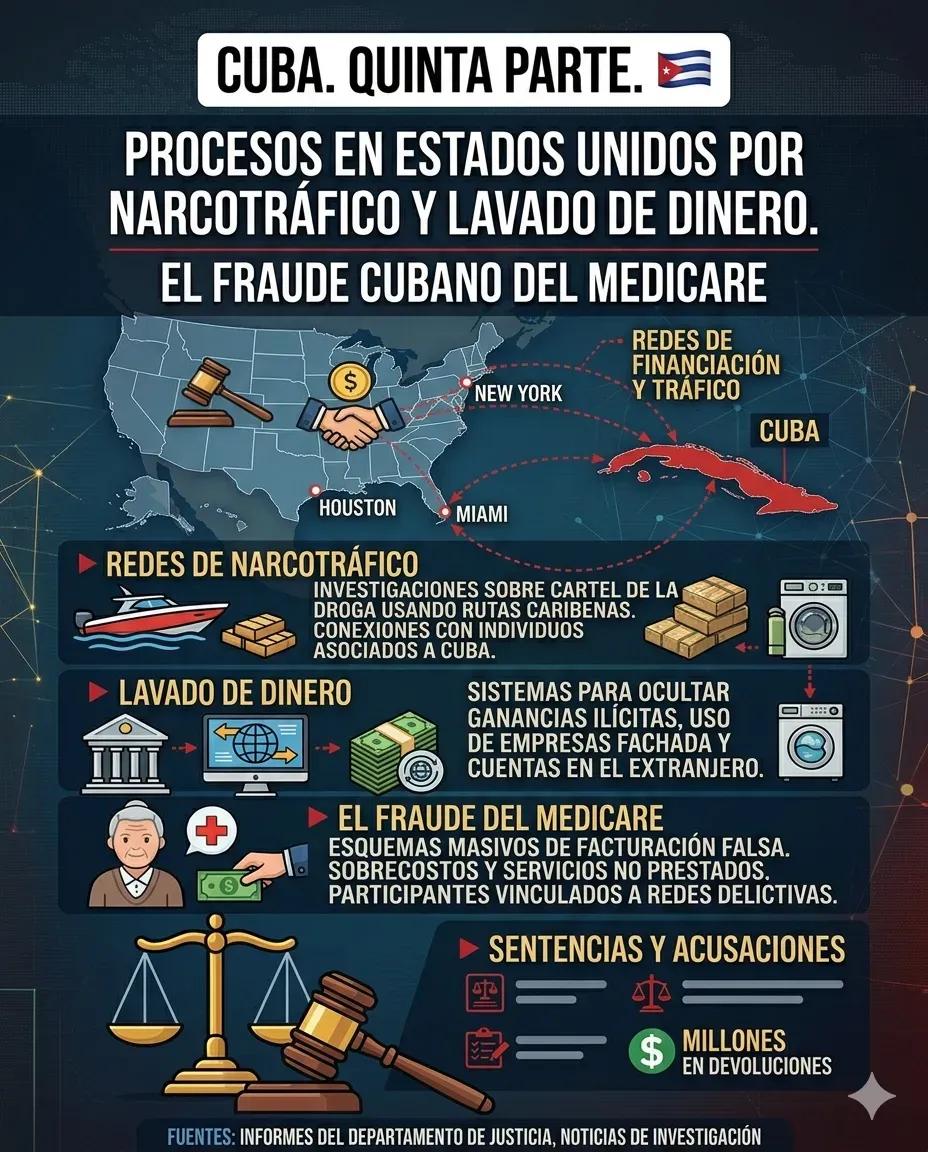
JUDICIAL FILES WITH CASE NUMBERS
The following cases are formal accusations or documented processes before federal courts in the United States and before Cuban justice itself. They are recorded with the corresponding case number to allow for independent verification.
No. 82-643-Cr-JE — United States v. Santamaría Cuadrado et al. (November 1982)
Fourteen individuals were indicted in the Southern District Court of Florida, including Vice Admiral Aldo Santamaría Cuadrado, Commander of the Cuban Navy. The charges involved the importation of five million Quaalude pills and marijuana into Florida between 1979 and 1981. No defendant was apprehended or appeared. Cuba kept them indefinitely protected. Santamaría himself presided, seven years later, over the military council that executed General Ochoa in 1989, accused of nearly identical crimes. This paradox remained without judicial explanation. Source: New York Times, November 6, 1982, "U.S. Drug Charges Cite 4 Cuban Aides."
Federal Grand Jury, SDFL — RICO Draft 1993 (United States v. Raúl Castro Ruz et al.)
A 17-page draft prepared under the RICO Act (18 U.S.C. §§ 1961-68), never formally issued. The main defendants are Raúl Castro, Manuel Piñeiro "Barba Roja," and 13 high-ranking officials. The allegations involve a 10-year conspiracy, 7.5 tons of cocaine, and the allocation of special radio frequencies to drug trafficking organizations. The reason for the non-issuance was a combination of evidentiary difficulties and political obstacles from the State Department. Raúl Castro governed Cuba without being judged until his retirement in 2018. Source: Seattle Times, April 8, 1993, "The U.S. Drug Case Against Cuba — Smuggling Probe Names Raul Castro, Other Officials."
Cuban Military Tribunal — Cuba v. General Arnaldo Ochoa Sánchez et al. (1989)
Ochoa, De la Guardia, Martínez, and Padrón were executed on July 13, 1989. The legal paradox was noted from the outset: Cuba had no death penalty for drug trafficking, so the regime utilized the charge of "treason" to execute them. Vice Admiral Santamaría, accused in Miami in 1982 of similar offenses, presided over the court without having been tried himself. The documented volume in the Cuban trial was approximately six tons of cocaine; the federal draft from Miami reported nine tons or more. Sources: Los Angeles Times, July 13, 1989, "Firing Squad Executes Cuban Hero: Ex-General, 3 Others Shot for Roles in Drug Trafficking"; Cunningham, "Trafficking for a Cause: A Historical Analysis of Cuban State-Sponsored Drug Trafficking," Air University Journal of Indo-Pacific Affairs (JOTA), 2024.
Case No. 16-cr-20267 — United States v. Ariel Nuñez-Finalet et al.
Ariel Nuñez-Finalet accumulated over $16 million in Medicare fraud between 2011 and 2014. When indicted in 2016, he fled to Cuba and lived there for years. He was only captured in Spain in 2023, after leaving the island. He was extradited on November 21, 2023, and sentenced on March 29, 2024, to 36 months in prison plus $1,910,222 in restitution. His co-conspirators Pedro Torres and Antonio Hevia remain fugitives in Cuba. Source: U.S. Department of Justice / SDFL, March 29, 2024, "Fugitive Cuban national extradited from Spain and sentenced to 36 months' imprisonment for health care fraud conspiracy."
SDFL, 2012 — Network of 70 companies, laundering up to $63 million to Cuban banks
What makes this case unique is not the amount: it is the destination. Tracking money to a country where the State controls absolutely every banking transaction has only one possible interpretation: if the money arrived, it was because someone allowed it to pass. This case constituted the first time federal investigators traced money stemming from Medicare fraud directly to the Cuban banking system. The amount traced was up to $63 million through a network of approximately 70 shell companies in Florida. Prosecutors clarified that they had no direct evidence of state participation, but experts pointed out that such magnitude cannot enter Cuban banks without the government's knowledge, given that the banking system is completely state-controlled. Sources: Weaver, Whitefield, Charles, "Miami Money-Laundering Case Spotlights Link Between Medicare Fraud And Cuba's National Bank," Miami Herald, June 30, 2012; The Senior Citizens League, "Millions Stolen From Medicare Traced To Cuban Banks," September 12, 2012.
MEDICARE: THE CIRCLE OF FRAUD AND REFUGE
The FBI Miami began to notice the pattern in the mid-1990s: HIV clinics, providers of medical equipment, and home health services in Miami-Dade and Broward were presenting billing figures that did not correspond with any verifiable medical reality. What they were witnessing was a complete criminal ecosystem: phantom companies, cash patient recruiters, doctors signing prescriptions without seeing patients, and a perfected escape system. The pattern was neither spontaneous nor improvised. It was an industry.
The concentration of people of Cuban origin in that ecosystem was not random and cannot be explained solely by geographic proximity. According to a year-long investigation by the Sun Sentinel of Fort Lauderdale published on January 8, 2015, titled "Plundering America: The Cuban Criminal Pipeline," individuals born in Cuba represented less than 1% of the total population in the United States but accounted for 41% of national arrests for health program fraud. In Miami-Dade, where 24% of the population was born in Cuba, that group represented 73% of arrests for health system fraud, 72% of cargo theft cases, 59% of prosecutions for marijuana trafficking, and more than half of arrests for credit card and insurance fraud. When a statistical concentration of that magnitude appears across multiple categories of organized crime, it ceases to be a coincidence and becomes evidence of a structured network.
THREE DECADES OF DOCUMENTED TIMELINE
The documented history of Cuban Medicare fraud unfolds in waves that federal investigators learned to identify only after losing billions of dollars. By the mid-1990s, the operational model was already established: open a phantom clinic, find a doctor willing to sign, recruit patients as passive accomplices, and bill Medicare for services that were never rendered. The entry threshold was minimal. The punishment threshold, even more so.
Conservative estimates from the Sun Sentinel, based exclusively on restitution orders issued in closed federal cases, revealed over $2 billion stolen between 1994 and 2015 ("Plundering America: The Cuban Criminal Pipeline," Sun Sentinel, January 8, 2015). Alex Acosta, then U.S. Attorney for the Southern District of Florida, was precise in his public statement: in South Florida alone, Medicare thieves were stealing over $2 billion a year. Not in total. Per year. Year after year.
In 2007, an informant testified in a federal court in Miami that the organizer of a $56 million network in South Florida was Mario Aleman, an officer of Cuban intelligence G-2. Aleman had returned to Cuba. He was never prosecuted. That same year, the Department of Justice created the Medicare Fraud Strike Force, a permanent federal unit designed to pursue frauds of this magnitude, recognizing that the problem required a permanent institutional response ("Strike Force Formed to Target Fraudulent Billing of Medicare," U.S. Department of Justice, May 9, 2007).
In 2010, a Cuban network in Texas was dismantled after defrauding $9 million from Medicare. Its mechanism was sophisticated: they sent Cuban nationals to various cities across the United States to open fake cancer and HIV clinics, bill the federal program, and disappear before the alarms went off. In 2011, the network of Elizabet Lombera, which operated from Güines, Cuba, was dismantled and had accumulated over $12 million in frauds in less than two years. Each case revealed the same infrastructure: contacts in Cuba to recruit operators, networks of ethnic trust to maintain secrecy, and a guaranteed destination once the operation needed to be abandoned ("Plundering America: The Cuban Criminal Pipeline," Sun Sentinel, January 8, 2015).
In 2012, a defining moment occurred: for the first time, federal prosecutors managed to trace Medicare fraud money directly to the Cuban banking system. The amount traced was up to $63 million, funneled through a network of 70 Florida-based companies to accounts in Cuban banks. The investigation confirmed what investigators had suspected for years: the money did not stay in Miami. It had an institutional destination in Havana.
In 2015, the Strike Force of the Southern District of Florida prosecuted 73 individuals for schemes that totaled $263 million. In June 2016, the largest operation to date arrested over 300 people nationwide. The total amount was $900 million. In July of that same year, three individuals were formally charged in Miami for a scheme of $1 billion, the largest to date in the program's history.
REFUGE AS STATE SERVICE
Randall Culp, head of the health fraud unit of the FBI Miami, summarized it unequivocally in an interview with the Tampa Bay Times in 2009: "No one thought they were a flight risk." The defendants had arrived as political refugees. Judges granted them bail. They paid the bail and crossed the Florida Straits. This mechanic was not a failure of the judicial system: it was a deliberate exploitation of its rules.
The FBI estimated that between 30 and 50 health fraud fugitives fled to Cuba during the most active period of investigations. A parallel investigation by the Sun Sentinel identified at least 50 more who were not accounted for in the FBI's calculations. In total, over 150 suspects returned to Cuba or other parts of Latin America while their cases were open. At the time of the most comprehensive investigations available, over 500 individuals born in Cuba had pending federal arrest warrants, and another 500 faced state warrants in Florida for fraud and drug trafficking ("Plundering America: The Cuban Criminal Pipeline," Sun Sentinel, January 8, 2015).
Senator Charles Grassley saw it clearly enough in 2011 to write directly to Attorney General Eric Holder and Secretary of State Hillary Clinton. His question was direct: was the Cuban government facilitating or actively directing Medicare fraud? The response he received was a non-response. Grassley noted: "It is already concerning that organized crime has penetrated health fraud. It is even more disturbing if officials from a foreign government are also facilitating or directing that fraud" ("Plundering America: The Cuban Criminal Pipeline, Part III," Sun Sentinel, January 8, 2015). The State Department did not respond with actions. The pattern continued.
About the Author
William L. Acosta is a graduate of PWU and Alliance University. He is a retired police officer from the New York police, a former U.S. Army serviceman, as well as the founder and CEO of Equalizer Private Investigations & Security Services Inc., a licensed agency in New York and Florida, with international projection. Since 1999, he has led investigations in narcotics, homicides, and missing persons cases, in addition to participating in criminal defense at both state and federal levels. A specialist in international and multi-jurisdictional cases, he has coordinated operations in North America, Europe, and Latin America.

Comments