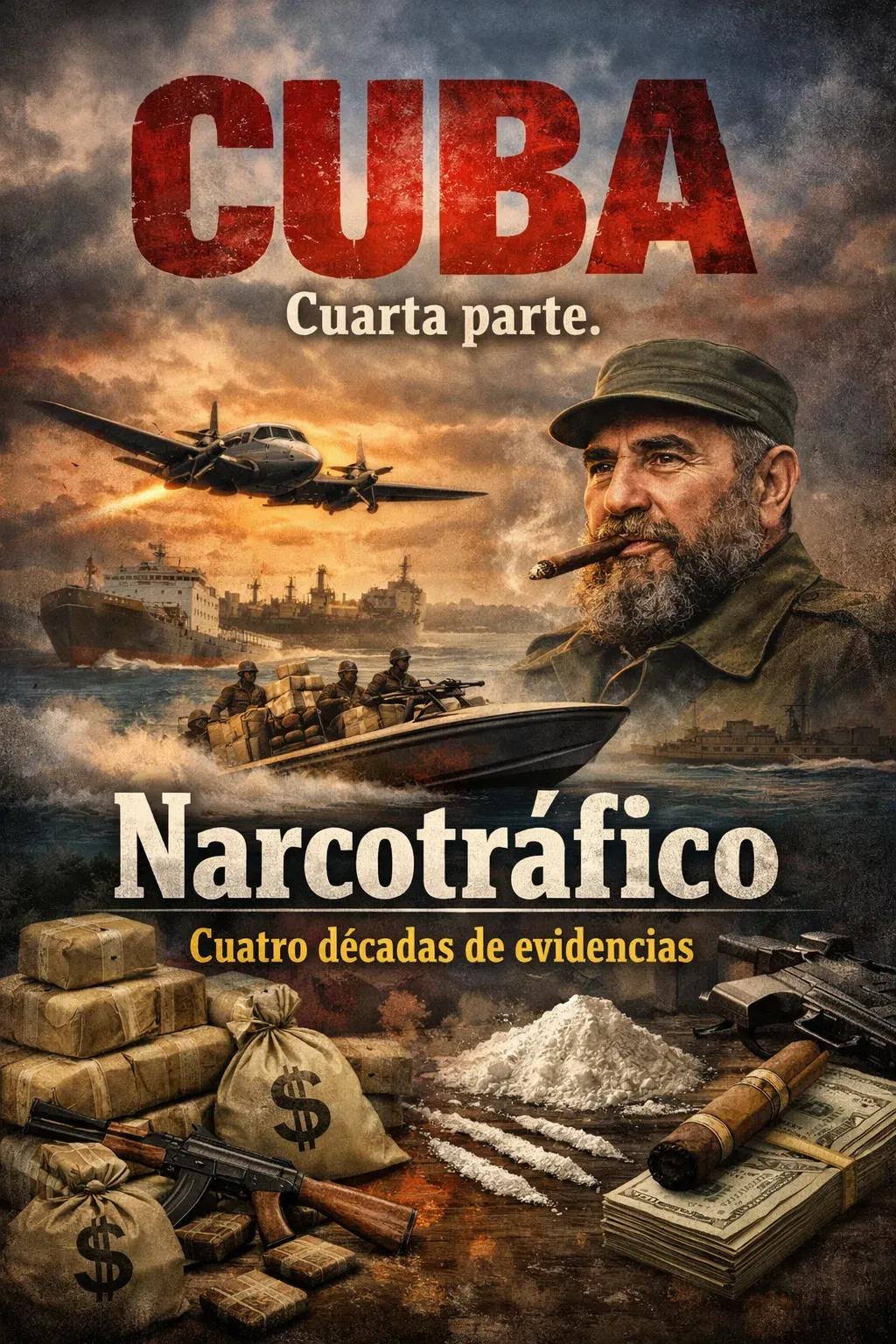
FOUR DECADES OF EVIDENCE
The following was constructed from federal charges, sentences from U.S. courts, verified reports, and academic documents. When a case number exists, it is noted. When a charge did not go to trial, it is indicated.
1979 — The first contacts with Medellín
In 1979, Carlos Lehder traveled to Cuba to agree on air and maritime routes with the Medellín Cartel. According to the federal indictment draft reviewed by the Miami Herald and reported by the Seattle Times on April 8, 1993, "Lehder traveled to Cuba in 1979 to negotiate the opening of a drug trafficking air route over the island with Cuban government officials." Lehder later testified before the Miami grand jury. He was sentenced to life plus 135 years. His testimony confirmed that the meetings on Cuban soil were not incidental: they were the starting point of an operational alliance.
1982 — First federal indictment with case number
In November 1982, the U.S. District Court for the Southern District of Florida issued case No. 82-643-Cr-JE against 14 defendants, including Vice Admiral Aldo Santamaría Cuadrado, Commander of the Cuban Navy. The charges covered the importation of five million pills of quaalude and marijuana into Florida between 1979 and 1981. No defendant stepped into the courtroom. Cuba kept them on the island indefinitely ("U.S. Drug Charges Cite 4 Cuban Aides", New York Times, November 6, 1982). That same year, the Reagan administration designated Cuba as a State Sponsor of Terrorism, citing support for M-19, FMLN, and facilitation of drug trafficking. Cuba remained on that list until May 2015.
1986–1989 — The Ochoa network and the show trial
Between 1986 and 1989, General Arnaldo Ochoa and Colonel Antonio de la Guardia organized the shipment of approximately six tons of cocaine from the Medellín Cartel through Cuba. Raúl Castro himself publicly acknowledged that "high-ranking officials" were involved. On July 13, 1989, Ochoa, De la Guardia, Amado Padrón, and Jorge Martínez were executed by a firing squad ("Firing Squad Executes Cuban Hero: Ex-General, 3 Others Shot for Roles in Drug Trafficking", Los Angeles Times, July 13, 1989). Minister of the Interior Abrantes died in prison two years later.
The legal paradox did not go unnoticed: Cuba had no death penalty for drug trafficking, so the regime used the charge of "treason" to execute them. Specialized analysts pointed out the executions as a witness elimination. The documented volume in the Cuban process was approximately six tons; the Miami federal indictment draft recorded nine tons or more ("The U.S. Drug Case Against Cuba", Seattle Times, April 8, 1993). The difference was never explained.
1993 — The RICO draft that was never issued
In 1993, the Federal Grand Jury for the Southern District of Florida prepared a 17-page draft under the RICO Act (18 U.S.C. §§ 1961-68), accusing Raúl Castro, Manuel Piñeiro "Barba Roja" and 13 high-ranking officials of a 10-year conspiracy involving 7.5 tons of cocaine and the use of special radio frequencies assigned to drug trafficking organizations. "In return for substantial sums of money, Raúl Castro exploited his official position by offering drug traffickers the safe use of Cuba, including Cuban airspace, as a transshipment point for cocaine shipments of hundreds of kilograms destined for the United States," the draft states as reported by the Seattle Times ("The U.S. Drug Case Against Cuba — Smuggling Probe Names Raul Castro, Other Officials", Seattle Times, April 8, 1993). The draft was never formally issued. Documented reasons include evidentiary difficulties and political obstacles from the State Department. Raúl Castro ruled Cuba until 2018 without being prosecuted.
1995–2009 — The Medicare wave
In the mid-1990s, the FBI Miami began documenting a systematic wave of fraud against the Medicare program in South Florida. At the end of the first phase, in 2009, 85 shell companies had billed $420 million for nonexistent medical services. Thirty-six defendants fled with $142 million in cash; at least 18 sought refuge in Cuba according to the FBI. By 2015, the federal Strike Force for the Southern District of Florida had prosecuted 73 individuals for $263 million just in Miami. The national total between 2007 and 2015 exceeded seven billion dollars and 2,300 defendants. In 2012, a case in the Southern District of Florida traced directly to the Cuban banking system an amount of up to $63 million: the first time Medicare fraud money was traced to accounts in Cuba ("Feds in Miami: Millions Stolen from Medicare Wound Up in Cuban Banks", Palm Beach Post, June 18, 2012; "Millions Stolen From Medicare Traced To Cuban Banks", The Senior Citizens League, September 12, 2012).
2015–2021 — From normalization to return to the list
In 2015, the Obama administration removed Cuba from the list of State Sponsors of Terrorism. The decision was political, not technical: Medicare fugitives in Cuba remained in Cuba; ELN leaders continued negotiating in Havana. On January 17, 2019, a vehicle loaded with explosives killed 21 cadets at the General Santander School in Bogotá. The ELN claimed responsibility ("Bogotá car bomb: Colombia blames ELN rebels for deadly explosion", BBC News, January 18, 2019; "The ELN's Attack on the National Police Academy in Bogotá and Its Implications", Combating Terrorism Center at West Point, February 6, 2019). Cuba refused to extradite the organization's leaders who were on its territory ("Colombia asks Cuba to extradite ELN rebels after bombing kills 21", Al Jazeera, January 20, 2019). In January 2021, Secretary of State Mike Pompeo redesignated Cuba as a State Sponsor of Terrorism, explicitly citing sheltering ELN leaders, American fugitives on its territory, and active support for the Maduro regime ("U.S. Announces Designation of Cuba as a State Sponsor of Terrorism", U.S. Department of State, January 11, 2021).
2024–2025 — New federal convictions
The pattern of Medicare fraud did not cease. In March 2025, Fernando Espinosa León, a 60-year-old Cuban citizen, was sentenced to five years and ten months in prison and ordered to pay restitution of $7.6 million for the Global Medical Supply scheme before the U.S. District Court for the Middle District of Florida ("Cuban National Sentenced To Over Five Years In $7.6 Million Medicare Fraud Scheme", HHS Office of Inspector General, March 24, 2025). In May 2025, Julián López received 30 months for $3.2 million through One Medical Services in the same district. Case No. 16-cr-20267 before the Southern District of Florida concluded with Ariel Nuñez-Finalet sentenced to 36 months after being extradited from Spain in November 2023; he had fled to Cuba upon being charged in 2016 and lived there for years ("Fugitive Cuban national extradited from Spain and sentenced to 36 months' imprisonment for health care fraud conspiracy", U.S. Department of Justice / SDFL, March 29, 2024). His co-conspirators Pedro Torres and Antonio Hevia remain fugitives in Cuba as of the publication date of this report.
About the Author

William L. Acosta graduated from PWU and Alliance University. He is a retired police officer from the New York police department, a former U.S. Army personnel, and founder and CEO of Equalizer Private Investigations & Security Services Inc., a licensed agency in New York and Florida with international reach. Since 1999, he has led investigations into narcotics cases, homicides, and missing persons, as well as participating in criminal defense at both state and federal levels. A specialist in international and multi-jurisdictional cases, he has coordinated operations in North America, Europe, and Latin America.
Comments