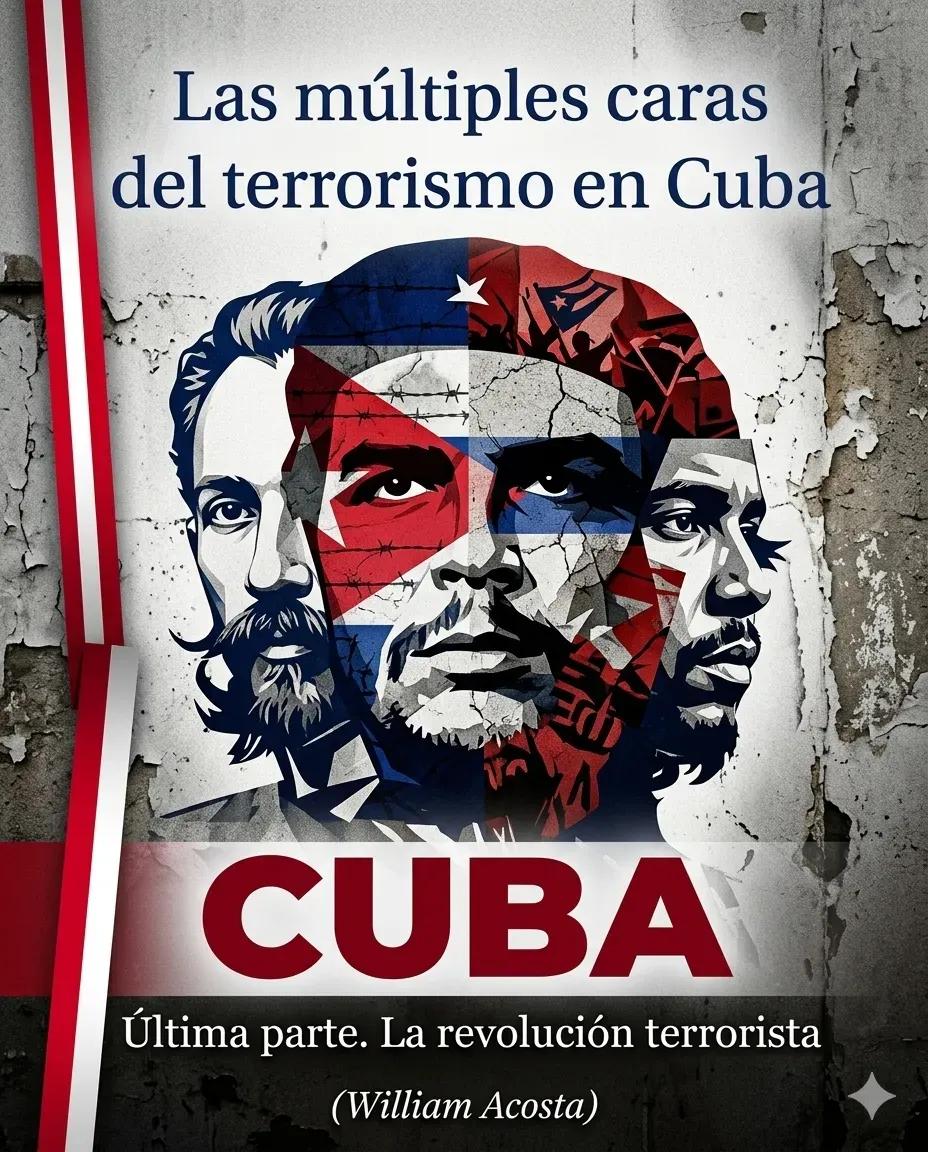
CUBA AND THE NETWORKS OF INTERNATIONAL TERRORISM: FROM THE PLO TO HEZBOLLAH
If Cuba's history with Latin American drug trafficking can be traced back to 1979, its story with global terrorism is much older. And deeper. This is not about abstract ideological sympathies or anti-imperialist rhetoric: it is about physical training, technology transfer, shared intelligence, and guaranteed sanctuary. From the guerrilla training camps of the sixties to the operational base of Hezbollah confirmed in 2011, the Cuban regime built a network of relationships with terrorist organizations over six decades that the CIA, the State Department, and Israeli intelligence have documented separately and at different historical moments.
The starting point was the Tricontinental Conference of 1966 in Havana, where Fidel Castro gathered delegates from liberation movements in Africa, Asia, and Latin America—including representatives from the PLO—and announced that Cuba would be the center of global support for armed resistance against imperialism. That statement was not just rhetorical: it was the opening of a permanent program of training, funding, and logistics for organizations that Western democracies classify as terrorists.
THE ALLIANCE WITH THE PLO: TRAINING, WEAPONS, AND INTELLIGENCE
Since 1968, Cuban military agents and intelligence instructors were present at PLO bases in North Africa and Iraq, according to declassified CIA documents ("Cuba: Training Third World Guerrillas," CIA Directorate of Intelligence, declassified in 2012). In June 1969, Cuban soldiers participated alongside PLO fighters in an armed raid in Sinai. In 1972, Castro personally met with PLO leaders in Algeria and agreed to expand joint activities.
Between 1976 and 1982, the CIA estimated that 300 Palestinians were receiving training simultaneously in Cuban military camps. The PLO, in turn, trained Latin American guerrillas in Lebanon, South Yemen, and Libya—a pedagogical subcontracting agreed upon with Havana ("Cuba's Commitment to Violence, Terrorism and Anti-Americanism," Cuban Studies Institute, May 20, 2020). In 1974, after breaking relations with Israel and seeking the leadership of the Non-Aligned Movement, Castro invited Yasser Arafat to Havana. Arafat visited Cuba a total of eight times, and during his 1979 visit, he signed a formal agreement for military cooperation and the supply of weapons.
That same year, Cuba sent troops to support Syria during the Yom Kippur War. It was not a symbolic gesture: Cuban troops operated on the front lines with units of the Syrian army. Israel won the war; the Cubans withdrew in 1975. But the strategic signal was clear: Havana was willing to project military force thousands of miles away in support of causes deemed a priority by its allies ("Cuba and Iran Are Still State Sponsors of Terrorism," Heritage Foundation, January 4, 2024).
THE OPERATIONAL BASE OF HEZBOLLAH IN CUBA (2011)
The most specific evidence of the ties between Cuba and Hezbollah comes from a memorandum sent on September 5, 2011, to the personal email of then-Secretary of State Hillary Clinton by her advisor Sidney Blumenthal, now part of the public record through the WikiLeaks email archive. The memorandum, drafted from what Blumenthal described as "extremely sensitive sources," reported a formal warning from Israeli Mossad to the Israeli government: "Hezbollah is establishing an operational base in Cuba, designed to support terrorist attacks throughout Latin America" ("Intel: Hezbollah & Cuba," WikiLeaks — Hillary Clinton Email Archive, emailid/12568, September 5, 2011).
The scope of this base was not limited to Israeli targets. Sources indicated that Hezbollah operatives had been instructed to also recognize facilities associated with the United States and the United Kingdom in the region—diplomatic missions, major banks, and businesses—as "contingency targets to be attacked in the event of U.S. or British military intervention in Syria or Iran." The negotiations for the terms of the base were conducted directly by Hassan Nasrallah, who promised Cuban intelligence (DGI) that Hezbollah would "avoid any trace of evidence that could lead back to Cuba in the event of an attack in Latin America," according to Vice News report on February 13, 2016 ("Hillary Clinton Was Warned of Possible Terror Attacks in Latin America," VICE, February 13, 2016).
The existence of the operational base was subsequently confirmed by the Cuban Studies Institute in its May 2020 report, which noted that Hezbollah, "at the orders of Hassan Nasrallah, established an operational base in Cuba" and that "Havana, directly and through Venezuela, continues to provide intelligence to Hamas and Hezbollah." In July 2021, Hezbollah's head of international relations, Ammar Al-Moussawi, visited the Cuban embassy in Beirut to express solidarity during the massive protests in Cuba, publicly consolidating the link between the two organizations ("Cuba and Iran Are Still State Sponsors of Terrorism," Heritage Foundation, January 4, 2024). The connection between Hezbollah, Cuba, and Venezuela—including ties to the Maduro regime and its funding sources—has also been documented in the Atlantic Council ("The Maduro-Hezbollah Nexus: How Iran-backed Networks Prop up the Venezuelan Regime," Atlantic Council, October 7, 2020).
THE CUBA-TEHRAN AXIS: SIX DECADES OF STRATEGIC ALLIANCE
Cuba and Iran built their alliance on a common foundation: the rejection of U.S. hegemony and the willingness to project it beyond rhetoric. In May 2001, Fidel Castro visited Tehran and uttered a phrase that summarizes decades of strategic coordination: "Iran and Cuba, in cooperation with each other, can bring America to its knees" (cited in Center for Free Cuba, June 18, 2025). It was not hyperbole. It was the statement of a policy.
The concrete exchanges between both regimes reached dimensions that range from military to biotechnological. In 2001, José de la Fuente, former Director of Research and Development at Cuba's Center for Genetic Engineering and Biotechnology, published a public denunciation in the journal Nature Biotechnology claiming that Cuba had sold Iran dual-use technology capable of being used in the production of biological weapons. "No one believes that Iran is interested in this technology for the purpose of protecting Middle Eastern children from hepatitis," he wrote (Nature Biotechnology, October 2001; reproduced in Senate hearing, U.S. Senate Foreign Relations Committee, June 5, 2002). Along these lines, Secretary of State Colin Powell stated before Congress that the United States believed that Cuba had "at least a limited offensive biological warfare research and development effort" and that Cuba "has provided dual-use biotechnology to rogue states" ("Cuba's Pursuit of Biological Weapons," U.S. Senate Foreign Relations Committee, June 5, 2002).
In 2005, Cuba and Iran signed a memorandum of cooperation that included agreements in electricity, biotechnology, and mining. In December 2023, Ayatollah Khamenei received Cuban President Miguel Díaz-Canel in Tehran and stated that their strategic alliance "can take a common and effective stance on important international issues such as the Palestinian question." Iran, the world's largest state sponsor of terrorism, uses Cuba as a regional node to consolidate its presence in Latin America and the Caribbean—a presence that the U.S. State Department has described as "growing and systematic." The trilateral axis of Havana–Tehran–Caracas—documented in detail in the previous section on Venezuela—finds its oldest ideological and operational foundation here.
CUBA, HAMAS, AND OCTOBER 7
Following Hamas's attack on October 7, 2023, against Israel—the largest terrorist attack against Jews since the Holocaust, with 1,200 dead and over 250 kidnapped—the response of the Cuban regime was revealing. The Cuban Ministry of Foreign Affairs issued a statement blaming Israel for the "impunity" that would have generated the violence, without condemning Hamas's attack in any of its terms ("Cuba and Iran Are Still State Sponsors of Terrorism," Heritage Foundation, January 4, 2024).
This omission was not accidental. Cuba has been holding high-level meetings with Hamas and its main sponsor, Iran, for decades. According to the Cuban Studies Institute and the Center for Free Cuba, Havana regularly provides intelligence to Hamas and coordinated with Iran and Hamas an international diplomatic offensive during the year leading up to October 7—an effort in which Cuba was described as a "key ally" in an inquiry published by the Jewish Policy Center on November 16, 2023 ("Jihad: Cuba's Role," Jewish Policy Center, November 16, 2023).
ETA: FOUR DECADES OF BASQUE SANCTUARY IN HAVANA
Cuba's relationship with ETA, the Basque separatist group responsible for over 800 deaths between 1959 and 2010, began in 1964 when militants from the organization received training in Cuba. The book Historia de un desafío: Cinco décadas de lucha sin cuartel de la Guardia Civil contra ETA (Manuel Sánchez and Manuela Simón, 2017) documents that "in the spring of 1964, ETA militants received training in Cuba, with lessons on kidnappings, subversion, and sabotage. Thus began the ideological and terrorist training that would later become a constant in the history of the terrorist group."
In the 1980s, after agreements between the Spanish government of socialist Felipe González and the Cuban regime, about 20 ETA members settled in Cuba as part of an informal arrangement. Some were deported from third countries; others as direct fugitives from Spanish justice. Among them, Miguel Ángel Apalategi ("Apala"), one of the founders of the organization, received a new identity and protection on the island. The terrorist José Ángel Urtiaga Martínez lived in Cuba since the 1980s, wanted by Spanish justice ("Cuba's Continuous Support for Terrorism," Cuban Studies Institute, August 29, 2019).
In 2011, two ETA members residing in Cuba—Elena Bárcena Argüelles ("Tigresa") and Francisco Pérez Lekue ("Luke")—published a statement from Havana accusing the Cuban regime of being "jailers" by denying them false documents to leave the island, revealing the nature of their relationship with Cuban authorities: total dependence, absolute control ("Is Cuba Tired of Its ETA Guests?", El País, May 25, 2011). Declassified cables from WikiLeaks confirmed that ETA members who had "attended FARC had spent time in Cuba."
THE COMPLETE MODEL: CUBA AS A NODE OF TERRORIST CONVERGENCE
What emerges from this record is not a series of diplomatic coincidences. It is a deliberate architecture. For decades, Cuba offered organizations as diverse as the PLO, ETA, the Provisional IRA, M-19, FARC, ELN, Hamas, and Hezbollah the same combination of services: training in guerrilla tactics and counterintelligence, travel logistics with false documentation, sanctuary from extradition, and, in the cases of Hezbollah and Iran, sensitive technology transfer and intelligence coordination.
General James Clapper, then U.S. Director of National Intelligence, testified before Congress in February 2016 that the Cuban regime remained "an espionage threat on par with Iran, second only to China and Russia." In that same period, the Obama administration issued a directive instructing U.S. intelligence to cooperate with Cuban intelligence services—a decision that members of Congress, including Representative Mario Díaz-Balart, warned was tantamount to sharing information with Iran and Hezbollah, given the degree of integration between those networks ("Congress: Cuba to Share Critical U.S. Intel With Iranian Spies," Washington Free Beacon, October 27, 2016).
The IHH—a Turkish charity organization funded by Hamas and a member of the "Union of Good," Hamas's financial umbrella—continued to operate openly in Havana. The Venezuelan migration identification system, "Misión Identidad," managed by Cubans, facilitated access for Cuban agents to Venezuela and, through it, terrorist organization operatives to third countries. Cuba duplicated and distributed Venezuelan passport forms and stamps for use by drug trafficking networks, Colombian guerrillas, and Islamic terrorists.
The pattern is not that of a state that passively tolerates the presence of dangerous actors in its territory. It is that of a state that actively manages them, protects them from extradition, connects them with their regional allies, and uses them as a tool of foreign policy. In the case of Hezbollah, that management included direct negotiations between Nasrallah and Cuban DGI to establish an operational base just 90 miles from the shores of the United States. Drug trafficking and terrorism, seen separately, may seem like distinct stories. Read together, they are the same book.
THE ESPIONAGE MACHINERY: CELLS, AGENTS, AND STOLEN SECRETS
If drug trafficking was the visible business of the Cuban regime abroad, espionage was its most sophisticated and enduring enterprise. Since the creation of the General Directorate of Intelligence (DGI) in 1961, directly instructed by the Soviet KGB, Cuba has built one of the most effective intelligence networks in the world in proportion to its size, with active operations in territories...
Chris Simmons, a counterintelligence analyst at the Defense Intelligence Agency (DIA), explained it clearly before the House Foreign Affairs Committee on June 3, 2012: "Cuba can accurately be characterized as a violent criminal organization disguised as a government. It is the world's only intelligence trafficker, providing U.S. adversaries with an endless flow of U.S. secrets collected by its signals intelligence facilities, supplemented by human informants. The brokering of that information reportedly generates hundreds of millions of dollars annually, one of the main income streams that sustain the regime" ("Cuba's Global Network of Terrorism, Intelligence and Irregular Warfare," U.S. House Committee on Foreign Affairs, 112th Congress, June 3, 2012).
Ana Belén Montes: seventeen years in the heart of the Pentagon
The most devastating case of Cuban espionage on U.S. soil documented is that of Ana Belén Montes. A U.S. citizen of Puerto Rican descent, she was recruited by Cuban intelligence in 1984 while studying at Johns Hopkins University, even before she joined the government. In 1985, she was hired as an analyst at the DIA and rose to become the principal analyst for the Pentagon on Cuba, having access to the most sensitive plans of the U.S. military. From the first day of her employment, she was a spy working for Havana.
For seventeen years, Montes delivered to Cuba the identities of four undercover U.S. agents, the names of hundreds of analysts working on the Cuba file within the intelligence community, classified information about a stealth reconnaissance satellite with which the U.S. spied on Russia, China, and Cuba, and the operational plans of virtually all U.S. military operations in Central America during the 1980s. According to analyst Simmons, "she virtually sabotaged all U.S. military operations in Central America for five years in the 1980s. We will never fully know the damage she did to the U.S." (PBS NewsHour, January 9, 2023; Boundary Stones / WETA, June 2, 2025).
Montes received coded instructions from Havana via shortwave radio, decoded them on a specially prepared laptop, and communicated with her handlers via calls from payphones to a pager in New York. She was arrested on September 21, 2001, one day before she was to receive the full briefing on Operation Enduring Freedom, the invasion of Afghanistan. Investigators concluded that had she attended, the plans would have reached the Taliban through Havana. In October 2002, she was sentenced to 25 years. She was released on January 6, 2023 (Reuters, January 7, 2023; CNN, January 8, 2023).
The Wasp Network: the largest Cuban espionage network ever dismantled in the U.S.
On September 12, 1998, the FBI arrested ten members of what it called the Wasp Network, the largest Cuban espionage ring uncovered in the United States to date. The network was composed of at least 27 Cuban agents operating under false identities in South Florida. Their targets included infiltrating groups of Cuban exiles, monitoring movements at Homestead Air Base, inserting an agent inside the Boca Chica Naval Station in Key West as a maintenance worker, and penetrating the U.S. Southern Command and MacDill Air Force Base (U.S. House Committee on Foreign Affairs, 2012; Center for Free Cuba, September 13, 2022).
The leader of the network, Gerardo Hernández, operated under the false identity of Manuel Viramontez. He was sentenced to two life terms for conspiracy to commit espionage and conspiracy to commit murder in connection with the provision of information to Cuba that enabled the downing of two planes from the organization Brothers to the Rescue on February 24, 1996, killing four people. Antonio Guerrero, Ramón Labañino, and Fernando González received life sentences or nineteen years respectively. The five were released in December 2014, as part of a prisoner exchange negotiated during the Obama administration (Wikipedia, "Cuban Five").
Five other members of the network accepted plea agreements with prosecutors and cooperated with the government. Their testimonies revealed that Cuba had explicitly ordered the infiltration of U.S. military facilities and that the network was ready to facilitate the smuggling of weapons and explosives into the United States if circumstances required it.
Other convicted agents: the systematic pattern
The cases of Montes and the Wasp Network were not isolated incidents. They are the most visible of a systematic pattern that the FBI documented in multiple cases over decades. In May 2000, Mariano Faget, a senior official at the U.S. Immigration and Naturalization Service with access to cases of possible Cuban defectors, was convicted of revealing classified information to a Cuban intelligence agent (New York Times, compiled in Organizacion Autentica, January 2003). In June 2009, Kendall Myers, a retired State Department official who had accessed hundreds of classified diplomatic cables about Latin America and Europe, was arrested along with his wife after being discovered spying for Cuba for more than thirty years ("Cuba's Global Network of Terrorism, Intelligence and Irregular Warfare," U.S. House Committee on Foreign Affairs, June 3, 2012). In December 2023, Víctor Manuel Rocha, a retired U.S. ambassador and former member of the National Security Council, was arrested accused of having acted as a Cuban agent for decades from within the highest echelons of U.S. foreign policy (Miami-Dade Tax Collector Statement, March 31, 2026, citing FBI warning).
The FBI's assessment and the ongoing threat
In its 2016 global threat assessment, National Intelligence Director James Clapper classified Cuba as an active espionage threat on par with Iran, surpassed only by China and Russia. In March 2026, in the context of joint military operations between the United States and Israel against Iran, the FBI instructed its counterterrorism and intelligence teams to remain on high alert, warning about the presence of dormant cells of organizations linked to Iran, among which analysts explicitly included networks with Cuban connections given the intelligence integration between Havana and Tehran (Fox News, March 1, 2026). The data summarizing the scale of the problem was articulated in Congress in 2012: since 1998, the FBI had exposed a network of at least 16 Cuban agents accused or convicted only in Florida, and analysts estimated that those cases represented the tip of the iceberg of a much larger structure that remains active ("Cuba's Global Network of Terrorism, Intelligence and Irregular Warfare," U.S. House Committee on Foreign Affairs, June 3, 2012).
WHEN A STATE STOPS BEING SOVEREIGN
There comes a moment when the distinction between a government and a criminal organization ceases to be philosophical and becomes a legal question with practical consequences. To arrive at that moment, it is necessary to understand what makes a State legitimate: not diplomatic recognition, not a seat at the United Nations, not the flag or the anthem. The legitimacy of a State rests on one function: protecting its population, administering territory with collective interest criteria, and acting in the international order according to verifiable commitments.
Political scientist Charles Tilly observed in his influential 1985 essay "War Making and State Making as Organized Crime" that the modern state historically emerged from the same processes as organized crime: monopoly of violence, resource extraction, elimination of rivals. The difference between the State and the mafia, Tilly argued, is that the State succeeded in institutionalizing that monopoly and gaining external recognition. When a State reverses that process, when it begins to use the monopoly of violence to enrich an internal faction at the expense of the rest of the population, when it sells its sovereignty to the highest criminal bidder and when it exports repression instead of protection, it does not become a failed state. It becomes something more dangerous: a captured State with full operational capacity.
Cuba fits into that category with a precision that few nations in the hemisphere can match. It is not a State that collapsed and allowed crime in. It is a State that never allowed anyone else in. The regime was not corrupted by drug trafficking: it weaponized it. It was not infiltrated by foreign espionage: it sold it. It was not weakened by terrorism: it financed, trained, and provided sanctuary for it. In each of those dimensions, the action was deliberate, systematic, and documented in the courts of the greatest democracy in the world.
What can the international community do?
International law and national policies have specific tools to respond when a State crosses that line. The problem is not the absence of legal instruments. The problem is the political will to apply them.
The first and most direct tool is designation as a State Sponsor of Terrorism, as provided in Section 6(j) of the U.S. Arms Export Control Act. Cuba was designated in 1982, removed from the list in 2015 under the Obama administration for political reasons, and redesignated in January 2021. That designation activates automatic sanctions, restricts multilateral financing, and limits governmental cooperation. Its practical effect, however, has been limited because Cuba diversified its income precisely through the channels this report documents: state-controlled tourism, medical services exports abroad, and remittances from the exile community.
The second tool is the sanctions regime established by the U.S. Department of the Treasury through the Office of Foreign Assets Control (OFAC). Sanctions aimed at specific regime officials, against GAESA entities, and against the financial routes of Medicare fraud are more surgical than the general embargo and have proven to exert greater pressure. The problem is systematic evasion: Cuba uses intermediaries in third countries, banks in jurisdictions with weak regulation, and cryptocurrencies to move funds.
The third tool is the inter-American human rights system. The Inter-American Commission on Human Rights has documented decades of abuses and issued precautionary measures that have been repeatedly ignored by the regime. The Inter-American Court of Human Rights could theoretically prosecute individuals at the official level, but Cuba withdrew from the contentious jurisdiction of the Court, and the regime does not recognize rulings that are unfavorable to it.
The fourth tool, and perhaps the most underutilized, is the principle of universal jurisdiction. Several crimes documented in this report, including crimes against humanity in Venezuela executed under Cuban advisory, systematic torture of political prisoners, and participation in structures of transnational drug trafficking, could support prosecutions in national courts in Spain, Argentina, or other countries that recognize universal jurisdiction. The obstacle is political: no government has been willing to bear the diplomatic cost of initiating that process.
What is clear, after four decades of documented evidence, is that the Cuban regime did not change its nature with the death of Fidel Castro or with the cosmetic reforms of recent years. It changed its generation, not its model. The leadership currently controlling GAESA, the DGI, and the Revolutionary Armed Forces is the same that trained Venezuelan paramilitaries, that signed intelligence agreements with Hezbollah, and that protected Medicare fugitives while the Cuban people stood in line for bread. That continuity is not accidental. It is the logical consequence of a system designed to perpetuate itself, not to serve.
The question of what can be done does not have a simple answer. But it has an unavoidable starting point: calling things by their name. A State that sells military secrets to the adversaries of its neighbors, that offers sanctuary to terrorists and fugitives, that exports repression and uses its sovereignty to shield organized crime is not a government with which one negotiates impunity in exchange for stability. It is a criminal organization with a flag. And treating it as such is the first step towards any real solution.
CONCLUSION: WHEN IMPUNITY BECOMES INSTITUTIONALIZED
Four decades of documented evidence lead to a conclusion that this report cannot soften: Cuba is not a case of casual complicity or convenient tolerance toward organized crime. It is a case of a State that turned criminality into an instrument of foreign policy, that financed it with sovereignty and exported it with doctrine.
The line from Carlos Lehder's meetings in Havana in 1979 to the $14.6 billion in Medicare fraud recorded in the June 2025 operation is not a statistical coincidence. It is an architecture. Each element of the system serves a function: the sovereign territory offers the corridor; intelligence offers the cover; legal impunity offers the destination. And when the money reaches the banks controlled by GAESA, there is no jurisdiction that can reach to recover it.
What makes this case different from any conventional cartel is not the scale of the consequences.daño —although that scale is extraordinary— but rather the nature of the actor. When a cartel kills, there is a structure that can be dismantled. When a State kills, there is a system that needs to be named. This report names it.
The evidence documented here was available to decision-makers in Washington for decades. There were formal accusations with case numbers since 1982. There was a draft of a RICO indictment with Raúl Castro's name since 1993. There were $63 million tracked to Cuban banks since 2012. There was a letter from Senator Grassley that never received a response. There were Medicare fugitives living in Havana while the health programs of millions of Americans were systematically depleted.
The question that remains open is not whether the evidence existed. The question is what political cost it had to decide, time and again, not to act on it. This report does not answer that question. It poses it. And that is perhaps the most important function that investigative journalism can fulfill: to put on the table what the archives already know, so that no one can say they didn’t know.
About the Author
William L. Acosta is a graduate of PWU and Alliance University. He is a retired police officer from the New York Police Department, a former U.S. Army soldier, as well as the founder and CEO of Equalizer Private Investigations & Security Services Inc., a licensed agency in New York and Florida, with international outreach. Since 1999, he has led investigations in narcotics cases, homicides, and missing persons, in addition to participating in criminal defense at both the state and federal levels. A specialist in international and multi-jurisdictional cases, he has coordinated operations in North America, Europe, and Latin America.

Comments