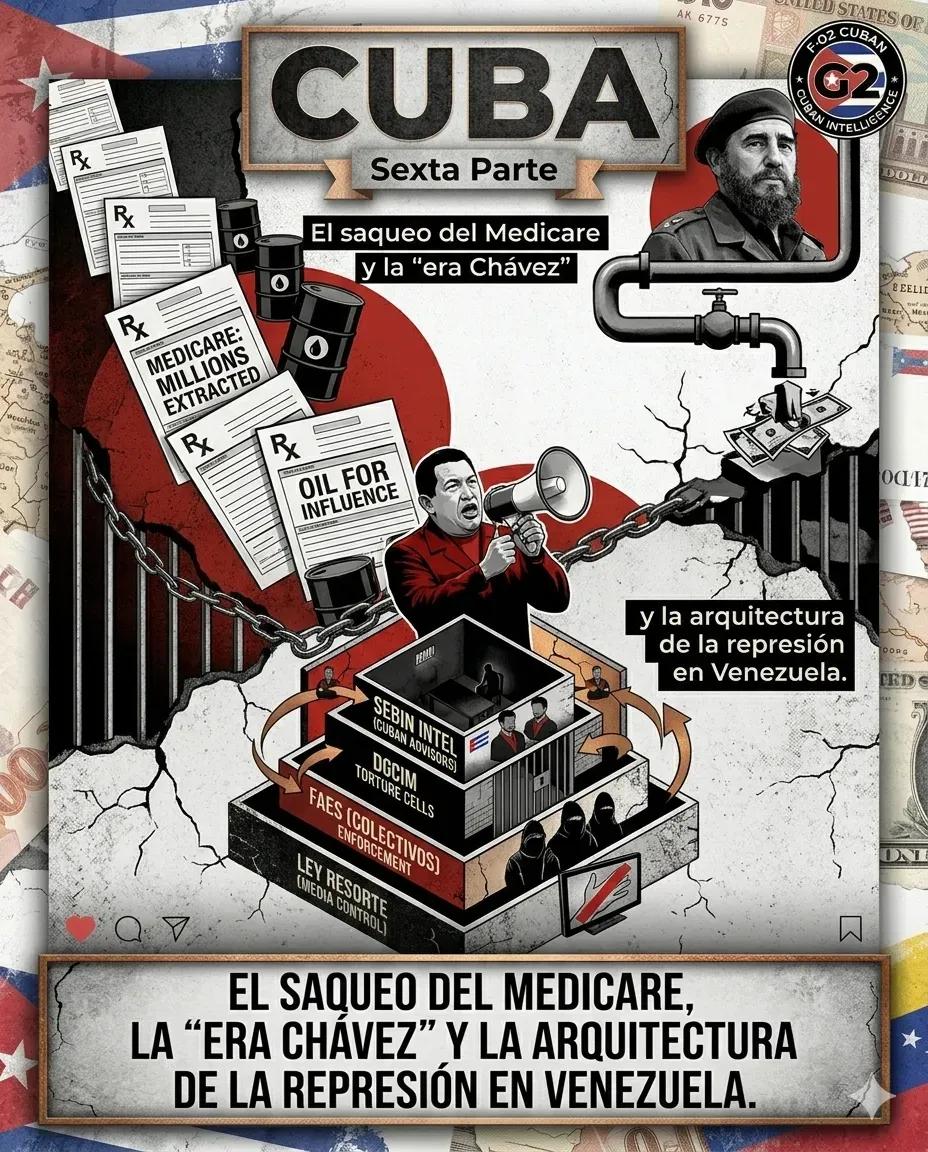
THIRTY YEARS OF LOOTING THE FEDERAL SYSTEM
The Medicare Fraud Strike Force, created in March 2007, has prosecuted more than 5,400 defendants who fraudulently billed over $27 billion in total from its inception until 2025 (U.S. Department of Justice, "National Health Care Fraud Takedown Results in 324 Defendants Charged," June 30, 2025). In fiscal year 2024 alone, criminal recoveries from the program reached $961 million, the highest level in ten years.
The largest operation in the program's history took place in June 2025: 324 defendants nationwide, with an anticipated loss of $14.6 billion, of which 73 defendants were from the Southern District of Florida alone. One of the cases involved a transnational organization that used fictitious foreign owners to submit $10.6 billion in false claims, exploiting the stolen identities of more than a million Americans.
RECENT CASES: NAMES, AMOUNTS, AND SENTENCES
In March 2025, Fernando Espinosa León, a 60-year-old Cuban citizen, was sentenced to five years and ten months in federal prison. His company, Global Medical Supply, submitted fraudulent claims totaling $7.6 million to Medicare between 2016 and 2020. The court ordered the forfeiture of $4 million ("Cuban National Sentenced To Over Five Years In $7.6 Million Medicare Fraud Scheme," HHS Office of Inspector General, March 24, 2025). In May 2025, Julián López, a 55-year-old Cuban citizen residing in Miami-Dade, was sentenced to 30 months in prison through his company One Medical Services: $3.2 million in false claims and a restitution order of $1,496,412.
In July 2025, Magaly Travieso, 54, was sentenced to nine years in federal prison. Her company, ProMed Healthcare, submitted false claims totaling over $20 million between 2019 and 2023. Authorities seized $6 million in assets. In March 2026, a federal court in Miami revoked the U.S. citizenship of Mirelys Cabrera Díaz, a Cuban resident of Hialeah, following her conviction for $6 million in Medicare fraud. The revocation of citizenship as an additional consequence of the criminal conviction marked a precedent in the federal response to the phenomenon.
THE REGIME'S COMPLICITY: MONEY THAT REACHES HAVANA AND NEVER RETURNS
Dr. Mehmet Oz was the highest-ranking official to describe the pattern using the language of institutional complicity. In statements to Fox News in February 2026, he was straightforward: "They are billing five million dollars in one month for nonexistent equipment. Then they flee to Cuba. When we try to recover the money, it has already been transferred abroad" ("Medicare administrator accuses Cubans of fraud and fleeing to Cuba with the money," CiberCuba, February 27, 2026). In April 2026, when interviewed on Fox Business from South Florida, he went further: "We believe the Cuban government is involved" ("Scandal in Florida: Possible links between the Cuban regime and Medicare fraud," CiberCuba, April 7, 2026; "Cuba rejects US claims of involvement in Florida healthcare fraud," AFP, April 9, 2026). When federal agencies try to recover funds, the money is already in Cuba. It is not an interagency coordination failure. It is the designed functioning of a system where Havana acts as both extraction destination and shield of impunity simultaneously.
What the $63 million tracked to Cuban banks in 2012 demonstrated was that the money was crossing the Florida Straits through a financial system controlled by the Cuban state, specifically by GAESA and the Central Bank, and that such transit was impossible without some level of institutional knowledge and tolerance. The Cuban regime, which absolutely controls all banking transactions on the island, cannot be unaware of the money's origin arriving at its banks from networks of shell companies in Miami. Not knowing, in itself, is a form of cooperation.
GAESA: THE REGIME'S BLACK BOX
The Grupo de Administración Empresarial S.A. (GAESA) is the business conglomerate controlled by the Cuban Revolutionary Armed Forces. It controls hotels, airports, telecommunications, remittances, retail, and banking services. Leaked internal documents from 2025, analyzed by the Miami Herald and economist Pavel Vidal from Columbia University's Cuba Capacity Building Project, confirmed that GAESA controlled 95% of the country's foreign currency financial transactions and that its total revenue was 3.2 times greater than the annual revenue of the Cuban state budget (CiberCuba, "GAESA: how a 'socialist' country ended up under the control of an opaque military conglomerate," February 21, 2026). It does not publish financial statements. It has no independent external audit. It does not answer to any public oversight body.
The operational route of money through the GAESA system follows a process of progressive capture. When someone in Miami sends money to Cuba, the transfer goes through FINCIMEX, the Cuban intermediary. Upon reaching the island, the money is converted into MLC —freely convertible currency— but can only be spent in stores and services controlled by the regime: TRD Caribe, CIMEX, Gaviota. Markups on the real cost of imported goods range from 300% to 500%. The MLC recovered by the regime is reconverted into dollars or euros through the Central Bank of Cuba. The money, regardless of its origin, enters the system and does not leave.
What financial intelligence investigations document, with high analytical confidence, is that the regime designed this system so that no flow of foreign currency, whatever its origin, escapes the control of the military conglomerate. The $63 million tracked to Cuban banks in 2012 did not enter that system parallel to the regime; it entered through it. The operational relationship between GAESA and the Cuban military advisory in Venezuela is documented in the section "The Havana-Caracas Axis" of this report.
THE HAVANA-CARACAS AXIS: FROM CHÁVEZ TO MADURO
If there is a chapter in this story that illustrates how far the Cuban model can go when it finds a sufficiently vulnerable and rich state, that chapter is called Venezuela. What Cuba built over decades —military penetration, intelligence control, using the state as a shield— was transplanted, with local adaptations, to the heart of the Venezuelan government.
THE CHÁVEZ ERA: TOTAL ADVISORY IN EXCHANGE FOR OIL
Since 1999, thousands of Cuban advisors have arrived in Venezuela as doctors and teachers for the Chavista social programs. But under that cover operated a different mission: Cuban intelligence cadres and Revolutionary Armed Forces officers restructured Venezuelan security services, installed surveillance systems over the troops themselves, and designed the political control mechanisms that Chávez needed to consolidate power.
In exchange, Venezuela delivered to Cuba between 90,000 and 115,000 barrels of oil daily at preferential prices, according to analysis by economist Daniel Lacalle ("How Maduro, Cuba and their allies stole Venezuela's oil wealth," dlacalle.com, January 11, 2026). Venezuelan oil not only kept the lights on in Havana; it financed the operational capacity of the Cuban intelligence apparatus for a decade and a half.
THE 2008 AGREEMENTS THAT THE UN READ
In May 2008, Cuba and Venezuela signed at least two secret military agreements that transformed the bilateral relationship into an operational alliance. An investigation by Reuters published in August 2019 revealed that these agreements "gave Cuba vast access to the Venezuelan armed forces and broad freedom to spy on and reform them." Under these pacts, Cuban officials were authorized to train Venezuelan soldiers, restructure intelligence agencies, and build an internal surveillance system focused on monitoring the Venezuelan army itself ("Havana's intelligence and military ties exposed after Maduro raid," Fox News, January 5, 2026, citing Reuters investigation, August 2019). The United Nations' Independent International Mission physically reviewed these documents and confirmed their scope, as documented by Havana Times in "The Footprints of Cuban Intelligence in Venezuela" on August 15, 2024.
Retired General Antonio Rivero, exiled in Miami since 2014, was categorical in stating to Diálogo Américas: "In 2008, the presence of Cuban military personnel in Venezuela was consolidated through 15 secret agreements between Cuba and Venezuela to transform the Venezuelan Armed Forces and turn them into the same structure that operates in Cuba." Expert Francisco Cox, in documented testimony before Amnesty International, noted that they physically saw the 2008 memorandum that enabled the creation of a new body within the DGCIM and Cuban training in surveillance, infiltration, and military target determination.
An article published by Infobae in March 2026, titled "Oil for Repression," documented that since the time of Fidel Castro and Hugo Chávez, the Venezuelan regime used up to 105,000 daily barrels of oil as payment to Cuba in exchange for training of security forces, especially intelligence and counterintelligence.
THE MADURO ERA: FROM ADVISORY TO TOTAL DEPENDENCE
With Chávez's death in 2013, Cuba did not lose influence; it deepened it. Nicolás Maduro came to power with a political debt to Havana that he never concealed. Cuban advisors remained present in Venezuelan security services, in Maduro's personal guard, and in the state's intelligence bodies. The relationship shifted from being an alliance between two sovereigns to a functional dependence: Venezuela without Cuba would not know how to oversee its own military.
THE CARTEL OF THE SUNS AND THE CUBAN FOOTPRINT
The capture of Maduro by U.S. forces in January 2026 brought a legal precision that the DOJ had not previously made: the revised accusation abandoned the term "Cartel of the Suns" as a formal organization and replaced it with "a culture of corruption and a patronage system" financed by drug trafficking. That distinction, seemingly technical, has a first-order analytical consequence.
A state patronage system sustained by drug trafficking, without a formal cartel structure, is exactly what Cuba built over decades before the existence of chavismo. The difference is that Cuba was never captured. Venezuela was.
The Cuban participation in the Venezuelan criminal framework operates at several simultaneous levels. At the doctrine level, Cuba provided the conceptual architecture: using the state as a cover for trafficking, with plausible deniability. At the intelligence level, advisors from the Cuban Intelligence Directorate integrated into the DGCIM and SEBIN provided internal surveillance and shielded drug-trafficking military leaders from DEA infiltration. At the political protection level, Cuba diplomatically protected Maduro, and its operatives were part of his personal security. At the logistical level, the Cuban keys functioned as a historical transit point for Venezuelan cocaine on its way to Europe and the United States, according to DEA analyses documented by Cunningham in the Air University Journal of Indo-Pacific Affairs (JOTA, 2024). Cuba is not a peripheral partner in Venezuelan drug trafficking: it is the model that made it possible.
COLLECTIVES, ARAGUA TRAIN AND THE SHADOW OF HAVANA
The link between the Cuban regime and the criminal structures of the Venezuelan state goes beyond the Cartel of the Suns. Cuban advising in social control and repression has also facilitated the consolidation of paramilitary groups such as the collectives and the political protection of mega-bands like the Aragua Train.
The Collectives: Armed Arm with Cuban Doctrine
Venezuelan collectives are irregular armed groups that operate in urban areas under the tolerance and support of the state. Their model has a direct precursor in the Cuban Committees for the Defense of the Revolution (CDR), which have functioned since 1960 as a neighborhood-level social surveillance system. The report from UN High Commissioner Michelle Bachelet published in July 2019 documented that the collectives "have contributed to the deterioration of the situation by exercising social control and helping to repress protests" ("UN Human Rights report on Venezuela urges immediate measures to halt and remedy serious violations," OHCHR, July 4, 2019). Testimonies from Venezuelans who fled the country and analysis from Human Rights Watch document that the collectives adopted community control tactics and selective repression that experts recognize as derived from Cuban security doctrine.
The Aragua Train: From State Prison to Transnational Network
The Aragua Train was born within the Tocorón prison, Aragua, with the explicit tolerance of the Venezuelan state (Encyclopaedia Britannica, "Aragua Train," updated March 9, 2026; "Weaponized Chaos: The Rise of the Aragua Train as Venezuela's Paramilitary Instrument," Center for a Secure Free Society, November 18, 2025). In a penitentiary system where the regime delivered internal control of prisons to the gangs themselves, the organization grew to operate in Chile, Colombia, Peru, Ecuador, and, more recently, the United States. The logic of letting armed groups grow when they are politically useful, and then exporting their consequences, is precisely the Cuban logic of Mariel, applied four decades later in Venezuela.
The question that the "
CUBA Y LA ARQUITECTURA DE LA REPRESIÓN EN VENEZUELA: HOMICIDIOS, DESAPARICIONES Y TORTURA
What Cuba installed in Venezuela starting from the secret agreements of 2008 was not just a reform of the intelligence services. It was a complete system of control, surveillance, and selective extermination, calibrated to ensure the regime's permanence above any legal or humanitarian consideration. The UN Independent International Fact-Finding Mission, Human Rights Watch, Amnesty International, the Venezuelan Penal Forum, PROVEA, and the CASLA Institute have documented the measurable consequences of this system: thousands dead, thousands tortured, and hundreds forcibly disappeared. What the numbers also show is that Cuba was not a peripheral collaborator in those crimes. It was their architect.
The lethal violence of the Venezuelan state under Maduro cannot be read as common crime. It is planned institutional violence, executed by security bodies that operated with Cuban advisory. In 2017, Venezuela recorded a rate of 56.8 homicides per 100,000 inhabitants, the highest in South America according to the Global Study on Homicides by the United Nations Office on Drugs and Crime (UNODC, "Global Study on Homicide," 2018). But that official figure did not include the murders committed by the state security forces themselves, euphemistically cataloged as cases of "resistance to authority."
When the UN High Commissioner, Michelle Bachelet, published her report in July 2019, she revealed that the Venezuelan government had reported to its own agencies 5,287 deaths at the hands of security forces in 2018, and another 1,569 in the first five months of 2019: a total of almost 7,000 people killed by the state in a year and a half. The High Commissioner described that figure as "surprisingly high" and pointed out that many could constitute extrajudicial executions ("UN Human Rights report on Venezuela urges immediate measures to halt and remedy serious violations," OHCHR, July 4, 2019). The main perpetrator was the elite group of the Special Actions Forces —the FAES— created in 2016 under the institutional framework designed with Cuban advisory.
Human Rights Watch confirmed in September 2019 that since 2016, nearly 18,000 people had died at the hands of security forces in situations of alleged "resistance to authority" ("Venezuela: Extrajudicial executions in low-income areas," Human Rights Watch, September 18, 2019). The records from PROVEA complete the accumulated picture: between 2010 and 2018, 23,688 people died at the hands of the Venezuelan state security forces, according to official figures provided to the United Nations system, with 69% of those cases concentrated between 2016 and 2018, the period of greatest consolidation of Cuban influence in the intelligence and control apparatus of the Venezuelan state.
About the Author
William L. Acosta graduated from PWU and Alliance University. He is a retired police officer from the New York City Police Department, a former military personnel of the United States Army, and the founder and CEO of Equalizer Private Investigations & Security Services Inc., an agency licensed in New York and Florida with international reach. Since 1999, he has led investigations in narcotics, homicides, and missing persons cases, as well as participating in criminal defense at both state and federal levels. A specialist in international and multi-jurisdictional cases, he has coordinated operations in North America, Europe, and Latin America.

Comments