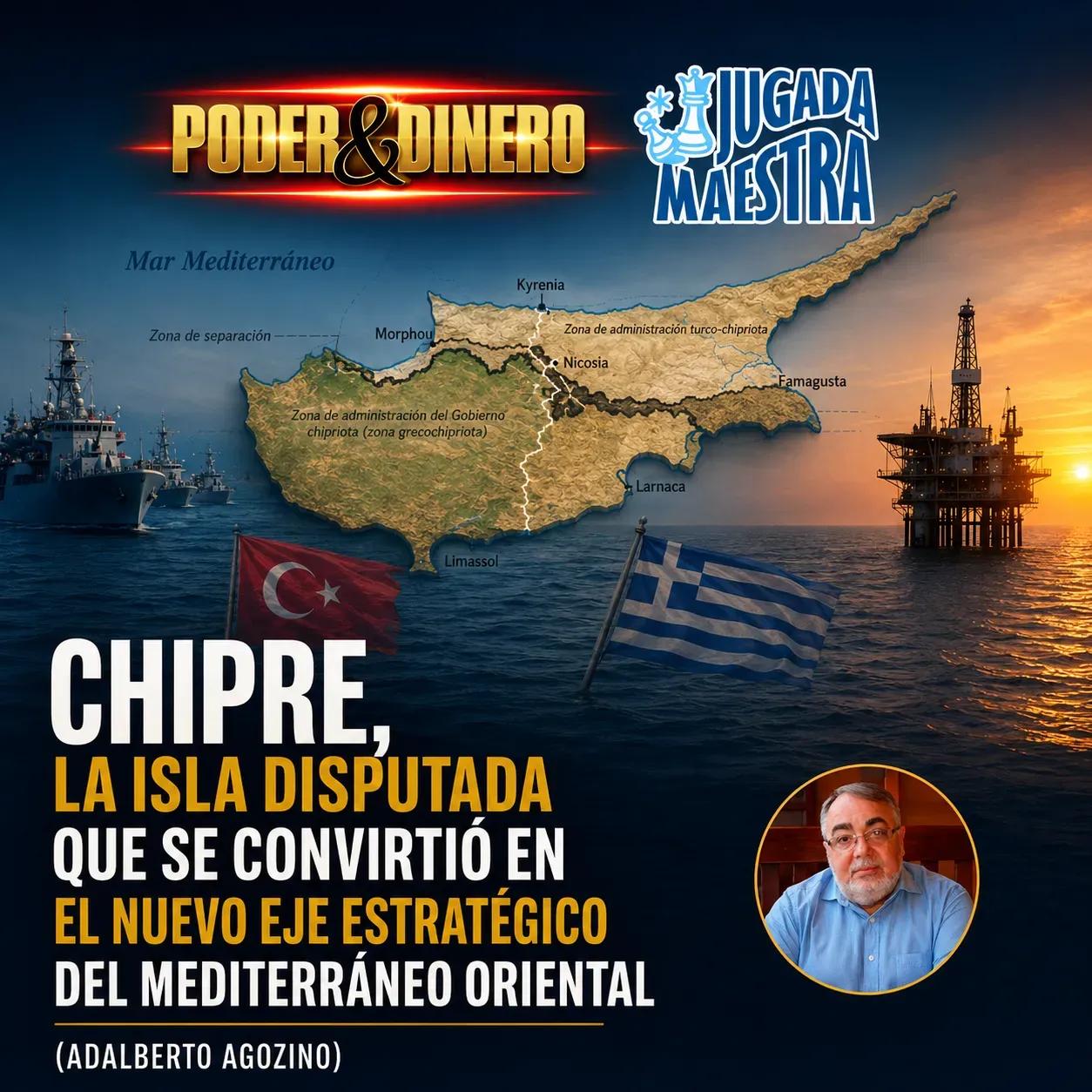
In the heart of the Eastern Mediterranean, where Europe approaches the Middle East and where maritime routes link the Suez Canal with European coasts, the small island of Cyprus has regained a geopolitical centrality that seemed reserved solely for great powers. For centuries, Phoenicians, Persians, Romans, Byzantines, Venetians, Ottomans, and British understood the strategic value of this territory located off the coasts of Syria, Lebanon, and Turkey. Today, in the 21st century, that ancient status as a decisive enclave has acquired a new dimension marked by energy rivalry, military tensions, and disputes over political control of the Eastern Mediterranean.
The Republic of Cyprus, a member of the European Union since 2004, remains the only European state partially occupied by foreign forces. Since the Turkish military intervention of 1974, the northern part of the island has remained under the control of Ankara and the self-proclaimed "Turkish Republic of Northern Cyprus", recognized only by Turkey. This territorial fracture not only conditions internal Cypriot politics but has also become one of the most persistent focal points of tension between Greece and Turkey, two nominal allies within NATO that maintain deep strategic, historical, and maritime differences.
The island, located just over a hundred kilometers from the Syrian and Turkish coasts, constitutes a fundamental piece for understanding the security architecture of the Eastern Mediterranean. Its geographical position transforms it into a bridge between Europe, Asia, and Africa, but also into a military and energy platform of enormous value. It is no coincidence that the United Kingdom has maintained the sovereign bases of Akrotiri and Dhekelia on Cypriot territory, deemed essential for British and Western operations in the Middle East. It is also not coincidental that the European Union observes with increasing interest the stability of the island in a context marked by the war in Ukraine, energy insecurity, and regional competition.
The strategic relevance of Cyprus has intensified particularly following the discovery of significant natural gas fields in the seabed of the Eastern Mediterranean. The reserves detected off the coasts of Israel, Egypt, and Cyprus itself profoundly altered the regional balance and opened the possibility of turning this region into an energy alternative for Europe in the face of dependence on Russian gas.
In Cypriot waters, the discovery of the Aphrodite field and the exploration of new maritime blocks have awakened the interest of major international companies and reinforced Nicosia's conviction that the country could transform into a major energy player. However, those discoveries also multiplied tensions with Turkey, which rejects the maritime agreements signed by Cyprus with Egypt, Israel, and Greece, claiming that both the Turkish Cypriot community and Ankara hold rights over part of those resources.
For years, Turkish prospecting vessels accompanied by military units have operated in maritime areas claimed by the Republic of Cyprus, generating recurring diplomatic crises with the European Union. Nicosia has denounced these drilling activities as violations of its sovereignty and successfully pushed Brussels to approve sanctions against individuals responsible for the explorations deemed illegal. Thus, the energy conflict has become integrated into a much broader dispute linked to the control of exclusive economic zones and the redefining of power in the Eastern Mediterranean.
Behind this confrontation lies the historic rivalry between Greece and Turkey, marked by decades of mutual distrust, territorial disputes, and traumatic memories. For Athens, the Turkish military presence in northern Cyprus constitutes an unacceptable occupation that threatens regional stability. For Ankara, however, the 1974 intervention was a necessary response to the coup promoted by factions favoring the union of the island with Greece. Since then, the Cypriot conflict has become an extension of the strategic competition between the two Aegean powers.
Tensions are not limited solely to Cyprus. They also encompass maritime boundaries in the Aegean Sea, airspace control, and disputes over hydrocarbon-rich continental shelves. In this complex game, Cyprus occupies a crucial place because it allows projecting military and energy influence towards the Middle East and North Africa.
In recent years, Nicosia has responded to Turkish pressure by strengthening a network of regional alliances that redefine the political map of the Eastern Mediterranean. The trilateral cooperation between Cyprus, Greece, and Israel has become one of the most significant strategic phenomena in the region. The three countries share common interests linked to maritime security, energy exploitation, and the containment of Turkish expansion.
The rapprochement between Cyprus and Israel is particularly revealing of contemporary geopolitical transformations. For decades, Israel maintained a close strategic cooperation with Turkey. However, the deterioration of relations between Ankara and Tel Aviv has pushed Israel to seek new regional partners. Cyprus then emerged as a natural ally due to geographical proximity, political affinity, and energy convergence.
Joint military maneuvers, technological cooperation agreements, and projects linked to gas transportation have solidified an increasingly deep relationship between the two countries. The EastMed pipeline project, promoted together with Greece, symbolized this new strategic architecture aimed at transporting gas from the Eastern Mediterranean to Europe without passing through Turkish territory. Although economic and technical difficulties have slowed its development, the project retains a strong geopolitical charge because it represents the will to create an alternative energy axis in the region.
Greece, for its part, considers Cyprus an essential component of its Mediterranean strategy. Military and diplomatic cooperation between Athens and Nicosia has intensified steadily in the face of a shared perception of an increasingly assertive Turkey under the leadership of Recep Tayyip Erdoğan. The presence of Turkish troops in the northern part of the island, estimated in tens of thousands of personnel, continues to be viewed by the Cypriot government as the main threat to its national security.
Meanwhile, Cyprus has developed increasing ties with Egypt and several moderate Arab countries, seeking to establish itself as a diplomatic bridge between the European Union and the Middle East. The Cypriot president himself, Nikos Christodoulides, has insisted on presenting the island not only as a country marked by Turkish occupation but also as a regional actor capable of playing a relevant role in Mediterranean stability and in relations between Europe and the Arab world.
The war in Gaza and the growing regional instability further reinforced Cyprus's strategic importance. Its proximity to Israel and Lebanon has turned the island into a fundamental logistical center for evacuations, humanitarian operations, and diplomatic coordination. The European Union has begun to see Cyprus not only as a small peripheral state but as an indispensable platform for European projection towards the Middle East.
At the same time, the island tries to prevent the issue of occupation from completely monopolizing its international image. For years, Cypriot diplomacy has been almost exclusively focused on denouncing the Turkish presence and seeking international support for reunification. Today, without abandoning that claim, Nicosia aspires to project itself as a modern, dynamic, and strategic actor within the European architecture.
However, the conflict remains deeply rooted. The Green Line that divides Nicosia continues to be one of the most visible symbols of contemporary European fragmentation. Patrolled by United Nations forces for decades, this demilitarized zone serves as a daily reminder that the Greco-Turkish confrontation in the Eastern Mediterranean has never fully ended in Cyprus. The enormous flag of the self-proclaimed Turkish Cypriot republic visible from the capital constitutes, for many Greek Cypriots, a constant expression of occupation.
The reunification negotiations driven by the United Nations have gone through successive failures. The so-called Crans Montana process, regarded at one time as the most serious opportunity to reach a definitive agreement, ended without concrete results. The growing distrust between the parties, differences over the institutional model, and the issue of Turkish military guarantees continue to block any stable solution.
Despite this, Cyprus maintains notable economic and political stability compared to much of the region. Its membership in the European Union, the development of the financial sector, tourism, and the expectation of energy exploitation have contributed to strengthening its international position. Furthermore, the island has managed to establish itself as an important center for services and trade between Europe and the Middle East.
In an era marked by the return of competition between powers and the increasing militarization of energy routes, Cyprus once again occupies a disproportionately important place relative to its size. The island simultaneously represents a European border, a Western military platform, a potential energy node, and a stage where the ambitions of Turkey, Greece, Israel, and great international powers converge.
The history of Cyprus demonstrates that the Eastern Mediterranean continues to be one of the most sensitive areas on the planet. Where continents, religions, energy interests, and imperial memories intersect, geography continues to shape politics. And few nations embody this reality better than this small divided island, situated at the very center of the geopolitical turmoil of the 21st century.
Adalberto Agozino is a Doctor of Political Science. Professor at the National Gendarmerie University Institute and the National Defense Faculty of Argentina. Director of the Argentine Institute of Geostrategic Studies. Editor of Alternative Press Agency. Expert on Maghreb issues.

Comments