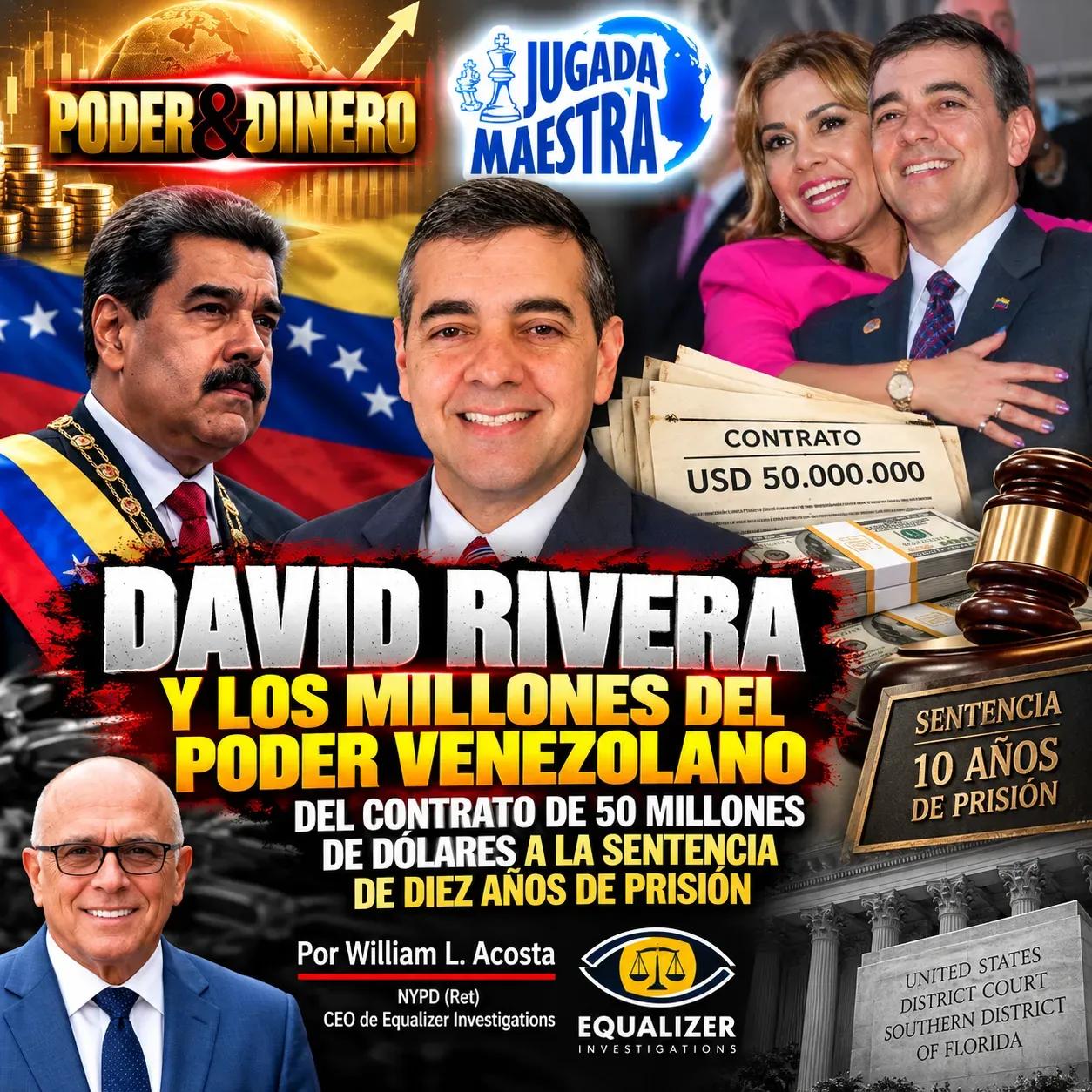
On October 2, 2026, a federal court in Miami sentenced former congressman David Rivera to ten years in prison. The sentence punished an operation that sought to leverage Rivera's political connections in the United States to open doors for the Venezuelan government. The jury had found Rivera and Esther Nuhfer guilty on May 1. The trial proved that they acted as foreign agents without fulfilling the mandatory registration and that they committed financial crimes related to that work (Department of Justice, “Former US Congressman Sentenced”; “Former U.S. Congressman and Lobbyist Convicted”).
To understand the case, it is necessary to reconstruct how Rivera reached Nicolás Maduro's environment and what happened to the money from the contract. The file also requires distinguishing the responsibility of the convicted from the role of those who participated as intermediaries, officials, or witnesses.
The Venezuelan door opened after Congress
Rivera represented Florida in the federal House of Representatives between 2011 and 2013. The contacts that led to the Venezuelan contract were established after his exit from Congress, in late 2016 or early 2017. According to the testimony of Hugo Perera gathered by the press, Nuhfer organized the meeting between Perera and Rivera; Perera, in turn, introduced them to the Venezuelan businessman Raúl Gorrín. The four met in Coral Gables and Fisher Island. Gorrín offered access to Maduro and then-Foreign Minister Delcy Rodríguez (“He’s the Star Witness”).
Therefore, the documented connection with Venezuelan leaders did not originate from an official mission by Rivera as a congressman. It developed while he acted as a private consultant. However, his political career had allowed him to cultivate relationships with influential people in the United States. That access was of interest to those seeking interlocutors in Washington.
The original indictment describes the presentations in early 2017 and the efforts to obtain U.S. political support. It attributes to Rodríguez the order that CITGO executives hire Interamerican Consulting, Rivera's firm, through PDV USA. It identifies Maduro and Rodríguez by name; other participants are described with anonymous designations. This formulation is an allegation by the prosecution, not an individual condemnation of the Venezuelan officials (U.S. District Court for the Southern District of Florida, Indictment, paras. 4–5 of count 1).
Fifty million agreed and twenty million collected
The contract, dated March 21, 2017, had a nominal value of 50 million dollars for three months of consulting. That figure was the agreed price, not the money Rivera ended up keeping. At the commencement of the trial in March 2026, prosecutor Roger Cruz stated that he received approximately 20 million. The defense maintained that it concerned commercial services and efforts to help the Venezuelan opposition, not to favor Maduro (“Former US Congressman Secretly Lobbied”; U.S. District Court for the Southern District of New York 1–4).
The indictment records, among other payments, a transfer of five million dollars received on October 27, 2017, from a PDVSA account at Gazprom Bank, Russia. The document also notes that Rivera continued to claim 30 million pending in December 2018. The 50 million agreed and the 20 million received from the operation do not equate to Rivera's personal profit: the cited sources do not establish how much he retained after payments to third parties (Southern District of Florida District Court, Indictment, paras. 78 and 91 of count 1).
Part of the funds went to collaborators. According to coverage of the litigation documents, Perera received around five million dollars for facilitating the presentations. The coverage of the sentence also describes a transfer of 3.75 million to a company servicing Gorrín's yacht, justified, according to the prosecution, by simulated agreements. These are destinations of the money that help explain the distribution, not amounts that should be added as additional personal income for Rivera (Camacho; Goodman, “Former GOP Rep.”).
The official statement of the sentence indicated that Rivera deposited approximately 1.5 million dollars from the contract into his state campaign account between March 2017 and August 2018. The previous announcement of the verdict mentioned around 600,000 dollars used to finance the campaign. The first figure corresponds to deposits and the second to campaign expenses. The sources do not provide a detailed accounting breakdown explaining the relationship between the two (Department of Justice, “Former US Congressman Sentenced”; “Former U.S. Congressman and Lobbyist Convicted”).
What was his motive? The prosecution argued that the defendants intended to enrich themselves through political representation which they concealed from the U.S. government. The payments and use of resources in the campaign support the economic dimension of that theory. The defense disputed the nature of the work. The file does not attribute to him a personal affiliation with Chavismo nor any motive that has not been demonstrated.
From the federal indictment to the verdict in Miami
The Miami case carries number 1:22-cr-20552. The original indictment presents a seal dated November 16, 2022; a subsequent court resolution identifies November 17 as the date of the original indictment. The documentation consulted does not clarify this discrepancy. Rivera was arrested in Atlanta on December 5 and was initially released on bail (U.S. District Court for the Southern District of Florida, Indictment 1; “Order on Defendant Esther Nuhfer’s Motion for Judgment”; Goodman and Spencer).
On December 14, 2023, the grand jury issued a superseding indictment, recorded the following day as document 122. It added two counts against Rivera for false tax returns and one for attempted tax evasion. These charges must be distinguished from the offenses submitted to the May 2026 verdict. The coverage of the October sentence described them as pending (U.S. District Court for the Southern District of Florida, “Order on Defendant Esther Nuhfer’s Motion for Judgment”; “Ex-Congressman and Rubio Ally”).
Before the trial, the parties also litigated over assets that could be seized. On December 12, 2025, the Eleventh Circuit confirmed the preventive immobilization of a property belonging to Rivera in New Smyrna Beach. That appeal, number 24-11161, referred to those assets; it did not resolve Rivera's guilt (Eleventh Circuit Court of Appeals 1–5).
The trial began on March 23, 2026, before Judge Melissa Damian. On April 15, the judge rejected a petition from Nuhfer aimed at obtaining a judicial acquittal regarding the conspiracy theories and aiding and abetting the commission of the crime. On May 1, the jury found both guilty. Rivera was detained after the verdict; the court coverage indicated the flight risk as the basis for this decision (U.S. District Court for the Southern District of Florida, “Order on Defendant Esther Nuhfer’s Motion for Judgment”; Department of Justice, “Former U.S. Congressman and Lobbyist Convicted”; Goodman, “Former Miami Congressman”).
Rivera was found guilty of seven counts and Nuhfer of four
The superseding indictment contained a total of eleven counts, distributed among the defendants. They were not eleven counts against each. The table distinguishes the charges judged from the tax charges added to the indictment:
Charge
Conduct and standard
Defendant and outcome
1. Conspiracy to act as an unregistered foreign agent. 18 U.S.C. § 371 and 22 U.S.C. §§ 612(a), 618(a).
Rivera and Nuhfer. Both guilty.
2. Deliberate acting as a foreign agent without registration under FARA. 22 U.S.C. §§ 612(a), 618(a)(1).
Rivera and Nuhfer. Both guilty.
3. Conspiracy to commit money laundering. 18 U.S.C. § 1956(h).
Rivera and Nuhfer. Both guilty.
4, 5, 7, and 8. Monetary transactions involving property derived from unlawful activity exceeding 10,000 dollars. 18 U.S.C. § 1957.
Rivera. Guilty of all four counts.
6. Monetary transaction involving property derived from unlawful activity. 18 U.S.C. § 1957.
Nuhfer. Guilty.
9 and 10. Filing false tax returns. 26 U.S.C. § 7206(1).
Rivera. Separate charges from the FARA and money laundering verdict; described as pending in October.
11. Attempt to evade taxes. 26 U.S.C. § 7201.
Rivera. Separate charge from the May verdict; described as pending in October.
Sources: original indictment, counts 4–8; ruling on April 15, 2026, on the superseding indictment; official announcement of the verdict on May 1; coverage of the sentence on October 2. Counts 2–8 also included the aiding and abetting theory provided in 18 U.S.C. § 2. This theory of liability did not constitute an additional charge. FARA is the English acronym for the Foreign Agents Registration Act.
Nuhfer received five years in prison on August 18, 2026. Rivera received ten years on October 2. The sentences do not establish by themselves the dates of release. Rivera's defense announced that it would appeal (Department of Justice, “Former US Congressman Sentenced”; Supall; Goodman, “Former GOP Rep.”).
The Venezuelan leaders and the intermediaries
Rodríguez occupies a central place in the prosecution's version: she would have promoted the hiring and the approach to Washington. Maduro appears as the leader whose government aimed to improve its relations with the United States. Neither was charged in case 22-cr-20552 (U.S. District Court for the Southern District of Florida, Indictment 3, 6).
Gorrín was the business and political link that allowed bringing U.S. contacts to that Venezuelan environment. Perera was the intermediary who made the presentations and later collaborated with the prosecution. According to trial coverage, Perera was not charged along with Rivera and Nuhfer. His business participation and the interest he might have in cooperating must be taken into account when contrasting his testimony with the communications and financial records (“He’s the Star Witness”; Camacho).
In the subsequent Washington case, number 1:24-cr-00570-EGS, the grand jury indicted Rivera on December 17, 2024. The Department of Justice announced it the following day. There, it was alleged that he received more than 5.5 million dollars to manage, between June 2019 and April 2020, Gorrín’s removal from the OFAC sanctions list. The indictment includes alleged violations of FARA and financial crimes. These are payments from another period, investigated in a different file than that which led to the Miami sentence (District Court for the District of Columbia 1; Department of Justice, “Former Member of Congress Charged”).
The U.S. contacts and their limits
Marco Rubio declared on March 24, 2026, that Rivera had not informed him of the Venezuelan contract. He explained that he would have reacted differently had he known. Pete Sessions participated in contacts and meetings about Venezuela and testified as a witness. Brian Ballard, whose firm represented Globovisión, also testified; he stated that he broke with Rivera when he learned of the 50 million contract. Susie Wiles was registered as a lobbyist for Globovisión at Ballard Partners, and the defense sought her testimony. None of those four were charged in the trial of Rivera and Nuhfer (Goodman, “Rubio Testifies”; “Trump Ally Testifies”).
The testimonies of Rubio and Ballard raise a central question: what did the U.S. interlocutors know about the contract and about who was financing the efforts? A covert operation can leverage trusted relationships without revealing to its participants the true source of the money.
The other cases linked to Gorrín
Gorrín's judicial environment includes offenses distinct from clandestine lobbying. His case 18-cr-80160-WPD began on August 16, 2018, with an accusation of conspiracy to violate the U.S. law against bribery of foreign officials, conspiracy to commit money laundering, and nine counts of money laundering. On December 15, 2020, the indictment was expanded to include Claudia Patricia Díaz Guillén and Adrián José Velásquez Figueroa. That file documents a distinct operation from that investigated in Rivera's trial (Department of Justice, “United States v. Raul Gorrin Belisario, Docket”; U.S. District Court for the Southern District of Florida, Superseding Indictment, 18-cr-80160).
Alejandro Andrade Cedeño, former Venezuelan treasurer, was prosecuted in case 17-cr-80242-RLR, initiated on December 18, 2017. He pleaded guilty four days later and received ten years in prison on November 27, 2018. He admitted to accepting more than a billion dollars in bribes from Gorrín and other participants in exchange for favoring currency operations (Department of Justice, “United States v. Alejandro Andrade Cedeño, Docket”).
Gabriel Arturo Jiménez Aray, former owner of Banco Peravia, was processed in case 18-cr-80054-RLR, initiated on March 12, 2018. He pleaded guilty on March 20 and received three years in prison in November of that year. He admitted to having contributed to laundering bribes and benefits from the operation through the bank. His case is related to Gorrín, not to a conviction for the charges in Rivera's trial (Department of Justice, “United States v. Gabriel”; “Former Owner”).
Díaz Guillén and Velásquez were found guilty on December 13, 2022. They originally received fifteen years each on April 19, 2023, for money laundering offenses related to Gorrín's bribes. The Stanford legal tracking database records a new sentence on March 11, 2024, which reduced both sentences to twelve years. The update is important: citing only the initial fifteen years would give an incomplete picture of their procedural situation (Department of Justice, “United States v. Claudia”; “Former Venezuelan National Treasurer and Her Husband”; Stanford).
On October 23, 2024, Gorrín was also charged in case 24-cr-20468-Altman/Lett for an alleged money laundering conspiracy of $1.2 billion related to exchange contracts with PDVSA. The consulted documentation presents him as a defendant, not as convicted for that charge. The sentences of Andrade, Jiménez, Díaz, and Velásquez are not sentences imposed on Gorrín (Department of Justice, “Venezuelan Television”; “United States v. Raul Gorrin Belisario”).
Public trust turned into merchandise
The facts show how the operation worked: intermediaries with access to Venezuelan power found a way to U.S. leaders through a former congressman; a business contract provided the resources; the political representation remained hidden. Those who conducted these dealings had to comply with the legal obligations of registration and transparency applicable to their activity.
The diplomatic outcome of the dealings does not solely determine criminal liability. An attempt at influence can create legal obligations even if it does not change a public policy. Similarly, a high-value contract does not automatically constitute a crime. The jury had to determine whether the defendants deliberately violated FARA and committed the alleged financial crimes. The magnitude of the payments provided context; it did not replace that evidence.
For those of us investigating criminal cases, the file leaves a practical lesson: a personal relationship can guide an investigation, but liability must be sustained by evidence. Contracts, transfer records, communications, and corroborated testimonies allow us to reconstruct who was involved, what was done, and what was known.
Rivera received ten years in prison for using his political access in a foreign representation that he kept hidden. The case shows how contacts acquired in public life can turn into a private business financed from abroad. Telling it rigorously requires following the money, explaining judicial decisions, and attributing to each person only the conduct that the evidence allows to support.
Documentary appendix and reading criteria
The file number identifies the case; the ECF number identifies a document within it. In Miami, 1:22-cr-20552 corresponds to the process; ECF 3 corresponds to the original indictment and ECF 122 to the substitute indictment. These are not crime or sentence numbers. In Washington, 1:24-cr-00570-EGS corresponds to the additional case and ECF 1 to its indictment.
Exact times of arrest, verdict, or sentencing are not published because the sources used do not allow verification. The time of publication of news does not equal the time of the hearing.
Dates that require distinction: Rivera's original indictment bears the stamp of November 16, 2022, while a later resolution mentions the 17th. For Jiménez, the coverage of the judicial calendar places the hearing on November 29, 2018; the official statement of the 30th states that he was sentenced that day. The article retains the month because the sources do not allow resolving that discrepancy.
The reduction to twelve years for Díaz and Velásquez is expressly attributed to the Stanford database and is corroborated by information from MLex on March 11, 2024. The official announcement from 2023 documents the original sentence; it is not utilized as if it reflected the later sentence.
The analysis of contacts is supported by Perera's testimony gathered by the press; the identification of Venezuelan leaders and charges is contrasted with judicial documents. The individuals the accusations keep anonymous do not receive conjectural identities.
The bibliography retains the original titles to facilitate their location. Parenthetical citations refer to the institutional author or to the beginning of the title when no signature has been verified. Some documents are provided through public reproductions of the file.
There is no indictment against Maduro, Delcy Rodríguez, Hugo Perera, Marco Rubio, Pete Sessions, Brian Ballard, or Susie Wiles within the criminal case examined here in Miami. Therefore, no formal accusation is attributed to them in that process. Any imputation in another case must be identified separately. Documents relating to Gorrín's other operations are included for their connection to that intermediary, without presenting them as part of Rivera's trial.
About the author
William L. Acosta is a graduate of PWU and Alliance University, a veteran of the U.S. Army, and a retired officer of the New York City Police Department (NYPD). He is the founder and CEO of Equalizer Private Investigations & Security Services Inc., an agency licensed in New York and Florida with international reach.
Since 1999, he has directed investigations related to narcotics, homicides, and missing persons, in addition to working on defense investigations in state and federal cases. His experience includes international and multijurisdictional cases, as well as the coordination of operations in North America, Europe, and Latin America.
Comments