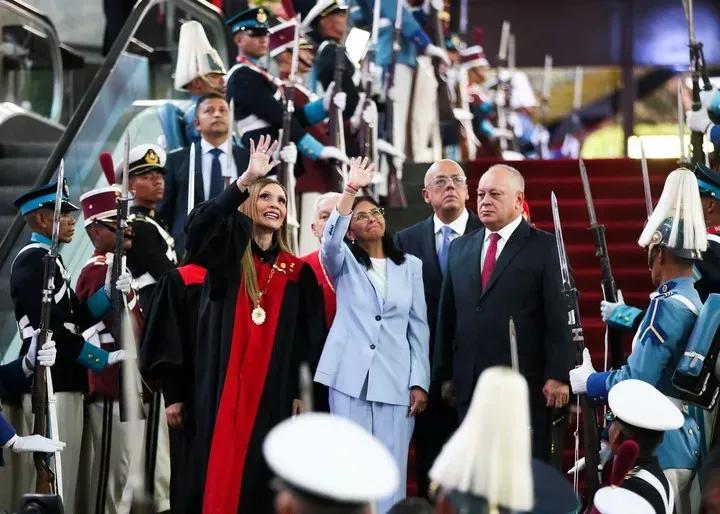
The announcement was solemn, measured, and carefully staged. From the headquarters of the Supreme Court of Justice and without the presence of the press, the acting president of Venezuela, Delcy Rodríguez, announced two decisions of high political impact: the closure of El Helicoide and the promotion of an amnesty law for political prisoners. In a country accustomed to grandiloquent announcements, the message sought to convey order, control, and a willingness to normalize.
The closure of El Helicoide touches a deep chord in Venezuela's recent history. For years, that building condensed the darkest side of state power: arbitrary detentions, allegations of torture, isolation, and fear. Its mere existence served as a warning. Therefore, its closure cannot be read as an administrative fact or a simple change of building destiny. Closing El Helicoide implies, at least on the symbolic level, admitting that serious and systematic abuses were committed there.
However, the problem does not lie in the announcement but in its reach. A torture center can be closed by decree, but the practices that made it possible do not disappear automatically. As long as there are no institutional guarantees, clear political responsibilities, and mechanisms to prevent recurrence, the risk is that the closure functions as a narrative cleansing operation rather than a real turning point.
The announced amnesty law operates in that same zone of ambiguity. The official discourse invokes coexistence, respect, and the need to leave confrontation behind. But genuine coexistence is not decreed; it is built, and it starts with a basic principle: no one should be imprisoned for thinking differently. Any amnesty that does not lead to the full and unconditional release of all those detained for political reasons is incomplete from the start.
Previous experiences feed skepticism. Many releases in Venezuela have been accompanied by restrictive measures that prolong the punishment outside of prison. Prohibitions on speaking, limitations on movement, permanent judicial controls. Fragile, monitored, reversible freedoms. Under that scheme, amnesty runs the risk of becoming a tool for conflict management rather than a fundamental solution.
The international context explains part of the urgency. The United States has explicitly conditioned any progress in the bilateral relationship to concrete signals regarding human rights and the release of detainees. Economic and diplomatic pressure is real and growing. In that framework, the closure of El Helicoide and the amnesty also function as messages to the outside, aimed at showing a willingness to change without altering the internal balances of power.
The figures once again unveil the problem. Official numbers on releases do not coincide with each other and diverge from the surveys conducted by human rights organizations. This gap is neither technical nor casual. It is political. It reflects a logic of opacity that clashes head-on with any claim to genuine reconciliation.
The case of the foreign citizens detained in Venezuela, including Argentines, reinforces that perception. Requests for international mediation show that trust in internal institutional channels is limited. And when justice does not generate trust, amnesty loses credibility.
Since 2014, more than 18,000 people have been detained for political reasons in Venezuela. Thousands have regained their freedom, but many remain subject to restrictions that condition their daily lives. That fact should be enough to establish an undeniable ethical minimum. It is not enough to release a few or to close an emblematic building. The only legitimate way out is full freedom for all unjustly detained individuals and an end to political persecution as a method of governance.
Closing El Helicoide may be a necessary step. Promoting an amnesty may also be necessary. But neither gesture will be sufficient if not accompanied by a deeper and more uncomfortable decision for power: to accept that no coexistence is possible while a single political prisoner remains. The recent history of Venezuela, and the experience of those who still await justice, makes that clear.

Comments