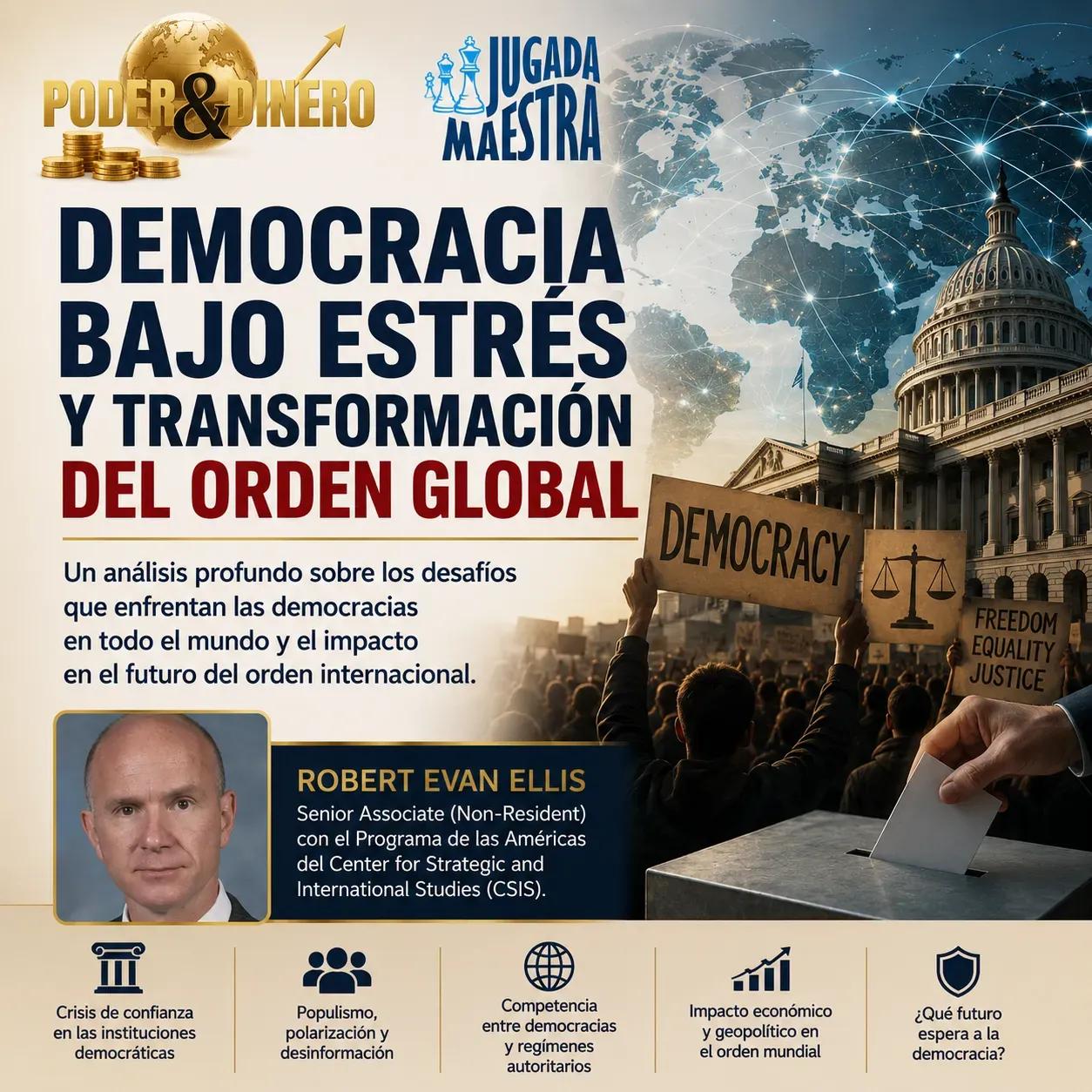
“Democracy under stress and the transformation of the global order”, by Robert Evan Ellis, analyzes the convergence of factors that, according to the author, are simultaneously weakening democracy, prosperity, and international security.
Ellis argues that citizen frustration with governments that fail to respond to material problems, insecurity, and corruption is fueling the growth of populist and authoritarian alternatives. This is compounded by the impact of social media and artificial intelligence, which facilitate the circulation of information but also misinformation, polarization, and manipulation.
One of the main axes of the analysis is the rise of China and its increasing capacity to offer an alternative model to the Western one. Ellis warns that the surveillance and control technologies developed by Beijing can enormously enhance states' ability to control their citizens and notes that some of these technologies have already been incorporated by Latin American governments.
The author also identifies a transformation of the international order based on rules, driven by China's growing power, Beijing's cooperation with authoritarian governments, and a diminished U.S. commitment to traditional multilateral institutions. Concurrently, drones, artificial intelligence, cyber warfare, and autonomous systems are granting small states and non-state actors capabilities to challenge much larger powers.
Another central point is the economic impact of AI and robotics. Ellis warns that automation could destroy jobs at a faster rate than societies can create new occupations, provoking social and political tensions that could again strengthen populist and authoritarian movements.
Finally, Ellis posits that China could progressively surpass the United States in areas such as technology, artificial intelligence, robotics, economy, and strategic influence. He considers particularly sensitive the competition for the Indo-Pacific, Taiwan, and the growing Chinese presence in Latin America.
His conclusion is that democracies must strengthen their institutions, education, transparency, technological capacity, and international alliances. For Ellis, preserving freedom, the rule of law, and individual rights will be fundamental in the face of a global scenario characterized by greater competition between democracies and authoritarian regimes, technological revolution, and possible geopolitical shocks.
Robert Evan Ellis — Senior Associate (Non-Resident), Americas Program, Center for Strategic and International Studies (CSIS).

Comments