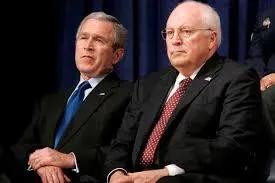
Image of Vice President Dick Cheney alongside former President George W. Bush
The former Vice President of the United States, Dick Cheney, passed away at the age of 84. According to reports from his family, he died due to complications arising from pneumonia and cardiovascular disease, having suffered from heart problems since the age of 37 and only receiving a heart transplant in 2012.
Cheney was born on January 30, 1941, in Lincoln, Nebraska. He attended Yale University on a scholarship but did not finish his studies. Years later, he attended the University of Wyoming, where he earned a bachelor's and master's degree in political science. At just 34 years old, he became Chief of Staff during the Republican presidencies of Richard Nixon and Gerald Ford (1969-1977 respectively), before spending a decade in the House of Representatives. From 1978, he was elected as the representative for the at-large congressional district of Wyoming in the U.S. House of Representatives until 1989.
During the presidency of George H.W. Bush (1989-1993), he served as Secretary of Defense and led the Pentagon during the Gulf War in 1991 when Iraq, led by Saddam Hussein, invaded Kuwait to seize its oil reserves to address the economic deficit Iraq had been facing since the war with Iran (1980-1990). The United States organized a coalition supported by the United Nations to expel Iraqi troops from Kuwait, an operation that was successful.
In the year 2000, he was chosen by then-Governor of Texas George W. Bush as the candidate for Vice President in the presidential elections, where they controversially defeated Al Gore, the Democratic candidate, following a Supreme Court ruling that declared George Bush the winner of the state of Florida. In 2001, he would begin his term as Vice President and played a significantly more important role than most of his predecessors in decision-making. This position would ensure Cheney's place in history, as well as generate controversy regarding his political reputation.
Dick Cheney transformed his position as Vice President, which lacked formal power, into a sort of de facto presidency in which he oversaw foreign policy and national security following the September 11 attacks in 2001 on the Twin Towers of the World Trade Center in New York and on a Pentagon base in Arlington, Virginia, just outside Washington D.C. Furthermore, Cheney was one of the architects of the "War on Terror," which included the invasions of Afghanistan in 2002 and Iraq in 2003, claiming that Saddam Hussein's regime possessed weapons of mass destruction, which never materialized during the military occupation in Iraq. This idea was supported by other figures in the Bush cabinet, such as Donald Rumsfeld (Secretary of Defense), Paul Wolfowitz (Deputy Secretary of Defense), Condoleezza Rice (National Security Advisor and later Secretary of State), and Colin Powell, Secretary of State during George W. Bush's first term (2001-2005), who sought support from the UN, an organization that did not endorse the U.S. invasion of Iraq and its allies.
Cheney also supported the controversial establishment of detention facilities at Guantanamo Bay, Cuba, where all suspects linked to terrorism from Al Qaeda, an Islamic group led by Osama Bin Laden that claimed responsibility for the 9/11 attacks, were held. He asserted that attackers would face "the reaction of U.S. military power." In 2005, he warned that decades of patient efforts in the war on terror would face resistance from those whose hope for power lay in the propagation of violence.
After his term as Vice President ended, it seemed he would distance himself from politics, but that was not the case, as he would support his daughter Liz in her political career for the House of Representatives from Wyoming. He would be remembered for his support of same-sex marriage, as someone from the hard conservative line of the Bush administration who backed marriage equality for personal and family reasons. His younger daughter, Mary, is openly lesbian, has a female partner, and children with her. Moreover, he held an ideology regarding individual freedom where governments should not interfere in citizens' private lives.
Within the Republican Party, he continued to influence and work for it, especially since 2016 when he became a notable opponent of President Donald Trump, beginning with his dismay at the accusations of Russian interference in the presidential elections between Trump and Hillary Clinton. He also criticized Trump for his apparent indifference to NATO. This conviction remained in 2020 and 2024 when two months before the presidential elections, he announced he would vote for Kamala Harris because he claimed Trump was a threat to the United States. Donald Trump responded to Cheney's attacks and criticisms by calling him an "irrelevant RINO" and "Republican in name only," causing the former Vice President to become a "non grata" person within the Republican Party. Despite this, Cheney received praise from some leftist sectors that had previously censured him.
The death of Dick Cheney marks the end of a political generation that governed under the logic of fear and total security, converging the efficiency of bureaucracy and the hardness of strategy, a balance that defined U.S. foreign policy. His legacy invites a review of the extent to which national security can impose itself over democratic transparency without endangering the values that are meant to be defended, opening a space for reflection.
Comments