The discussion surrounding Law 26.639 has returned to the center of the political agenda, but this time with a level of intensity that exceeds environmental concerns and fully engages in the debate about the country's model. What is at stake is not only the protection of strategic water reserves but also the way in which Argentina decides to link development, natural resources, and federalism.
Since its enactment in 2010, the law established clear limits on productive activities in glacial and periglacial areas, under the principle of preserving key water reserves. However, the new project promoted by the Executive Power proposes a redefinition of those areas, narrowing protection to those that fulfill specific water functions and consequently enabling the development of economic activities in territories that have until now been restricted.
The glaciers are not just isolated natural formations, but one of the main strategic reserves of fresh water in the country and a key regulator of the water cycle in large regions. In areas where precipitation is scarce, their contribution is crucial for sustaining rivers, productive activities, and entire populations. In this context, any intervention in these ecosystems does not allow for wide margins of error: unlike other resources, their degradation is not easily reversible and can permanently compromise the availability of water in the future.
This point is likely the core of the conflict. For the ruling party, it is about correcting normative ambiguities and generating conditions for greater predictability for investments in strategic sectors such as mining or hydrocarbons. For its critics, however, the reform implies a setback in environmental matters that could jeopardize essential resources in the long term.
But reducing the debate to a dichotomy between development and environment would oversimplify it. At its core, what emerges is a deeper discussion about the role of the state and, especially, about the place of provinces in the administration of their resources. The initiative reinforces the idea that local jurisdictions should define the scope of protection in their territories, which reopens a historical tension of Argentine federalism: how far provincial competencies extend and where the need to establish common criteria at a national level begins.
A concrete example of these tensions can be observed in Río Negro, where the development of energy and extractive projects coexists with the need to preserve sensitive ecosystems. The province, with an expanding productive profile, faces the challenge of balancing economic growth with environmental sustainability. In this context, greater autonomy to define the use of its resources can be seen both as an opportunity and as a risk, depending on the control mechanisms and the institutional capacity to manage them.
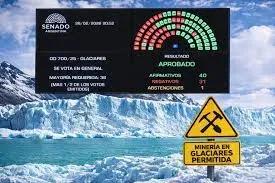
The debate has ceased to be an abstract discussion to become a concrete decision. In an extraordinary session, the Senate of the Argentine Nation gave half sanction to the modification of the law, with 40 affirmative votes, 31 negative, and one abstention. Far from closing the discussion, the vote clearly exposed the lack of consensus on a structural issue and highlighted that differences cut across not only the political blocks but also the provinces.
The project has now entered the Chamber of Deputies of the Argentine Nation, where a stage that promises to be even more intense will begin. The call for a public hearing with tens of thousands of registrants reflects that the discussion no longer belongs solely to political leadership, but has transferred to society. The magnitude of participation anticipates a debate fraught with diverse interests and positions that are difficult to reconcile.
In short, the reform of the Glacier Law serves as a condensation point of broader tensions. Development, environment, federalism, and economic strategy are intertwined in a discussion that, far from being resolved with a vote, remains open. What is at stake is not only a regulation but also the type of balance that Argentina is willing to build between growth and preservation in the coming years.

Comments