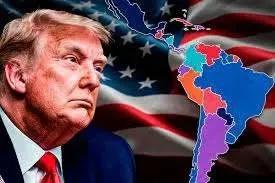
President Donald Trump has summoned several Latin American leaders aligned with his Administration to the Doral Hotel in Miami on March 7, with the aim of formalizing a new regional alliance that internationally supports Washington's strategic agenda. The initiative, according to sources close to the White House, aspires to consolidate a hemispheric bloc capable of counterbalancing China's growing influence in Latin America and ensuring political and economic control over a space that the United States has historically regarded as within its natural sphere of influence.
The "manifest destiny" and hemispheric tradition
Since its consolidation as an independent nation, the United States has cultivated the idea of possessing a "manifest destiny" of greatness. This conviction drove its territorial expansion during the 19th century and cemented a strategic culture that combined commercial pragmatism with military projection. French sociologist Raymond Aron defined the United States in 1973 as an "Imperial Republic": an internal democracy with global ambitions and responsibilities.
To become that singular "empire", Washington resorted to both purchase and war to expand its territory, incorporating lands that had belonged to the United Kingdom, Spain, France, Mexico, or Russia. But beyond physical expansion, decisive was the construction of a hemispheric doctrine that regarded the American continent as a priority area for security.
In 1823, President James Monroe articulated the principle that would go down in history as the Monroe Doctrine: "America for the Americans". In Washington, it meant the exclusion of European powers; in Latin America, it was interpreted as the assertion of U.S. tutelage. Eight decades later, in 1904, Theodore Roosevelt added his famous corollary, legitimizing the direct intervention of the United States in cases of "chronic instability" or failure to fulfill financial obligations in the region. The so-called "Big Stick" translated into occupations and landings in Cuba, Nicaragua, Haiti, or the Dominican Republic.
From the Cold War to strategic disinterest
World War II and, subsequently, the Cold War shifted the center of gravity of U.S. foreign policy toward Europe and Asia. Latin America ceased to be a priority except during crises. The Cuban Revolution of 1959 and the missile crisis of 1962 reignited Washington's attention, as did the Sandinista triumph in Nicaragua in 1979. However, those responses—Bay of Pigs, the Alliance for Progress, or support for the "Contra"—were episodic occurrences.
After the September 11 attacks in 2001, the so-called "war on terror" concentrated U.S. strategic resources in the Middle East. Meanwhile, China's economic presence in Latin America steadily and discreetly grew.
The Chinese advance in the Western Hemisphere
In the last two decades, Beijing has become the main trading partner of several South American economies. It has invested in strategic infrastructures, financed energy projects, and expanded its technological presence. Chinese companies are involved in the management of terminals in the Panama Canal, built the megaport of Chancay in Peru, and established a civilian observation space station in Argentine Patagonia managed by the China National Space Administration.
In parallel, China has consolidated its naval projection in the South China Sea and deepened its political coordination within the BRICS framework, a group exploring alternatives to dollar dominance in international trade. Moreover, it controls critical segments of global production of strategic minerals essential for energy transition and new technologies.
This context explains Trump's renewed interest in the hemisphere.
The "Donroe Doctrine" and pressure on the region
With the slogan "Make America Great Again", Trump interprets that the United States has lost ground to China in commercial, technological, and geopolitical realms. Latin America thus reemerges as a priority stage for strategic competition.
Some U.S. analysts have dubbed his approach the "Donroe Doctrine", a reinterpretation of the Monroeist tradition adapted to the 21st century. In its National Security Strategy 2025, the White House emphasizes the need to prevent "hostile" powers from consolidating positions in the Western Hemisphere.
In this framework, Washington has deployed a combination of incentives and pressures. The political and financial backing for Argentine President Javier Milei was accompanied by efforts before multilateral credit organizations. Simultaneously, the U.S. Administration made it clear that the continuity of its support would depend on the political stability and strategic alignment of Buenos Aires.
In Central America and the Caribbean, the White House has strengthened ties with ideologically aligned governments while hardening its stance against Venezuela, Cuba, and Nicaragua.
Venezuela as a central piece
The relationship with Caracas has been one of the most controversial axes. Trump intensified sanctions against the regime of Nicolás Maduro, which Washington accuses of drug trafficking and systematic human rights violations. U.S. policy has combined economic pressure with attempts to reconfigure control over the Venezuelan oil sector, the largest in the world in proven reserves.
For the White House, oil and strategic influence weigh more than democratic rhetoric. The geopolitical calculus seems to prioritize energy control and the containment of actors like Russia, China, and Iran, present in the South American country.
Tensions with Mexico, Brazil, and Colombia
Colombian President Gustavo Petro has maintained an ambivalent relationship with Washington, oscillating between cooperation and criticism. Mexico and Brazil, for their part, have defended a more autonomous foreign policy. Mexican President Claudia Sheinbaum and Brazilian President Luiz Inácio Lula da Silva have avoided open confrontation but resist aligning fully with the U.S. strategy towards China and Venezuela.
The result is a divided Latin America with two major sensitivities: governments that bet on close integration with Washington and others that favor a more equidistant or multipolar diplomacy.
The Miami summit
The meeting on March 7 seeks to institutionalize the bloc aligned with Washington. According to diplomatic sources, the objective would be to coordinate positions in international forums, guarantee preferential access to strategic resources—lithium, oil, food—and strengthen cooperation on security matters.
It remains to be seen what the actual scope of the meeting will be and what concessions the United States will offer its allies. History shows that the Western Hemisphere has never been a politically homogeneous space and that attempts at undisputed leadership often generate resistance.
In a world marked by competition among great powers, Latin America once again finds itself at the central board of global geopolitics. The Miami summit could mark the beginning of a new hemispheric phase or become another episode in a long dispute for influence on the continent. The outcome will depend not only on Washington but also on the capacity of Latin American countries to autonomously define their own place in the new international order.
Adalberto Agozino holds a PhD in Political Science, is an International Analyst, and is a Lecturer at the University of Buenos Aires.

Comments