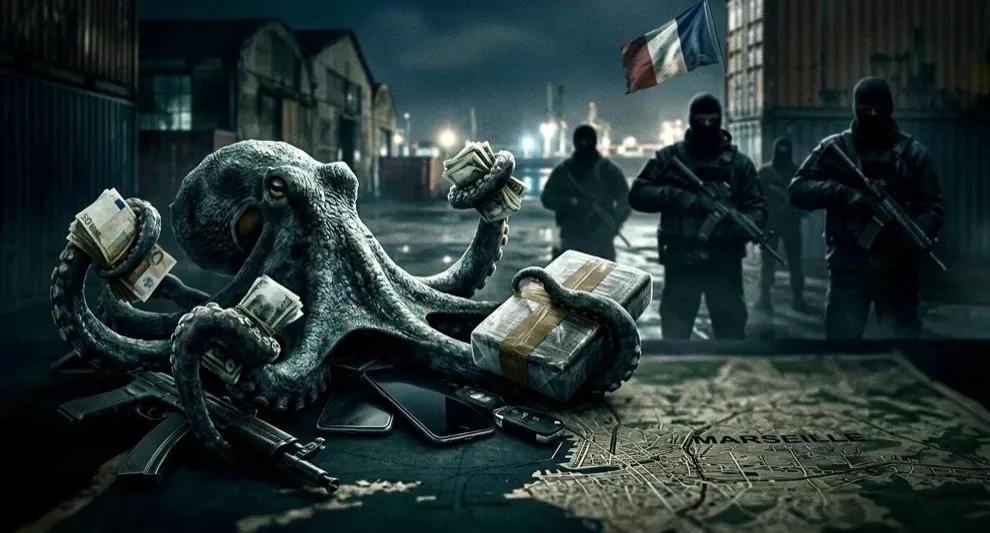
The DZ Mafia stopped being a simple neighborhood band in the suburbs north of Marseille to become a urban cartel with national and international ambition, capable of controlling territories, imposing terror, infiltrating institutions and connecting to major European cocaine routes (Le Monde 2024; Wikipedia 2024). Under the name "DZ Mafia," a core of bosses - among whom Amine Oualane, known as "Mamine" or “Jalisco,” Gabriel Ory, nicknamed "Gaby," and Madhi Zardoum, alias “la Brute” - built a criminal organization that mixed local gang codes with imported strategies from the Dutch-Moroccan Mocro Maffia and Latin American cartels (Le Monde 2026; Endeweld 2026; Wikipedia 2024). For more than a decade, this structure managed to impose its law in large areas of the city until the French state decided to counterattack with the Octopus Operation, conceived by the public prosecutor of Marseille, Nicolas Bessone, as a direct blow to the heart of the group (RTL 2026; Gendarmerie Nationale 2026).
Origin and rise of the DZ Mafia
In the years 2010 and 2020, Marseille consolidated itself as one of the epicenters of violence related to drug trafficking in Europe, with numerous settlements of accounts, burned cars and homicides related to the control of the drug market (France 24 2023; Valeurs Actuelles 2026). In this context, the DZ Mafia emerged, a set of criminal organizations that, according to the French encyclopedia, was structured as a single cartel originating from the neighborhoods of the north, accused of hired murders, drug trafficking, kidnappings and other serious crimes (Wikipedia 2024). The account of Le Monde describes how Amine Oualane and Gabriel Ory took control of the cité du Castellas and founded their own gang there, “Castellas Del Jalisco,” later extending their dominion to other areas such as the Cité de la Visitation and the Aygalades (Le Monde 2024; Wikipedia 2024).
The organization turned its initials into a recognizable criminal brand, associated with execution videos, claims of responsibility, and symbols circulating on social networks, a strategy that reinforces its reputation for danger and appeal among recruited youth (Le Monde 2024; Blast 2025). This deliberate use of image and media terror, combined with a division of labor that includes leaders, middle managers, adolescent hitmen, “treasurers,” and logistics managers, brings it much closer to an urban cartel than to a simple youth gang (Le Monde 2024; Le Diplomate 2025).
The investigation that led to Octopus
Faced with the accumulation of homicides and the growing weight of the DZ Mafia, the French courts decided to move from isolated cases to a structural offensive against the organization (Gendarmerie Nationale 2026; Le Figaro 2026). In early 2024, a judicial investigation specifically dedicated to the DZ was opened, initially handled by the judicial police of Marseille and later transferred to the Gendarmerie, particularly to the Section of recherches, given the sensitivity and scope of the case (Le Figaro 2026; Le JDD 2026). The case was named “Operation Octopus,” referencing the octopus and the perception of the group as a central body with multiple tentacles: drug trafficking, homicides, money laundering networks, subgroups, relations with other mafias, and possible vectors of institutional corruption (Gendarmerie Nationale 2026; TF1 Info 2025).
Prosecutor Nicolas Bessone, the Republic's prosecutor in Marseille, explained that the goal was “to hit the heart of the organization,” meaning to target not only street sellers but also leaders, middle managers, and the economic apparatus that supports the structure (RTL 2026; TF1 Info 2026; Le Figaro 2026). The investigation relied on eighteen months of wiretaps, technical surveillance, analysis of economic flows, and audio monitoring of spaces, including cells of detained persons considered to be leaders, such as Madhi Zardoum (“la Brute”), imprisoned for various offenses related to trafficking and criminal projects (Ouest-France 2026; Le Monde 2026). Additionally, a legal figure created by the law of June 2025 was applied, allowing the prosecution of mere participation in a criminal organization, even if no direct implication of the accused in a specific crime has been proven, expanding the scope of the indictment within the DZ galaxy (RTL 2026).
A blow prepared for years
Before the major operation in 2026, the French state had already attacked the group's financial “portfolio.” In September 2025, the Public Prosecutor's Office of Marseille announced the dismantling of a large international money laundering network that transformed millions of euros from, among other sources, Marseille's drug trafficking into gold (TF1 Info 2025). According to that investigation, teams of Syrian and Maghreb origin transported cash from France to Italy in vehicles with hidden compartments; there, Kosovo and Middle Eastern intermediaries converted it into gold before sending it to countries such as Kosovo and Turkey (TF1 Info 2025). Authorities specified that several of the people involved in the network were directly linked to the DZ Mafia, highlighting the transnational dimension of their criminal economy (TF1 Info 2025; Valeurs Actuelles 2026).
Meanwhile, various reports were profiling the DZ as “the most structured and dangerous criminal group” in the French scene, with a presence in other cities along the Rhône axis, such as Nîmes, Alès, or Clermont-Ferrand (Endeweld 2026; Le Diplomate 2025). A confidential report from the criminal intelligence service SIRASCO, cited by Marc Endeweld, even classified it as a cartel and warned of its “will to undermine democracy” through pressure on institutions, territorial wars, and corruption (Endeweld 2026).
March 2026: 42 arrests and 26 indictments
Operation Octopus entered its decisive phase in early March 2026. Over two days, the National Gendarmerie deployed around 900 agents in Marseille and other points across the territory, with support from the GIGN and aerial means, for a series of simultaneous raids and arrests (Gendarmerie Nationale 2026; M6 Info 2026). The immediate result was the arrest of 42 individuals suspected of belonging to the DZ Mafia or collaborating with its drug trafficking, violence, and money laundering apparatus (RTL 2026; TF1 Info 2026; Le Figaro 2026). Among them were three presumed leaders or “chefs" identified as central figures in the organization: Amine Oualane (“Mamine”), Gabriel Ory (“Gaby”), and Madhi Zardoum (“la Brute”), detained or already imprisoned for various cases related to trafficking and violence (Endeweld 2026; Le Monde 2026).
On March 14, 2026, Nicolas Bessone appeared publicly to announce that, of those 42 people, 26 had been placed under examination, while 15 were sent to provisional detention and 11 remained under judicial control (RTL 2026; TF1 Info 2026; Le Figaro 2026). The charges include participation in a criminal organization, aggravated drug trafficking, and, in some cases, use of the new legal figure of participation in mafia organizations without the need to link each case to a specific crime (RTL 2026). Bessone emphasized that the investigation did not conclude with this first wave of charges, but that efforts would continue to trace the laundering circuits and the connections of the DZ with other networks (Le Figaro 2026; Gendarmerie Nationale 2026).
Institutional corruption: the lawyer who crossed the line
One of the elements that had the most impact on public opinion was the indictment and imprisonment of a practicing lawyer, accused of having been corrupted by the DZ Mafia (RTL 2026; TF1 Info 2026; Le Figaro 2026). According to information revealed by the prosecution and reported by several media, this lawyer had facilitated clandestine communications between a leader of the organization imprisoned in a high-security prison and the outside, using his professional status and the attorney-client privilege as cover (TF1 Info 2026; Le Figaro 2026). The case is even more sensitive because his firm was in a state of financial difficulty, undergoing restructuring, which could have increased his vulnerability to offers or pressures from the group (Endeweld 2026).
In the narrative of the case, this lawyer becomes a symbol of the real possibility of infiltration of the cartel in the judicial apparatus. The DZ not only dominates neighborhoods and points of sale, but also tries to exploit the fissures of the system –fear, money, economic weaknesses– to maintain its control even from inside a prison (RTL 2026; Le Figaro 2026; Endeweld 2026). Operation Octopus makes this threat visible, while also forcing the state to review its mechanisms of control over communications and the use of professional secrecy in contexts of organized crime.
Internal structure: leaders, subgroups, and “new generation”
The main sources describe the DZ Mafia as a set of organizations articulated into a single cartel, with different levels of command and substructures (Wikipedia 2024; Le Monde 2024; Le Diplomate 2025). At the top are leaders like Amine Oualane (“Mamine” or “Jalisco”), Gabriel Ory (“Gaby”), and Madhi Zardoum (“la Brute”).
“te”), presented by researchers and journalists as central figures of the organization at least since the beginning of the 2020s (Le Monde 2026; Endeweld 2026). Below, there are intermediate managers responsible for points of sale, internal discipline, arms and vehicle logistics, and the management of large sums of money; further down, young recruits handle surveillance, transportation, and executions, in a division of labor that recalls the functioning of a cartel (Le Monde 2024; Valeurs Actuelles 2026; Blast 2025).
The DZ has also managed to multiply its “internal brands.” After the taking of the cité du Castellas, Oualaney Ory founded the gang “Castellas Del Jalisco,” a name that directly refers to the Jalisco New Generation Cartel (CJNG) and evidences a conscious appropriation of the imagery of Mexican cartels (Wikipédia 2024; Le Monde 2024; Le Figaro 2026). More recently, the “DZ Nouvelle Génération” (DZ-NG) has emerged, associated with figures like Mehdi L. (“Tic”) and Walid B. (“Fondu”), who, according to Le Monde and Sud Radio, embody a new layer willing to challenge or continue the legacy of historical DZ (Le Monde 2026; Sud Radio 2026; Valeurs Actuelles 2026). This proliferation of acronyms allows the organization to fragment, adapt, and continue operating even when some historical members are imprisoned.
Alliances, routes, and evidentiary limits
The available sources document operational alliances of the DZ Mafia with other criminal organizations, especially in the European space. Several analyses point to relations with the Dutch-Moroccan Mocro Maffia, which controls key parts of cocaine trafficking between South America and Europe and describe the DZ as a partner in the French section of reception and distribution (Le Monde 2024; Le Monde 2023). Occasional relations with Corsican criminal networks have also been mentioned, particularly in terms of settling scores and dividing territories, although without configuring as a unified structure (Valeurs Actuelles 2025). Locally, the group's own trajectory includes episodes in which the organization puts its hitmen at the service of clans like La Castellane for specific pursuits or vengeance, constituting a criminal business for hire (Wikipédia 2024).
Regarding Latin America, reportages and documentaries on drug trafficking in France explain that the cocaine fueling the Marseille market comes from Andean countries like Colombia, and that Venezuela has become a transit hub towards Europe (CNN 2019; France 24 2025; TF1 Info 2025). Some pieces of video and press explicitly mention shipments leaving Colombia and arriving at the port of Marseille, where networks like the DZ dominate local distribution. However, open sources do not manage to identify direct contractual agreements between the DZ and specific Colombian or Venezuelan cartels, so talking about “businesses” with, for example, the Sinaloa Cartel or the CJNG would go beyond what can currently be proven publicly (Le Monde 2024; The Mexpatriate 2025; IRIS 2025).
Conclusion
The Octopus Operation marks a turning point in the relationship between the French State and the DZ Mafia. For the first time, the response abandons the purely reactive approach and is oriented towards dismantling the complete structure: leaders like Amine Oualane, Gabriel Ory, and Madhi Zardoum; subgroups like “Castellas Del Jalisco” and “DZ Nouvelle Génération”; intermediate structures, “treasurers,” and logistics heads; circumstantial allies; money laundering networks in various countries; and even a lawyer who would have crossed the line of his profession to become a vector of corruption (RTL 2026; Le Figaro 2026; Endeweld 2026). The spectacular dimension of the operation – 42 arrests, 26 indictments, 15 preventive incarcerations, nearly 900 gendarmes mobilized, millions of euros, and luxury goods seized – sends the message that the State is no longer confronted with a street gang, but rather with a high-level urban cartel (Gendarmerie Nationale 2026; TF1 Info 2026; Le JDD 2026).
At the same time, the case makes it clear that the problem cannot be solved with a single blow. As judicial proceedings advance, the French press describes an internal recomposition of the criminal landscape in Marseille, with the “DZ Nouvelle Génération” gaining weight and other actors trying to occupy the spaces left by imprisoned members (Le Monde 2026; Sud Radio 2026; Valeurs Actuelles 2026). “Settling scores” has decreased compared to the worst years, but it has not disappeared, indicating that the ecosystem that allowed the DZ to emerge remains alive (Valeurs Actuelles 2026; France 24 2023). The outcome of the trials, the State’s ability to continue attacking money laundering circuits, and its effectiveness in shielding institutions against corruption will determine whether Octopus will be remembered as the beginning of the end for the DZ Mafia or merely as a key chapter in the long war between an urban European cartel and a State seeking to measure up to it.
References
Gendarmerie Nationale. “Opération “Octopus”: nouveau coup de filet contre la “DZ mafia”. GendInfo, March 13, 2026. Available at: https://www.gendarmerie.interieur.gouv.fr/gendinfo/criminalite-organisee-et-enquetes/2026/operation-octopus-nouveau-coup-de-filet-contre-la-dz-mafia
Le Figaro. “Coup de filet contre la DZ Mafia: 26 personnes mises en examen, un avocat suspecté de complicité écroué.” March 13, 2026. Available at: https://www.lefigaro.fr/marseille/operation-visant-a-decapiter-la-dz-mafia-26-personnes-mises-en-examen-20260314
Le Journal du Dimanche. “Opération “Octopus”: le grand coup de filet contre la DZ Mafia à Marseille.” March 15, 2026. Available at: https://www.lejdd.fr/Societe/operation-octopus-le-grand-coup-de-filet-contre-la-dz-mafia-a-marseille-168864
Valeurs Actuelles. “DZ Mafia: entre procès et scissions, quel futur pour le groupe criminel.” April 2, 2026. Available at: https://www.valeursactuelles.com/clubvaleurs/regions/provence-alpes-cote-dazur/bouches-du-rhone/aix-en-provence/faits-divers/dz-mafia-entre-proces-et-scissions-quel-futur-pour-le-groupe-criminel
Sud Radio. “La DZ-NG, la nouvelle menace du narcotrafic à Marseille.” March 29, 2026. Available at: https://www.sudradio.fr/societe/narcotrafic-la-dz-mafia-nouvelle-generation-veut-prendre-le-pouvoir-a-marseille
Wikipédia. “DZ Mafia.” Last updated: February 3, 2024. Available at: https://fr.wikipedia.org/wiki/DZ_Mafia
Endeweld, Marc. “Vaste coup de filet policier dans une DZ Mafia en pleine recomposition.” The Big Picture (Substack), March 13, 2026. Available at: https://marcendeweld.substack.com/p/vaste-coup-de-filet-policier-dans
Endeweld, Marc. “La DZ Mafia s’étend en France et montre “une volonté d’affaiblir la démocratie.” The Big Picture (Substack), January 12, 2026. Available at: https://marcendeweld.substack.com/p/la-dz-mafia-setend-en-france-et-montre
Blast. “Narcotrafic, une histoire de la DZ Mafia – Épisode 3: La nouvelle ère du narcocapitalisme.” December 17, 2025. Available at: https://www.blast-info.fr/articles/2025/narcotrafic-une-histoire-de-la-dz-mafia-episode-3-la-nouvelle-ere-du-narcocapitalisme-dPp3tH3cQYqK
Le Diplomate. “DZ Mafia Marseille: Les nouvelles dynamiques criminelles.” November 25, 2025. Available at: https://lediplomate.media/analyse-dz-mafia-anatomie-cartel-urbain-ramifications-geopolitiques-narcotrafic-europeen/
About the Author
William L. Acosta is a graduate of PWU and Alliance University. He is a retired police officer from the New York Police Department, an ex-soldier of the United States Army, and the founder and CEO of Equalizer Private Investigations & Security Services Inc., an agency licensed in New York and Florida, with international projection. Since 1999, he has led investigations in cases of narcotics, homicides, and missing persons, as well as participating in criminal defense at both state and federal levels. Specialist in international and multi-jurisdictional cases, he has coordinated operations in North America, Europe, and Latin America.

Comments