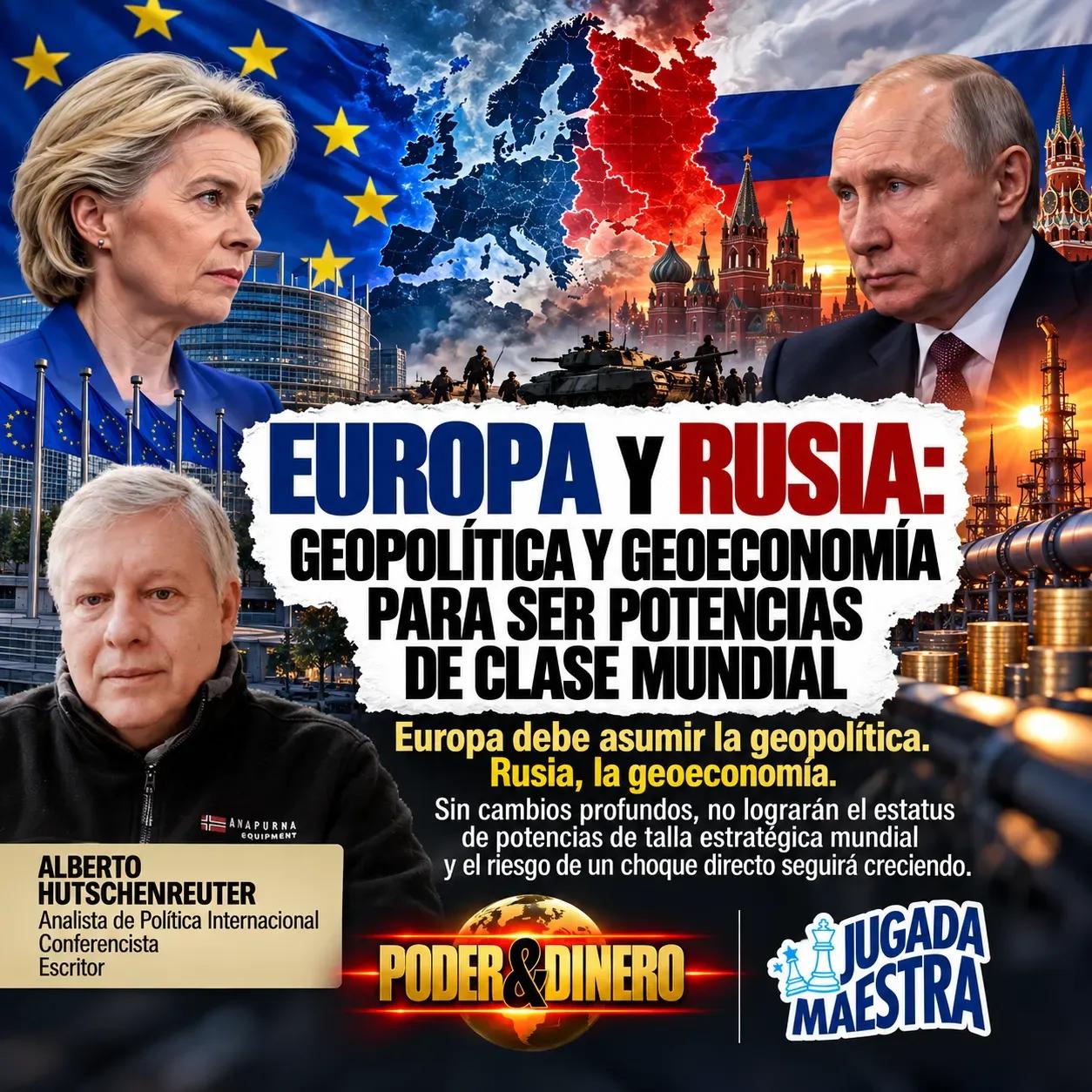
Europe and Russia are facing each other. Not directly, but indirectly. European assistance to Ukraine and the strong distrust regarding intentions between both places them in a state of increasing discord or "no war." Even more, in Europe they are increasingly convinced that during the next five years there could be a direct clash with Euroasiatic power.
If that happens, it would not only be a greater misfortune for the continent and the world, but possibly what remains of the century would be tainted by such an impact.
Beyond this gloomy scenario, the prolonged and exhausting war in Ukraine is showing Europe and Russia realities that they must consider.
To the former, that one cannot be merely an institutional power. Experience does not offer cases of purely normative powers: the actors on a scale are either capable or they are not. Powers like Athens or Venice were vital political and commercial centers, but those rankings were accompanied by proven military capabilities.
To the latter, that one cannot be merely a geopolitical-military center. Experience offers cases of such powers, but this (as demonstrated in the works of Carlo Cipolla or Paul Kennedy) almost always ensures decline. Sparta, Prussia, and the Soviet Union itself qualify as cases of "Sword States."
Therefore, if Europe and Russia aspire to be "strategic global players," that is to say, something more than "international order actors," they must focus more on geopolitics for Europe, and on geoeconomics for Russia.
For Europe to assume geopolitics means dismantling the self-perception of being "a garden in the jungle." International regularity implies anarchy and competition, not friendship and complacency. Within this framework, assuming geopolitics means shielding and promoting one's own interests, not foreign strategic scripts that can jeopardize security on European territory as they indeed have by extending NATO beyond what is strategically and geopolitically convenient (it should be remembered that statesmen and realist thinkers of the caliber of George Kennan, Henry Kissinger, Brent Scowcroft, and Kenneth Waltz, to name just a few, advised against the Alliance's enlargement towards the "red zones" of Russia).
Europe finds itself, despite its wishes, rapidly returning to geopolitics, but its approach could prove insufficient and even risky if it does not assess the indivisibility of security in a continental-Euroasiatic key, not exclusively continental-Western, as the same will not be achieved by excluding the major Euroasiatic actor, Russia. Experience tells us that an order cannot be achieved through exclusion; if we remember what happened with Germany and Russia after World War I, when both, one subdued and the other sidelined by the order of the Versailles winners, signed the Treaty of Rapallo in 1922, from which they initiated a collaboration policy that was only broken when Nazi Germany invaded the Soviet Union in 1941.
For Russia to fully turn to geoeconomics does not mean it will cease to be an actor living off products from the land, but rather to face the ever procrastinated technological modernization to become (perhaps in a few decades and provided no other war occurs) a "world-class power," that is, of complete national or aggregated power, something it was not during its two historical regimes, the monarchy and the Soviet era, nor as the Russian Federation, “a great power, a regional superpower, and a nuclear superpower,” as well defined by Russian expert Leon Aron.
It will not be an easy task for Russia to adopt what for another expert, the American Stephen Kotkin, would be a major step towards local, regional, and global stability: to desist from its "perpetual geopolitics" and embrace geopolitical pluralism, meaning the respect for the sovereignties in its near neighborhood. Indeed, Russia will hardly be able to rid itself of the “geopolitical gene”; but if it does not subordinate geopolitics to technological imperatives, it will not achieve a change from distrust to international deference, and could even face new "times of turmoil."
In summary, Europe and Russia are indispensable actors in a context of order that is increasingly awaited with urgency, but until they commit to imperative changes they will not achieve the necessary status of strategic global powers.
Alberto Hutschenreuter is Doctor in International Relations. Postgraduate in Control and Management of Public Policies. Former titular professor of Geopolitics (ESGA). Former professor at UBA and ISEN. Contributor to national and international specialized magazines and websites. Author of "Russian Foreign Policy after the Cold War. Humiliation and Repair" and “Geopolitics never left.”

Comments