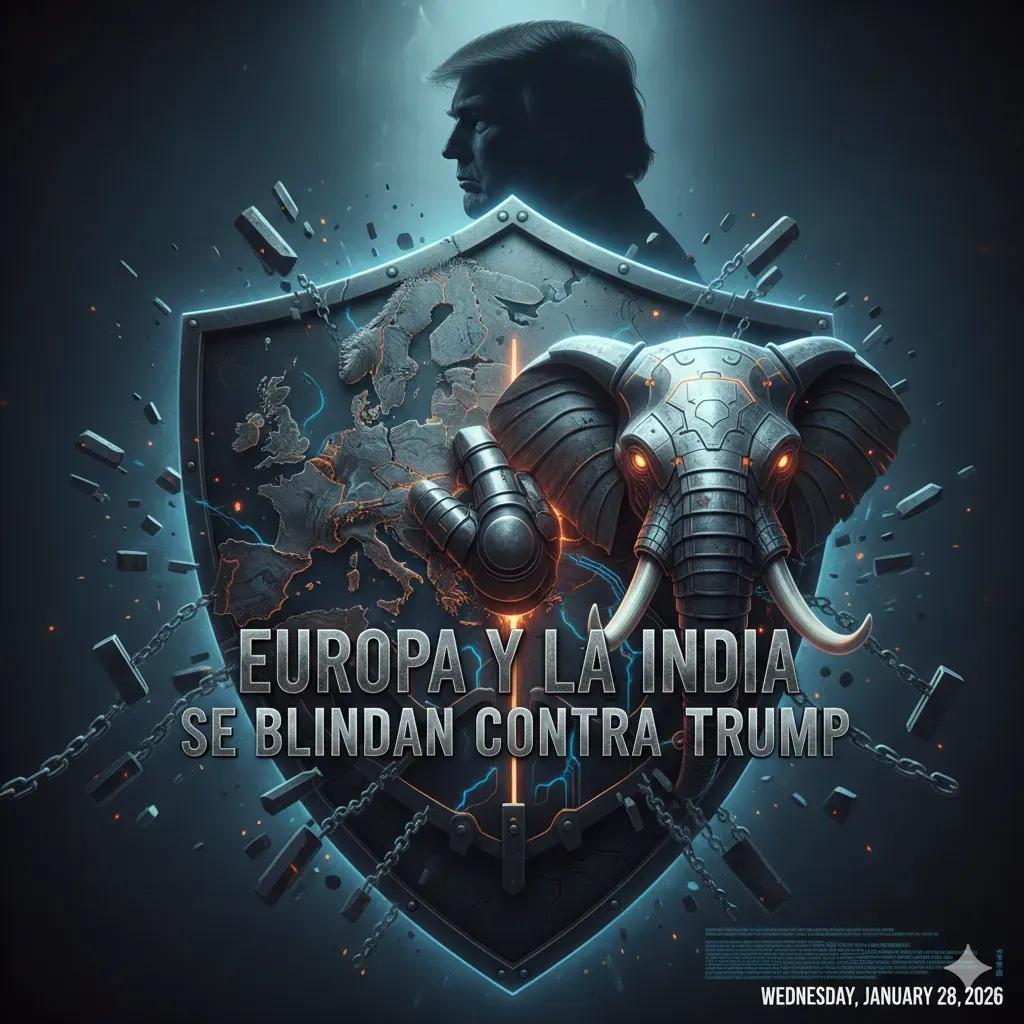
The signing of the trade agreement between the European Union and India in New Delhi marks a turning point in Brussels' foreign and strategic policy. After almost two decades of erratic negotiations, the pact materializes at a time of high geopolitical tension and takes on a significance that goes far beyond tariff reduction. Europe is explicitly seeking to shield itself against an increasingly hostile international environment, characterized by the use of trade, technology, and security as instruments of political coercion.
The agreement—described by the President of the European Commission, Ursula von der Leyen, as "the mother of all trade agreements"—is added to the recently signed one with Mercosur and responds to the same strategic logic: diversifying alliances, reducing critical dependencies, and strengthening European autonomy in the face of a Trump Administration that has turned tariffs into a direct lever of pressure on its allies.
From free trade to strategic security
Economic terms, the pact provides for the elimination or reduction of nearly 90% of tariffs between both parties, with a direct impact on key sectors of the European industry—automotive, heavy machinery, chemicals, pharmaceuticals, and agribusiness—and an estimated annual saving of 4 billion euros in customs duties. However, the political core of the agreement resides in its strategic chapters.
For the first time, a trade treaty between the EU and a major Asian actor incorporates structured mechanisms for cooperation in defense, maritime security, military industry, and dual-use technologies. The text establishes frameworks for joint procurement, co-production, and shared development of defense systems, with particular attention to drones, naval systems, air defense, space, and strategic surveillance.
"Industrial cooperation in defense is not just an economic issue, but a central element of our strategic autonomy,” emphasized Von der Leyen in New Delhi. “In a world where trade and security are increasingly used as weapons, Europe must learn to defend itself.”
Cybersecurity: the new common front
One of the most innovative aspects of the agreement is the explicit incorporation of cybersecurity as a pillar of the strategic relationship. Brussels and New Delhi commit to intensifying cooperation in the face of hybrid threats, cyber-attacks on critical infrastructures, industrial espionage, and disinformation.
The pact provides for the exchange of information between specialized agencies, the coordination of responses to cyber incidents, and the joint development of digital security standards applicable to both the civil and military sectors. It also opens the door to joint projects in artificial intelligence, cryptography, and the protection of 5G networks and future 6G infrastructures.
The EU's High Representative for Foreign Affairs and Security, Kaja Kallas, recently argued that "the line between economic security and national security has disappeared." "Cybersecurity is today as critical as conventional defense,” she stated, pointing out that the partnership with India occurs in a context where "the rules-based international order is under unprecedented pressure.”
Trump as an accelerator of the European shift
Although not explicitly mentioned in the text of the agreement, the shadow of Donald Trump looms over the whole process. Since his return to the White House, the U.S. president has intensified a policy of direct pressure on Europe: threats of differentiated tariffs, demands for Europeans to bear the brunt of their own defense, conditional support for U.S. plans for Russia and Gaza, and an overtly coercive rhetoric surrounding Greenland.
In Brussels, this approach is interpreted as a de facto break from the traditional rules of the transatlantic relationship. António Costa, President of the European Council, made it clear after the last extraordinary summit: "The European Union will defend its interests against any form of coercion. It has the tools to do so and is prepared to use them."
The agreement with India—as with the one signed with Mercosur—is read in that context as a structural, not circumstantial, response to a U.S. strategy that conceives trade as an instrument of political subordination.
India, an indispensable partner in the new global balance
For India, the pact reinforces its position as a central actor in the international system. The world's fourth-largest economy, the most populous country on the planet, and with growth rates above 7%, New Delhi solidifies its role as a strategic alternative to China in global value chains and as a key partner for industrial democracies.
Prime Minister Narendra Modi highlighted that the agreement "strengthens our shared commitment to democracy and to a rules-based trade,” and emphasized that it will allow India to "access European technology, capital, and innovation” without renouncing its strategic autonomy.
This balance is central to Indian diplomacy. While strengthening ties with Brussels, it maintains energy relations with Russia and avoids direct confrontation with Beijing. The agreement with the EU broadens its maneuvering space and reduces its historical dependence on the Russian military industry, especially in a context marked by tensions arising from the war in Ukraine.
Europe facing the coming world
Beyond its trade figures, the EU-India agreement symbolizes a profound change in how Europe conceives itself. After decades of entrusting its security to the United States and its prosperity to a relatively stable trade order, Brussels acknowledges that that world no longer exists.
"The time of strategic naivety is over,” warned German Chancellor Friedrich Merz recently. In that diagnosis converges a growing part of European capitals: trade cooperation can no longer be separated from security, defense, and technological sovereignty.
The pact with India, together with the agreement with Mercosur, outlines a Europe that seeks to cease being a battleground between great powers to become an actor with its own decision-making capacity. In an international system increasingly dominated by power, Brussels is experimenting with a response based on alliances, diversification, and autonomy. The result of that bet will define its place in the world for the coming decades.
Adalberto Agozino holds a PhD in Political Science, is an International Analyst, and teaches at the University of Buenos Aires.

Comments