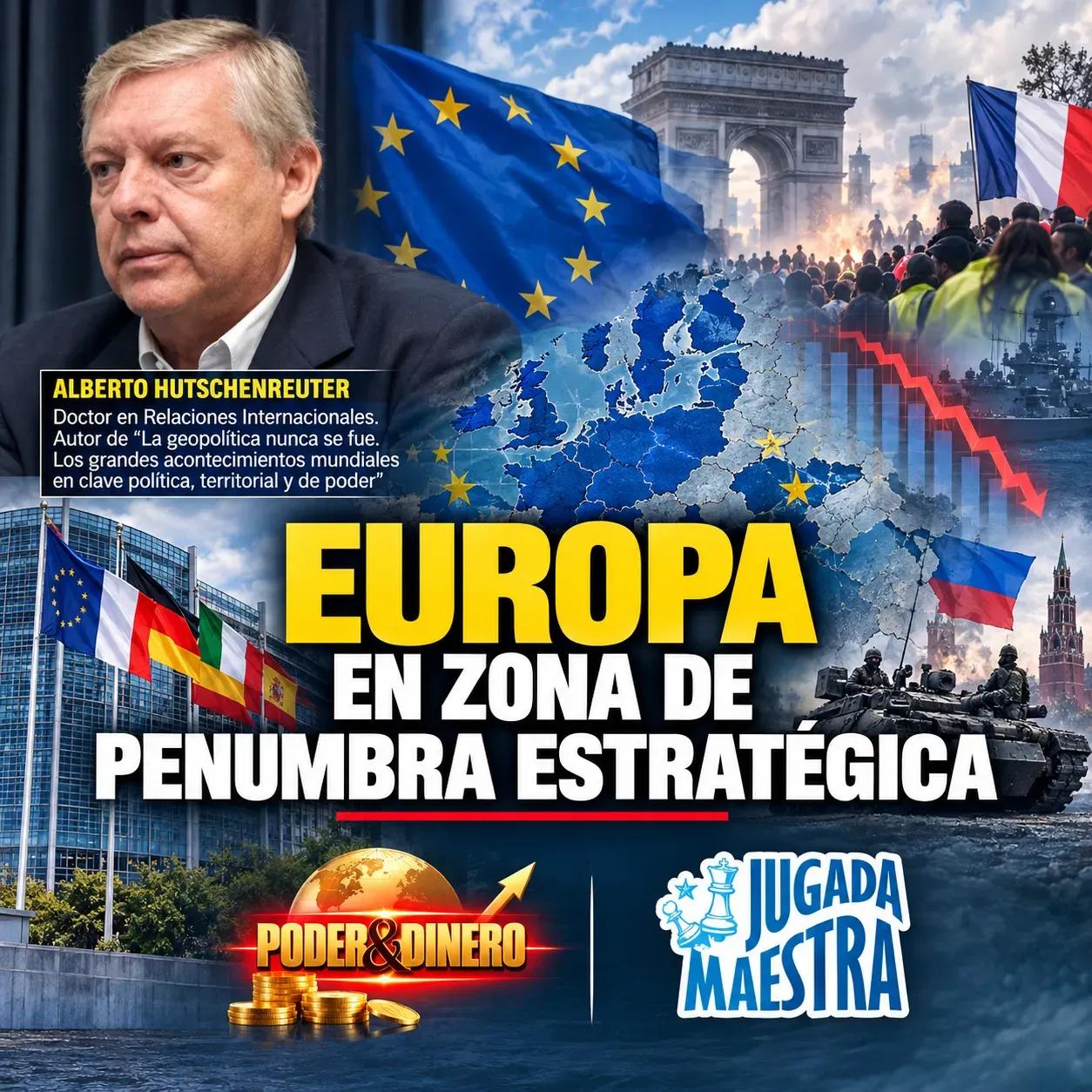
The social events taking place in several countries of Western Europe represent the epitome of a worrying decline whose origins must be traced back to the last decade of the 20th century. Then, after the disappearance of the threat that provided Western Europe with American military insurance since the end of World War II, Europe did not embark on any path that would lead it to think of itself, even when it had leaders with memory and strategic reflection capacity, such as Jacques Chirac. This fact is relevant, as three decades later that renunciation of stepping out of strategic comfort has led to an (avoidable) war on its territory with consequences that, in part, explain the mobilizations and excesses that today spread across several countries.
The complacency of becoming an "institutional power" (there is no record of such powers in experience) may have convinced the makers of the largest post-state enterprise in the world that they had achieved everything or almost everything. Moreover, possibly, in the future the regions of the "rest" of the world would reproduce their model, thus ending the tragedy of politics among nations: international anarchy.
Another point that weighs today and also comes from the past are the policies related to social spending and pensions. Nowhere in the world did social spending reach that of Europe. Hence, it was often spoken of the welfare state. However, to a large extent, that widespread benefit was made possible by the strategic-military comfort that today, due to the U.S. decoupling strategy, will no longer be maintained.
On the other hand, Europe has significantly regressed in terms of its global economic position. If two decades ago the European economy represented almost 28 percent of global GDP, today it stands at 17 percent. Considering the emergence of new economies and the great transformation that (in a context of fiscal adjustments and declining productivity) Europe must undertake to regain competitiveness, it is possible that by 2040 no European country, not even the (ex?) German locomotive, will be among the top ten economies in the world. Thus, if World War II marked the end of the power of the great countries of Europe, in the 21st century a merged Europe, that is, with greater critical mass, although not reaching a complete power, is once again suffering a loss of power.
In short, the fusion model did not save Europe from what the expert Fareed Zakaria has called the international "trilemma," that is, a global situation in which trade is growing, connectivity is increasing, and insecurity is rising. The insecurity in Europe is inward and outward. Inwardly, the sociopolitical dimension of (in)security is not insurmountable, but it is worrying. Indeed, governments, particularly that of France, practically have no room to respond satisfactorily to the legitimate demands of a society whose young segment faces difficulties regarding employment acquisition, access to housing, rising living costs, degrading university conditions, and future prospects, to name the main ones.
One of the dangerous scenarios in this scenario is that the incapacity of government institutions coincides with their relative inability to control violence. Therefore, there exists a real situation, the rupture of the social contract, and a potential situation, a possible breakdown of social peace. Some authors emphasize economic issues in this complex context, for example, the American economist John Mills, who places the center of Europe's problems in the abandonment of the industrial sector and the fall of productivity. But there are others, such as the French sociologist Emmanuel Todd, a scholar of soft factors (like demographic weakness) when considering the decline of a country; thus, Todd believes that the crisis in Western Europe must be viewed from a broader angle, that is, it is true that there is industrial decay, but something more compromising occurs: the loss or decomposition of collective meaning is accelerating as a consequence of the erosion of religious values.
Regarding the outside, the threat lies in that, from its position as an institutional power and aspirational leadership, Europe disregards geopolitics (as it did when it uncritically supported the U.S. Democratic initiative to expand NATO), that is, affirms antipragmatic approaches that increase insecurity. It was precisely this type of approach that has led Europe to be a "non-winner" in the war that has been taking place on its territory, Ukraine, for the past five years. We are not saying here that the great principles of international law are unimportant or should not be observed, but that the "principles" of geopolitics, from which this conflict began (well before 2022), must be considered by Europe if it truly wishes to put an end to the war.
In other words, and saving differences, today the leaders of Western Europe shelter and promote what we could call the "Leyen model," that is, a policy of reluctance and vigilance towards Russia, as opposed to the "Bismarck model," that is, the search for a strategic diagonal with the Eurasian actor to achieve an indivisible continental security principle, precisely the one that has been altered with NATO's eastward expansion and the pretense of bringing it to the immediate west of Russia. In conclusion, a cycle is ending in Europe, and there are no appreciable vectors, both inward and outward, to achieve a transition to another that propels it to become a world-class strategic actor. In this context, the elections in France, Italy, Spain, and Poland in 2027 will be crucial in relation to rethinking policies that pull Europe away from the strategic twilight zone it has been approaching since the end of the Cold War.
Alberto Hutschenreuter, Doctor in International Relations. Author of "Geopolitics Never Left. The Great Global Events in Political, Territorial, and Power Terms."

Comments