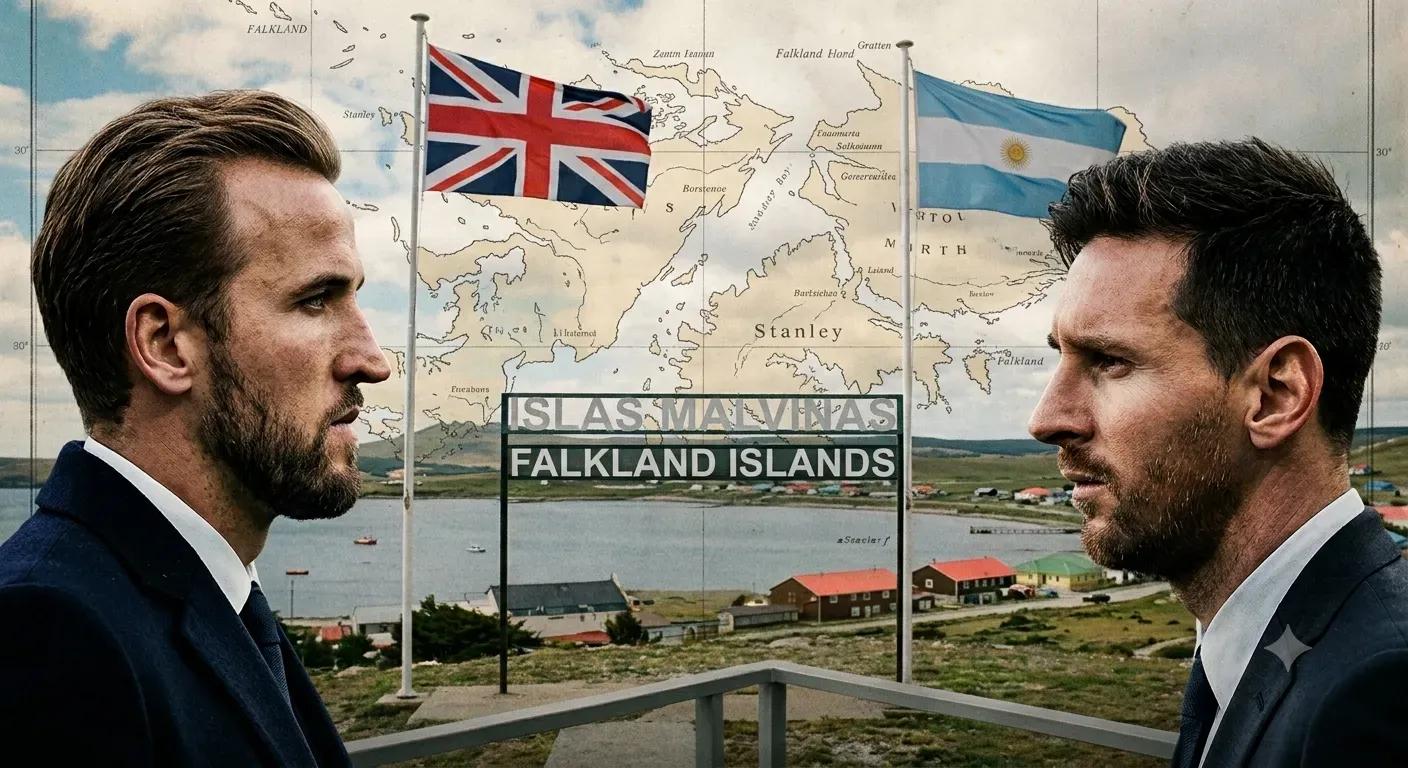
Argentina-England: when football isn’t enough to explain what Argentinians feel
Lionel Scaloni was clear. "It’s a football match, let’s not look for anything else." The Argentinian players repeated the same message. On the other side is a sports rival, a World Cup semifinal, and ninety minutes to determine who continues in the race for the World Cup. However, for millions of Argentinians, Argentina-England has never been just football.
Forty-four years after the Falklands War and forty years since the historic duel of Mexico 1986, the clash between both teams awakens emotions that exceed the playing field. Although the new generations did not experience the war and many of the current protagonists weren't even born when the conflict occurred, the symbolic weight remains intact.
The football rivalry between Argentinians and English existed long before 1982. However, the Falklands War forever transformed the way both countries view each other on the field. Since then, every World Cup encounter has been marked by a mix of historical memory, national pride, sports revenge, and popular passion.
The match that defined this relationship was on June 22, 1986, at the Estadio Azteca. Just four years after the war, Diego Maradona scored two of the most famous goals in football history: the "Hand of God" and the "Goal of the Century." That victory of 2 to 1 is etched in the Argentinian collective memory as much more than a sporting victory. Decades later, Maradona himself would acknowledge that, although they aimed to separate football from the war, there was an emotional weight that was impossible to ignore.
The World Cup clashes that built a unique history
Since 1978, Argentina and England have starred in some of the most memorable encounters in World Cups:
Argentina 0 - England 0 (World Cup 1986, group stage)
Although both already had a prior history, it was a match without significant sporting consequences.
Argentina 2 - England 1 (Mexico 1986, quarter-finals)
The match that changed everything. Maradona scored the "Hand of God" and the so-called "Goal of the Century." It became one of the most emblematic matches in World Cup history.
Argentina 2 - England 2 (France 1998, round of 16)
A tense duel that ended up being decided by penalties. Argentina advanced after David Beckham's red card and a memorable performance by Carlos Roa.
Argentina 0 - England 1 (Korea-Japan 2002, group stage)
David Beckham converted a penalty and took revenge for what happened four years earlier.
Argentina and England (United States-Mexico-Canada 2026, semi-finals)
Twenty-four years after the last World Cup encounter, history places them face to face once again in a decisive moment.
The challenge for Scaloni: separating the history from the match
The Argentinian coach understands perfectly the symbolic weight of this clash. That’s why he tried to deactivate any extrafutbolistica interpretation.
"It’s a football match. Period," he insisted at a press conference. The message aims to protect his players from added pressure in a moment where there is already enough competitive tension.
But reality shows that history remains present. During the celebrations after Argentina's qualification for the semi-finals, songs related to the Falklands and the historic clash with England were heard again. Some footballers even recognized that they understand the special significance this match holds for Argentinian fans.
Why does it still feel different?
Because football serves as one of the most powerful expressions of Argentinian identity. And because the Falklands remain a national cause that transcends generations, ideologies, and political contexts.
No one in Argentina believes that a sporting result can change history. Nor that a football match represents a real revenge for a war. However, sport has the power to condense collective emotions that often find no other channel of expression.
That’s why, while Scaloni calls for calm and remembers that it’s only football, millions of Argentinians will experience the semi-final with a different intensity. Not out of hatred. Not out of resentment. But because Argentina-England is part of an emotional memory built over decades.
Perhaps the coach is right: on the pitch, there will only be a football match.
But in the stands, in the bars, in homes, and in the Argentinian collective memory, it will be inevitable to feel that there is something more at stake.
Falklands today: between memory and diplomacy
The emotion that an Argentina-England match evokes should not overshadow another fundamental aspect of the Falklands issue: for more than four decades, Argentina has sustained its claim to sovereignty through diplomatic and peaceful means.
Since the end of the Falklands War in 1982, all democratically elected Argentinian governments have maintained the claim before international organizations, especially the United Nations. Argentina’s position is supported by multiple UN resolutions that recognize the existence of a sovereignty dispute and urge both parties to resume negotiations to find a peaceful solution to the conflict.
One of the main international supports for Argentina has been the continuous backing from the United Nations Special Committee on Decolonization, which year after year calls upon the United Kingdom and Argentina to resume dialogue. This is accompanied by statements from various regional organizations such as Mercosur, CELAC, and OAS, which have historically backed Argentina’s position.
Although London maintains a firm stance and argues that the matter is resolved by the principle of self-determination of the inhabitants of the islands, in Argentina, there is still hope that, at some point, a diplomatic negotiation similar to that which existed during the 1960s and 1970s can open up, when both countries discussed different rapprochement formulas.
Therefore, for many Argentinians, the Falklands represent more than just a territorial claim. It is a cause linked to national identity, to the memory of the fallen, and to the expectation that future generations can find a solution through dialogue and diplomacy.
Perhaps it is that combination of history, memory, and hope that explains why every time Argentina faces England in a World Cup, such deep emotions resurface.
Football cannot resolve international disputes or alter geopolitical decisions. But it does have the capacity to connect an entire country with a very sensitive part of its history.
But above all, to reinforce Argentinian identity in the Islands. Because they were, are, and will be Argentine.

Comments