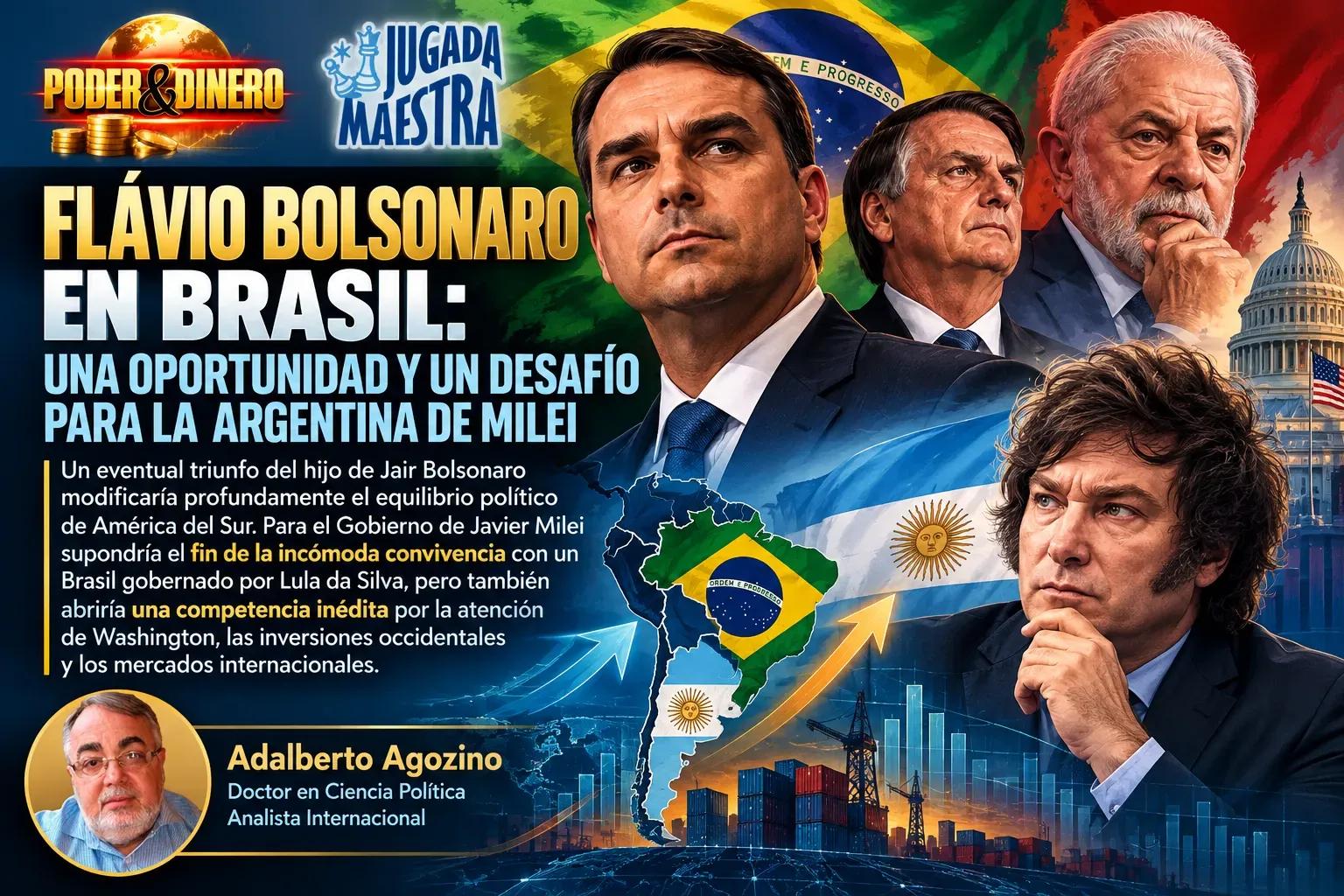
The eventual arrival of Flávio Bolsonaro at the Palácio da Planalto would produce a transformation of considerable magnitude in South American geopolitics. It would not only be the return of the Bolsonaro surname to the Government of Brazil, but also the incorporation of the largest Latin American economy into a regional political space where Argentina under Javier Milei, Paraguay, Ecuador, Peru, Chile, and, with different nuances, other conservative-leaning governments are already present. After a first round in which Flávio obtained 47.03% of the votes compared to 45.16% of Luiz Inácio Lula da Silva, the second round on October 25 appears to be an election capable of simultaneously modifying the political landscape of South America and the relationships between major powers and the region.
For Argentina, the change would have a paradoxical characteristic: it would be, at the same time, an extraordinary political opportunity and a considerable economic challenge. The arrival of a Brazilian president ideologically close to Milei would end the political tension that characterized the relationship between Buenos Aires and Brasilia during Lula’s government. However, that same coincidence would make Brazil a much stronger competitor than Argentina for the favor of Washington, international capital, and the strategic consideration of the White House.
The end of the Milei-Lula anomaly
The relationship between Milei and Lula has been conditioned from the beginning by a deep ideological incompatibility. The Argentine president made his rejection of socialism one of the cornerstones of his foreign policy and even openly supported Flávio's candidacy during his visit to Brazil. On that occasion, he harshly criticized Lula and expressed his willingness to contribute to a new conservative majority in Latin America.
A Flávio Bolsonaro government would allow turning that ideological coincidence into an institutional relationship between two of the main South American economies. Cooperation could gain particular intensity in matters of security, energy, infrastructure, trade, the fight against organized crime, and diplomatic cooperation. It would also facilitate the coordination of positions in multilateral bodies and in regional matters in which Buenos Aires and Brasilia have maintained discrepancies during the Lula administration.
Flávio's own program contemplates an explicit rapprochement with Argentina. The electoral document registered with Brazilian authorities prioritizes the approach to the United States, Israel, and Argentina, in addition to incorporation into the OECD and a gradual trade opening. That reference is of enormous importance for Buenos Aires: it means that Argentina would not be considered solely as a trading partner, but as a relevant piece of the potential Bolsonaro government’s international strategy.
The question, however, is whether that political proximity would automatically translate into economic benefits. The answer is less evident.
A more open and uncertain MERCOSUR
The point where Milei and Flávio could coincide most clearly would be the future of MERCOSUR. Both leaders share the perception that the institutional restrictions of the bloc, especially the obligation to negotiate collectively with third countries, limit each member's capacity to develop its own trade policy.
Flávio even suggested during the campaign that Brazil should free itself from the "ties" of MERCOSUR to advance towards bilateral agreements, an extraordinarily close position to that sustained for a long time by Milei. He also questioned the use of the bloc as an instrument of ideological confrontation with the United States.
The most likely consequence would not be a Brazilian withdrawal from MERCOSUR. The economic, legal, and business cost of abandoning the bloc would be too high, especially for Brazilian sectors integrated with the Argentine economy, such as the automotive industry, the capital goods industry, and numerous manufacturing chains. The most plausible scenario would be a gradual transformation of the bloc from a relatively disciplined trade union towards a more flexible structure, with more exceptions and greater freedom to negotiate external agreements.
For Milei, that transformation would have an immediate advantage. Argentina could advance with greater freedom toward a trade deal with the United States without necessarily being conditioned by the Brazilian position. The problem is that liberalization would also work in the opposite direction. Brazil could open its markets to the United States, Asia, and other economies and allow international competitors easier access to the gigantic Brazilian market.
The preference that certain Argentine products currently enjoy in Brazil could, therefore, lose relative value. The Argentine industry would have to compete with American, Asian, and European companies under conditions different from the current ones. The problem would be particularly sensitive for the automotive sector, whose Argentine-Brazilian productive integration is one of the pillars of bilateral trade.
The numbers explain the dimension of the risk. In 2025, trade between Argentina and Brazil reached 31.195 billion dollars, the highest level since 2013. Argentina exported to Brazil 12.771 billion dollars and imported 18.424 billion. Brazil remains, moreover, the main destination for Argentine exports.
The flexibilization of MERCOSUR would therefore only be beneficial for Argentina if Buenos Aires simultaneously manages to increase its productivity and conquer new markets. Otherwise, a paradox could occur: Milei would obtain the more flexible MERCOSUR he demands, but the Argentine industry would lose part of the protection that the Brazilian market currently provides.
Two governments, a competition for Washington
The most important change might not occur in Brasilia but in Washington.
In recent years, Milei's Argentina has acquired a singular position as the main political ally of the United States in South America. A Brazil governed by Flávio Bolsonaro would radically change that equation. The United States would then have two great South American governments ideologically close and, above all, privileged access to a Brazilian economy of dimensions incomparable to the Argentine.
The problem for Buenos Aires would not be losing U.S. favor, but no longer having the exclusivity that has so far given it additional strategic value.
Brazil has a demographic, industrial, energy, and mining scale that makes it an extraordinarily attractive partner for Washington. The country also has enormous reserves of critical minerals and rare earths. Brazil holds approximately 21 million tons of rare earth reserves, compared to about 44 million in China, and also concentrates relevant proportions of the world's reserves of graphite, niobium, nickel, and lithium.
Flávio has perfectly understood this situation. His approach to Trump, J. D. Vance, and Marco Rubio, and his interest in making Brazil a Western supplier of strategic minerals show that the relationship with the United States would not be based solely on ideological affinities.
In this area, Argentina would need to face an uncomfortable reality: Brazil could simultaneously become both an ally and a competitor.
The White House would be interested in Argentine lithium, copper, Vaca Muerta gas, and other resources, but would also have access to Brazil with a much larger productive scale and a formidable endowment of strategic minerals. The competition for U.S. investments could intensify.
This is no minor issue because the potential Bolsonaro government seems to want to present Brazil as a Western alternative to dependence on China. A document linked to his environment even proposed that Brazil become one of the world's main suppliers of critical minerals outside of China and a processing center for supply chains aligned with the United States.
For Milei, the conclusion would be clear: an allied Brazil does not necessarily mean a Brazil subordinated to Argentina. On the contrary, it could be Buenos Aires's main competitor in the new South American race for Western capital.
China: pragmatism before rupture
Policy towards China would likely be the main limit to a complete Brazilian alignment with Washington.
Flávio has used harsh language regarding the BRICS and de-dollarization, but his position on China is considerably more pragmatic. The campaign materials themselves indicate his intention to maintain an "economically pragmatic" relationship with Beijing: selling food and energy, attracting investments, and avoiding that Brazil has to formally choose between China and the United States.
The reason is elementary. China is too important for Brazil to be replaced by a political decision.
In 2025, bilateral trade between Brazil and China reached a record 171 billion dollars, with Brazilian exports amounting to about 100 billion and imports close to 70.9 billion. China thus represents a fundamental component of Brazil’s trade balance.
The investment dimension also does not allow for imagining a quick decoupling. Brazil received 6.1 billion dollars in Chinese investments during 2025, becoming the world's top destination for Chinese investments that year. The accumulated stock since 2007 totaled about 85.5 billion dollars.
Consequently, a Flávio government would likely attempt to implement a "China for trade, the United States for security" formula. Chinese investment could continue in energy, mining, and productive sectors, while Brazil would impose greater restrictions in telecommunications, port infrastructure, sensitive technologies, and certain strategic chains.
This formula already contains a lesson for Argentina. Brazil could achieve something that Buenos Aires is still trying to build: benefiting simultaneously from Washington and Beijing without adopting full political dependence on either.
If Flávio manages to keep Brazilian exports to China open while obtaining investments and strategic advantages from the United States, Argentina would find itself competing with a partner that plays simultaneously on both boards.
The Brazilian future in the BRICS
Brazil's position within the BRICS would constitute one of the greatest uncertainties.
Flávio has asserted that he would review Brazil's membership in the group and has questioned its use as an instrument of confrontation with the United States. However, a formal withdrawal would be much more complex than a modification of Brazilian policy within the bloc.
The most likely scenario would be a BRICS with Brazilian participation that is colder and less politicized. Brazil could reduce its prominence in de-dollarization initiatives, avoid turning the bloc into an explicitly anti-American platform, and decrease its participation in financial projects conceived as alternatives to the system dominated by Washington.
For Milei's Argentina, which rejected joining the BRICS, such an evolution would be politically comfortable. However, it would not imply a direct economic benefit. Brazil would continue to trade intensively with China and other members of the group, while Argentina would remain outside that institutional architecture.
The most interesting scenario would be precisely that of a Brazil that does not leave the BRICS but turns them into a predominantly economic and not geopolitical instrument. The formula would allow Brazil to maintain markets, investments, and negotiation capacity while simultaneously tightening its strategic ties with the United States.
Security, borders, and a new bilateral agenda
There is another area where the coincidence between Milei and Flávio could be especially intense: security.
The Brazilian program proposes to declare organized crime a narcoterrorist threat, toughen penalties, and strengthen cooperation with the United States, even developing an extensive technological infrastructure for border and urban surveillance.
For Argentina, a more aggressive Brazilian policy against organized crime could be beneficial. The Triple Frontier, drug trafficking, money laundering, smuggling, and activities linked to Primeiro Comando da Capital constitute necessarily transnational problems.
Greater intelligence coordination between Buenos Aires, Brasilia, and Asunción could significantly enhance regional response capacity. Projects related to border infrastructure, waterways, energy, and connectivity could also be accelerated.
However, security would also be a potential source of controversies if the new Brazilian government adopted overly confrontational positions regarding democratic institutions, the judiciary, or international organizations.
A closer relationship, but not necessarily easier
The central paradox of a potential Flávio Bolsonaro government can be summarized simply: for Milei, it would probably be the best political scenario and one of the most complex economic scenarios.
The ideological convergence between Buenos Aires and Brasilia would allow overcoming years of presidential friction, revitalizing bilateral cooperation, and creating a politically significant axis in South America. It could also favor the modernization of MERCOSUR, a more coordinated regional policy against organized crime, and a closer relationship with Washington.
But that same convergence would transform Brazil into a formidable competitor. Buenos Aires would cease to be Washington's only major South American partner and would have to compete with the Brazilian economy for investments, agreements, trade preferences, and strategic prominence.
The decisive variable will be Argentina's capacity to take advantage of the new situation. If Buenos Aires uses a potential convergence with Brazil to promote trade agreements, improve regional infrastructure, integrate production chains...
tivas y atraer inversiones hacia energía, minería y tecnología, el resultado podría ser extraordinariamente favorable.If, on the contrary, Argentina limits itself to celebrating the ideological coincidence with Brazil, it risks discovering that friendship between two governments does not eliminate competition between two economies.
The real challenge for Milei would not then be to make Flávio Bolsonaro an ally. Everything indicates that a potential Bolsonaro Government would be willing to do so. The challenge would be to achieve that this alliance turns the Buenos Aires-Brasilia axis into a regional power factor without Brazil, due to its greater economic, demographic, and strategic scale, ending up occupying in Washington the place that Argentina has conquered in recent years.
The phrase that best summarizes the scenario belongs, paradoxically, to Flávio's own economic environment. His eventual Government, as explained by Daniella Marques, would maintain "an open government to dialogue with all countries, China, the United States, Europe," using Brazil's natural wealth to strengthen the country's international position. This doctrine probably contains the key to the future: Brazil does not seem destined to choose between Washington and Beijing, but to utilize the rivalry between both to increase its own negotiation power.
For Argentina, the lesson is unequivocal. A Brazil governed by Flávio Bolsonaro could open an extraordinary window of opportunity for political integration in the Southern Cone, but it would also force Buenos Aires to abandon any illusion of automatic regional leadership. In the new scenario, the bilateral relationship would no longer be conditioned by the ideological distance between Milei and Lula. It would be determined, much more crudely, by each country's ability to transform its resources, geographic position, and international alliances into effective economic power.
Adalberto Agozino is a Doctor in Political Science, International Analyst, and Teacher at the University of Buenos Aires

Comments