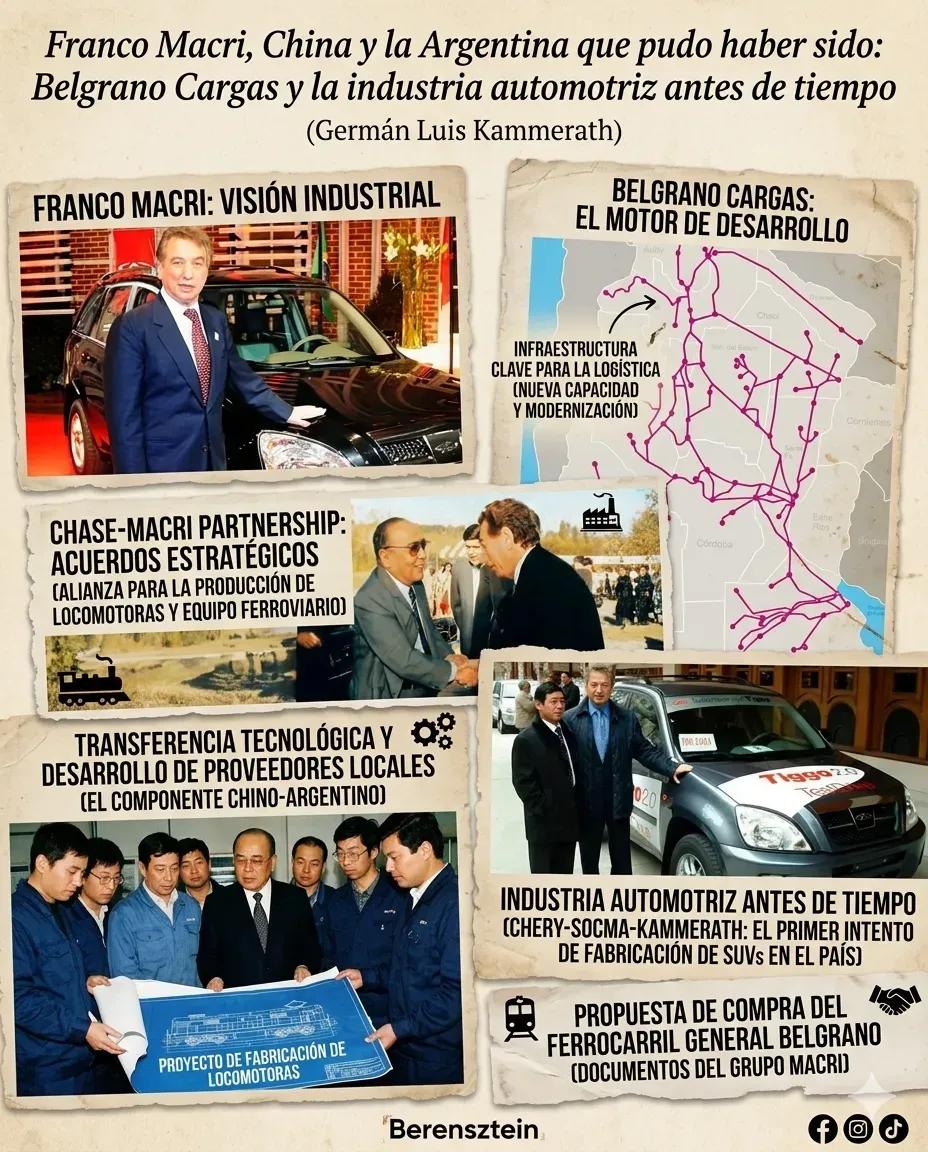
The Argentine economic history is filled with crises, truncated cycles, and unfulfilled promises. But it is also composed of another lesser-studied category: the opportunities that were within reach and that, due to political meanness, unproductive bureaucracy, or lack of strategic vision, were allowed to slip away.
Few better synthesize this pattern than the attempts of Franco Macri (Rome, April 15, 1930 - Buenos Aires, March 2, 2019) to link Argentina with the rise of China in two decisive areas for national development: railway infrastructure and the automotive industry.
Long before the world spoke of Chinese electric cars, long before it was understood that export competitiveness depends as much on logistics as on the exchange rate, Macri was already pushing two historically significant movements: to rebuild the Belgrano Cargas Train, one of the most relevant railway networks in Argentina, with Chinese private capital, and to attract Chinese automotive manufacturers to produce in the country.
Argentina at that time did not know how to support him. And the cost of that blindness is still being paid.
Seeing before others
Innovative entrepreneurs often carry a paradox: when they propose something new, they seem exaggerated; when time gives them reason, it is already too late.
Franco Macri belonged to that category. He was not simply a builder of companies. He had a geopolitical perspective that was rare among local businessmen. Alongside entrepreneurs like Carlos Bulgheroni, who began operations in Turkmenistan, Eduardo Eurnekian in the airport sector, especially in Armenia, the Techint Group with its enormous global presence in the sophisticated steel industry, or the Cordovan businessman Ricardo Fernandez Nuñez, who developed autoplanes in Poland, Ukraine, and the Czech Republic, all were or are world-class entrepreneurs. Franco Macri, a pioneer in China, understood early on, in the 1990s, that that country would not be a footnote in global trade, but one of its central axes.
At a time when many still viewed Beijing with distrust or ignorance, Macri traveled, built relationships, interpreted cultural codes, and sought to link Chinese capital with Argentina's structural needs.
His intuition was simple and powerful: if China needed food, raw materials, and new markets, Argentina should offer infrastructure, production, and long-term alliances.
The context opened by Menem
None of this would have been possible without a prior diplomatic platform. During Carlos Menem's presidency, Argentina developed a high-level relationship with China that was exceptional for the time.
In the late 1980s and throughout the 1990s, during Carlos Menem's presidency, central leaders of the Chinese political system visited the country, among them Presidents Yang Shangkun, Jiang Zemin, Hu Jintao, and Prime Minister Zhu Rongji. Menem also traveled to Beijing at politically sensitive moments for China and consolidated a bond of trust that would be valued for years. On the first visit of Chinese President Yang, who was warmly welcomed by Menem, the Chinese president presented a donation of 1,200 bicycles manufactured in China, which Menem personally received by riding one of them in the presence of the visiting leaders.
The diplomacy built the bridge. Franco Macri tried to fill it with economic content.
Los Abrojos: football, diplomacy, and the day China entered the Argentine strategic agenda
Relationships between states are not always built solely in foreign offices, protocol lounges, or official communiqués. Sometimes they are also forged at a shared table, in a frank conversation, or even on an improvised playing field. The story of the modern relationship between Argentina and China has one of those unique chapters at Los Abrojos, the Macri family's residence.
In 1989, a meeting took place that intertwined politics, business, hospitality, and cultural symbols: the reception of then Chinese President Yang Shangkun, who visited Argentina as the head of state of the People's Republic of China. It was a moment of high diplomatic value but also a revealing scene of how trust is built between distant nations. The Chinese president, of great centrality in the power structure of that country, speaking face-to-face with businessmen, laid a special foundation to attempt to move forward proposals of the highest level. It was unusual at that time for Chinese presidents to make such visits. The next was that of the current president Xi Jinping to La República Cabin of the Moneta Family during his first visit to Argentina in 2014.
Belgrano Cargas: the great strategic play
If one had to choose a project capable of altering the Argentine productive structure, few could compete with the modernization of Belgrano Cargas. This railway network connects agricultural, mining, and productive regions of the north and center of the country with ports and logistical nodes. Its efficiency directly impacts the final cost of exporting soybeans, corn, wheat, minerals, and industrial products. Today, nearly 30 years later, it is just about to be concessioned through an international public tender.
If that concession had been realized in the 2000s, each recovered kilometer would have meant lower transportation costs, greater external competitiveness, territorial integration, regional development, less pressure on roads, saving foreign currency, and public resources.
Franco Macri warned that there lay one of the keys to Argentine growth. That is why he, alongside Chinese entrepreneur Shi Ke-rong, promoted a private initiative at business risk to rebuild the railway trace and put it back in value. It was not the classic state contracting scheme funded by the Treasury. It was private capital betting on structural transformation. Macri had managed to get the Chinese Development Bank, a bank that depends on the National Development and Reform Commission, to offer to finance 100% of the rehabilitation of the railway line.
SHIMA and an idea ahead of decades
The creation of SHIMA, integrated by the Socma Group and the Chinese company Sanhe Hopefull Grain as a vehicle of cooperation between both businessmen, represented an institutional innovation in itself. It combined local knowledge of the Argentine productive system, access, and support in China, direct interest in agri-food trade, long-term logistical vision, and the willingness to assume private risk.
The reasoning was impeccable: improving the infrastructure that moves grain to ports benefited Argentine producers and ensured a more efficient supply for Asian buyers. It was a natural partnership between supply and demand.
Two decades later, that logic would be evident to anyone. At that moment, it faced resistance.
The Argentine barrier: meanness and shortsightedness
Large projects rarely fail due to a lack of economic sense. More often, they become bogged down in secondary interests. That happened here.
Transport area officials with no strategic vision, bureaucratic structures incapable of processing innovation, entrenched corporate interests, and concentrated economic sectors blocked a proposal that could have changed the national logistical matrix. Among the names associated with that period is Ricardo Jaime, a symbol of an era in which public management of transport was marked by controversies and missed opportunities.
Instead of facilitating a modern solution, the choice was made to delay, obstruct, or replace.
The result was known: years of railway delay, high logistical costs, and entire regions losing competitiveness.
The other missed opportunity: the Chinese automotive industry
Franco Macri's vision did not end with the trains. He also warned that China would advance in complex industrial sectors, including automotive, which he knew well from his time at SEVEL. At a time when many still associated that country only with low-cost products, Macri pushed for Chinese manufacturers to set up production in Argentina.
If fully realized, the country could have become one of the world's leading industrial platforms for vehicles of Chinese origin. This implied new manufacturing investments, skilled employment, development of parts suppliers, regional integration, early access to emerging technology, and strategic positioning in South America.
It did not happen. Political and regulatory hurdles diverted that opportunity to Uruguay, where the Chery plant was established. The inauguration was attended by the president of that country, Tabaré Vazquez. With Macri, they received Chinese Vice Premier Hui Liangyu, marking the first visit of a leader of that level to Uruguay.
Today, brands like BYD, Geely, and dozens of others enter the Argentine market from plants located in Brazil or through imports. What could have been manufactured locally is now imported from abroad.
The cost of lost time
Economics teaches that losing an opportunity does not mean remaining the same. It means going backwards relative to what could have been achieved.
If Belgrano Cargas had been modernized as proposed by Franco Macri and his Chinese partner, many regional economies would have gained competitiveness years earlier, the cost of exports would be lower, northern Argentina would have a different productive integration, the state would have avoided part of future expenditures, and the logistics system would be more robust today.
If the Chinese automotive industry had landed early on, Argentina would have captured pioneering investment, expanded the industrial base, increased export capacity, and the country would have been a regional reference in that transition.
The cost was not theoretical. It was concrete. Franco Macri paid the price for innovating ahead of time. In closed societies, the innovator is often treated as a threat. In mature economies, as a strategic asset.
His projects challenged inertia, disturbed interests, and demanded leadership capable of thinking beyond the next file or the next electoral cycle. He did not always find it.
The echo of an old saying
An old Spanish saying summarizes that historical frustration: "And the Saracens came and beat us, for God helps the bad when they are more than the good."
Beyond its popular tone, the phrase alludes to a persistent truth: good ideas do not always prevail when they face larger, noisier, or better entrenched coalitions.
Two and a half decades later
Today, after more than twenty-five years, the country finds itself once again in the bidding process for the Belgrano Cargas Railway. And Chinese automakers are advancing in the region with a power that cannot be ignored. The question is not whether China has arrived. The question is why Argentina was not better prepared to receive it when it could still choose the conditions of that relationship.
A reflection for the present
Looking back should not serve for nostalgia but for learning.
The combination of Franco Macri's entrepreneurial vision and the ecosystem of strategic relationships with China built during Menem's government could have made a huge contribution to Argentine development. It did not happen then. But the lesson remains relevant: when projects capable of improving competitiveness, attracting investment, and connecting the country with large global currents arise, the worst decision is to let them pass again.

Former Secretary of Communications of the Nation. Former Mayor of the City of Córdoba, 1999-2003.

Comments