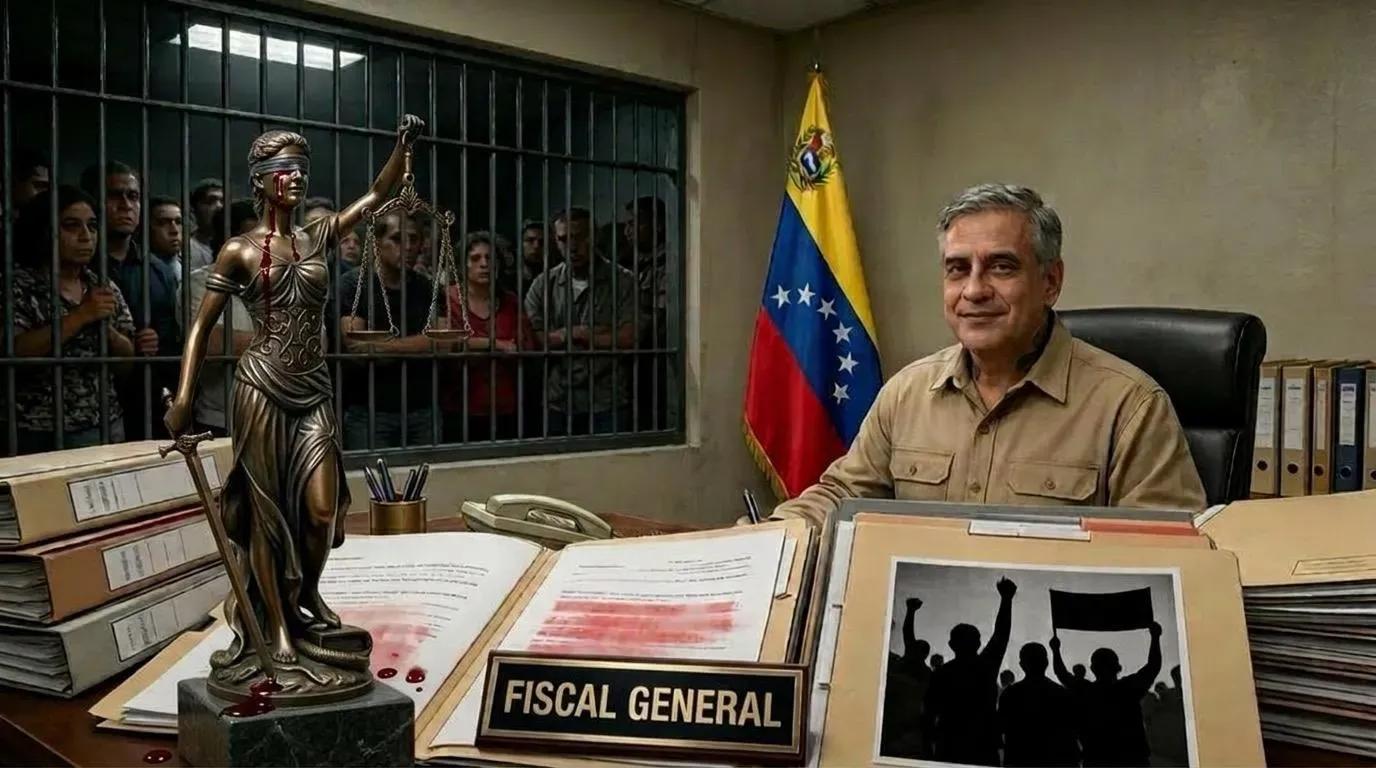
In Venezuela, almost no one is surprised anymore when power protects itself, but there are decisions that still hurt. The departure of Tarek William Saab from the Attorney General's Office and his immediate appointment as ombudsman is one of them (El Diario, February 26, 2026). It is not a mere game of musical chairs: it is the regime moving pieces to shield someone who turned the law into a weapon against the people, rather than bringing justice closer to the victims (DW, February 25, 2026; Diario Libre, February 25, 2026). It tells victims that their pain does not deserve justice, but mockery, and it is a signal of how far justice in Venezuela has ceased to be a right and has become a privilege reserved for those who uphold power (El Diario, February 26, 2026).
An express shuffle in the Assembly
On February 25, 2026, the National Assembly controlled by chavismo announced the resignation of Tarek William Saab as Attorney General and that of Alfredo Ruiz as ombudsman, all in a session conducted at a speed that left little room for public scrutiny (El Diario, February 25, 2026). That same day, the AN confirmed both resignations and, almost immediately, appointed Larry Devoe as temporary Attorney General and Saab as acting ombudsman, while a commission was created to propose definitive names within a very short time frame (El Diario, February 25, 2026; DW, February 25, 2026).
The official narrative presented Ruiz's departure as a result of health issues, but in practice, there was no real debate about Saab's record or the appropriateness of placing him at the head of the Ombudsman’s Office (DW, February 25, 2026). The move resembled more an internal shuffle between pieces of the same power scheme than a decision aimed at strengthening the rule of law (El Diario, February 26, 2026).
The result is that both the Attorney General's Office and the Ombudsman’s Office remain in the hands of figures closely aligned with the regime, closing even further the space for genuine reforms within the justice system, which further limits the real possibility of an authentic reform of the justice system (El Diario, February 25, 2026; Diario Libre, February 25, 2026).
What his tenure at the Attorney General's Office left behind: persecution, dismantling of guarantees, and impunity
The balance of nearly nine years of Tarek William Saab at the head of the Attorney General's Office is marked by accusations of political persecution, institutional capture, and the use of the criminal process as a tool for social control (El Diario, February 26, 2026). El Diario recalls that his arrival in the position in 2017 occurred after the dismissal of Luisa Ortega Díaz by the Constituent National Assembly, in a context where chavismo sought to secure control of the Public Ministry, and that since then his management has been marked by complaints of submission to the Executive, attacks on the opposition, and a lack of independence from political power (El Diario, February 26, 2026).
According to this analysis, the Attorney General's Office under Saab became a key cog in a system of impunity: investigations into extrajudicial killings, torture, forced disappearances, and arbitrary detentions have advanced little or not at all, while judicial processes against opposition leaders, journalists, and activists have been promoted under charges of terrorism, conspiracy, or incitement to hatred (El Diario, February 26, 2026).
Organizations such as Provea and Access to Justice, cited by El Diario, have pointed out that, in practice, the autonomy of prosecutors was dismantled, political pressure was exerted on the Public Ministry, and tools such as international arrest warrants were used selectively, all aimed at consolidating a judicial system at the service of the regime (El Diario, February 26, 2026).
This architecture of control has eroded the rule of law: guarantees of defense, due process, and judicial independence have been subordinated to the convenience of power, leaving citizens practically defenseless in the face of the state apparatus (El Diario, February 26, 2026; Diario Libre, February 25, 2026).
In light of this record, one of the minimum first demands in any real transition should be to revoke his professional credential and his license to practice law: Saab did not honor the profession, he used it to destroy guarantees and persecute citizens, emptying what it means to be a lawyer in a rule of law (El Diario, February 26, 2026; DW, February 25, 2026). BBC Mundo has shown him as the voice that denies human rights violations and presents the complaints as political attacks, while the reality of the victims says exactly the opposite (BBC Mundo, February 4, 2025).
Sanctions and international reckoning
Saab's role has not only been questioned within Venezuela. In July 2017, the United States imposed sanctions on a group of high-ranking Venezuelan officials for their role in undermining democracy and pushing for the Constituent National Assembly, a measure that various media described as a response to the authoritarian drift of Nicolás Maduro's government (CNN en Español, July 26, 2017; BBC Mundo, July 25, 2017). These sanctions included asset freezes and financial restrictions, and were part of a broader strategy to pressure Venezuela's power circle (CNN en Español, July 26, 2017).
El Diario highlights that, in addition to U.S. pressure, Saab has been subjected to sanctions by the European Union and other international actors, who consider him part of the structure responsible for the deterioration of the rule of law and the repression against dissent (El Diario, February 26, 2026).
Regional media such as Diario Libre precisely capture that image of a “questioned prosecutor,” pointing out that deep doubts weigh on him regarding respect for human rights and the political use of justice (Diario Libre, February 25, 2026). That a figure with this level of international scrutiny, associated with persecution and the dismantling of legal guarantees, is transferred to the Ombudsman’s Office cannot be understood as a gesture of institutional reconciliation but as a show of strength from a regime that protects its key operators (El Diario, February 26, 2026; DW, February 25, 2026).
“Ombudsman”: mockery and provocation for the victims
Saab's appointment as ombudsman has been perceived both inside and outside the country as mockery towards victims of state repression. El Diario reports that human rights organizations and experts consider this move a “blow” to those who have suffered arbitrary detentions, torture, or judicial persecution, because it places precisely one of the individuals responsible for the damage in the institution that should channel their claims against the state (El Diario, February 26, 2026).
DW collects statements from opposition leaders who describe the shuffle as an affront, pointing out that a questioned prosecutor is being rewarded with a position that provides him immunity and formal prestige, while blocking the possibility of real renewal in the justice system (DW, February 25, 2026). From the perspective of these actors, the Ombudsman’s Office is reduced to an instrument for protecting power and not the citizens, reinforcing the perception that the Venezuelan state has been emptied of democratic content (El Diario, February 26, 2026; Diario Libre, February 25, 2026).
Conclusion: when justice becomes an accomplice
The story of Tarek William Saab is not just the story of a man; it is the reflection of a system. A system that took the law, that space where we should all be able to meet as equals, and twisted it until it became unrecognizable (El Diario, February 26, 2026). A system that, instead of punishing abuses, promotes those who execute them or cover them up, and that not only fails to protect its citizens, but protects itself from them (DW, February 25, 2026; Diario Libre, February 25, 2026).
What is happening with Tarek William Saab is not an isolated episode, but the X-ray of a system that uses institutions to conspire against its own people. When a public official with a record of political persecution, international sanctions, and serious human rights violation allegations is removed from the Attorney General's Office and placed at the head of the Ombudsman’s Office, the message is clear: the priority is not to repair the damage, but to guarantee impunity.
That is why what is at stake with his appointment as ombudsman is not just another procedure but a fundamental question: what kind of country does Venezuela want to be?
As long as those who destroyed the guarantees continue to sit in the chairs from which they are supposed to protect them, justice will remain an empty word (El Diario, February 26, 2026). Taking away Saab's power to speak in the name of the law, whether as a prosecutor, as an ombudsman, or even as a legal professional, would not be an extreme gesture; it would be the first logical step to begin to recover the very meaning of justice in Venezuela (El Diario, February 26, 2026; DW, February 25, 2026).
Because a people that has been prosecuted, beaten, and silenced for years has the right, at least, not to be called “defense” what is clearly another form of aggression.
References
BBC Mundo. (2017, July 25). The U.S. government imposes a new round of sanctions against high-ranking Venezuelan officials. BBC News Mundo. https://www.bbc.com/mundo/noticias-america-latina-40711858[bbc]
BBC Mundo. (2025, February 4). Tarek William Saab, Attorney General of Venezuela: “They use human rights to damage the country’s image.” BBC News Mundo. https://www.bbc.com/mundo/articles/c1we5p4dp9do[bbc]
CNN en Español. (2017, July 26). The U.S. sanctions 13 Venezuelan officials, including the “number two” of chavismo. CNN en Español. https://cnnespanol.cnn.com/2017/07/26/ee-uu-sanciona-a-mas-de-una-docena-de-funcionarios-venezolanos[cnnespanol.cnn]
Diario Libre. (2026, February 25). Tarek William Saab: questioned Attorney General of Venezuela. Diario Libre. https://www.diariolibre.com/mundo/america-latina/2026/02/25/tarek-william-saab-cuestionado-fiscal-general-de-venezuela/3449316[diariolibre]
DW. (2026, February 25). Venezuela: Attorney General Tarek William Saab resigns. Deutsche Welle. https://www.dw.com/es/venezuela-renuncia-el-fiscal-general-tarek-william-saab/a-76127907[dw]
El Diario. (2026, February 25). AN confirms resignation of fiscal Tarek William Saab and defender of the People Alfredo Ruiz Angulo. El Diario. https://eldiario.com/2026/02/25/renuncia-del-fiscal-tarek-william-saab-y-el-defensor-del-pueblo-alfredo-ruiz-angulo/[eldiario]
El Diario. (2026, February 26). What Tarek William Saab's tenure as Attorney General left. El Diario. https://eldiario.com/2026/02/26/que-dejo-la-gestion-de-tarek-william-saab-como-fiscal-general
About the Author:
William L. Acosta holds degrees from PWU and the Alliance University. He is a retired police officer from New York City, a former U.S. Army military personnel, as well as founder and CEO of Equalizer Private Investigations & Security Services Inc., a licensed agency in New York and Florida, with international reach. Since 1999, he has led investigations in narcotics, homicides, and missing persons cases, and has also participated in criminal defense at both state and federal levels. A specialist in international and multijurisdictional cases, he has coordinated operations in North America, Europe, and Latin America.

Comments