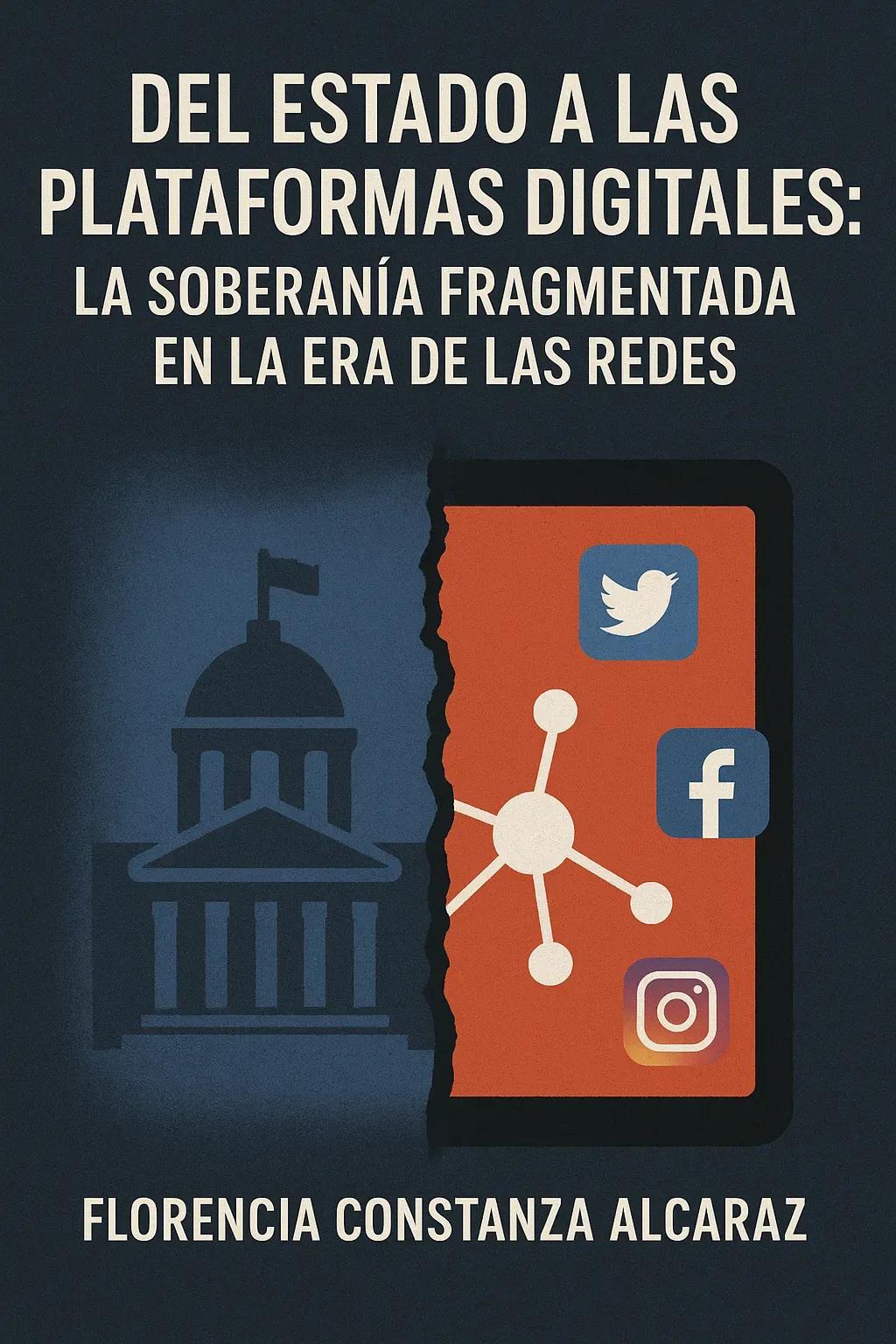
Throughout history, sovereignty has been understood as the ability to decide within and about the political order. Carl Schmitt decisively formulates this idea by stating that "the sovereign is he who decides on the state of exception" (Political Theology, 1922, p.13), that is, the one who possesses the power to suspend the norm to preserve order. Giorgio Agamben takes this definition and radicalizes it: in modernity, he argues, the state of exception ceases to be an extraordinary event and becomes a permanent paradigm of governance. Sovereignty, then, is expressed not only in the norm but also —and above all— in its interruption.
However, the contemporary scenario demands that we shift this discussion toward a new territory: the digital space. Social, emotional, and political life has moved to platforms where communication is mediated by algorithms, viral flows, and logics of constant exposure. In this context, Byung-Chul Han's contributions are fundamental. Revisiting Schmitt's definition, Han argues that today sovereignty manifests in the ability to interrupt, restore, or control the communicative flow within the "absolute noise" of networks. This power no longer resides solely in the State but is fragmented among technological corporations, connected crowds, and automated surveillance mechanisms.
Sovereign power and the state of exception: From Schmitt to Agamben
Carl Schmitt (1888-1985), one of the most influential legal scholars and political theorists of the 20th century, although also deeply linked to German National Socialism, formulates a decisive conception of sovereignty that will mark much of contemporary political thought. His well-known definition, "Sovereign is he who decides on the state of exception" (Political Theology. 1922, p.13), establishes that sovereign power is not simply identified with the authority that administers the everyday legal order but with the instance that can suspend that order when faced with an extreme situation.
For Schmitt, the state of exception should not be understood as a technical measure or as an emergency decree, such as a state of siege, but as a fundamental concept of state theory that allows us to identify who holds real power. As he himself notes:
“Here, ‘state of exception’ will be understood as a general concept of the doctrine of the State, not as any necessity decree or a state of siege. A systematic legal-logical reason makes the state of exception eminently the legal definition of sovereignty.” (Political Theology. 1922, p.13.)
In this perspective, the exceptional case cannot be anticipated or completely regulated by law, as it is a limit situation that exceeds any normative expectation. In the face of that scenario, someone must decide how to act and whether it is necessary to suspend the existing legality to preserve the continuity of the political order.
The one who decides —who can position himself within the law to protect it, but outside of it to suspend it— is the sovereign.
Agamben revisits Schmitt's famous definition to show that sovereignty implies a paradoxical position: the sovereign possesses the legal power to suspend the law, which means that the law itself contains the possibility of its own suspension. In this sense, the state of exception should not merely be understood as a situation of crisis but as a liminal space in which the law ceases to apply without completely disappearing. The norm is left “on hold,” out of play, but continues to operate as a reference.
Thus, when the law is suspended, it is not annulled: an ambiguous territory is created where the law remains in suspension while the sovereign continues to act in its name. Agamben states this precisely when he asserts that the state of exception is:
“That moment of law in which law is suspended precisely to guarantee its continuity and even its existence. Or also: the legal form of what cannot have a legal form because it is included in legality through its exclusion.” (State of Exception. Homo Sacer II, I. p.5.)
Agamben's central thesis is that the state of exception, understood as that supposedly provisional moment in which the legal order is suspended to confront an extreme situation, has become the permanent paradigm of governance in modernity. That is to say, what was once an extraordinary and temporary measure now tends to function as the structural rule of contemporary politics.
This idea does not only arise from Schmitt but is also taken up and developed by Agamben based on Walter Benjamin, particularly from the eighth thesis on the philosophy of history, written shortly before his death. There, Benjamin states:
“The tradition of the oppressed teaches us that the state of exception in which we live is the rule. We must arrive at a concept of history that corresponds to this fact.”
For Agamben, this assertion implies that the suspension of the law —which in theory should be exceptional— has been naturalized to become the usual mode in which power is exercised over life. Thus, the exception ceases to be an interruption of the legal order and turns into its normal mode of operation.
In summary, both Schmitt and Agamben allow us to understand that sovereignty is defined not only by the everyday administration of the law but by the capacity to suspend it when deemed necessary. If for Schmitt the sovereign is the one who decides on the state of exception, for Agamben, this state of exception no longer appears as an extraordinary moment but as the permanent condition under which power is exercised in modernity. We therefore live in a space where the law can be suspended without ceasing to operate, where life is exposed to continuous management without stable legal guarantees. This leads to a decisive political consequence: it is not simply about seeking new institutions or forms of constituent power, but as Agamben points out “...to interrupt and disarticulate the link between violence and law that sustains this normalized state of exception.” (State of Exception. Homo Sacer II, I. p. 14-15.)
How do we extrapolate sovereignty to the digital age?
If the exception has become the rule, we must ask ourselves how this logic operates in an ecosystem where public life is mediated by platforms whose functioning is neither transparent nor democratic. Authority today no longer resides solely in state institutions but also in the actors who manage the flow of information: algorithms, technology corporations, and viral logics.
Byung-Chul Han describes this scenario through the figure of the digital swarm: isolated individuals who react but do not act collectively. Without a “we,” without a common soul, society becomes a space of hypercommunication where reflection gives way to impulsivity. Silence —essential for the formation of a subject— disappears under the constant noise. And in this environment, the classical idea of political action dissipates.
Contemporary subjectivity becomes increasingly individualistic, competitive, and subjected to the logic of exposure. The illusion of freedom offered by networks obscures a system of surveillance and data extraction sustained by our voluntary participation. As Han warns, anonymity erodes responsibility: without a name, there is no promise or recognition. There is also no respect.
The sovereign in the digital age
Here the Schmittian definition shifts: the sovereign is no longer the one who suspends the law, but the one who controls attention. The exception ceases to be a legal act and becomes a communicational phenomenon. While in the State the suspension of the norm is exceptional and visible, in the digital realm the suspension is constant, diffuse, and invisible. There are no stable rules about what can circulate and what cannot: the boundary is negotiated in real-time.
This normative vacuum becomes evident in extreme examples: from the unrestricted circulation of sensitive or violent content to the possibility of live broadcasting an assault or even a murder in real-time. In these cases, the problem is no longer simply technical —it is not just about platforms allowing or not allowing certain actions— but deeply ethical and political. Unavoidable questions then arise: What do we understand today by freedom of expression?, What are the limits of what can be said and shown?, Who is legitimized to set them and under what criteria?
However, it is essential to differentiate these two planes. The question of the moral limits of expression belongs to the ethical domain, where individual conduct is evaluated according to personal responsibility and the harm it can cause. In contrast, the analysis that interests us here is situated in the political realm, where the central focus is not the isolated individual but the forms of organization of power, the production of norms, and the administration of collective life.
As Fernando Savater (1992) states:
“In the ethical sphere, individual freedom resolves into actions; while in politics it is about creating institutions, laws, lasting forms of administration, delicate mechanisms that easily break down or never function entirely as one expected.” (Politics for Amador, p. 12)
In this sense, the purpose of this essay is not to discuss what is right or wrong to say or show —though that problem pervades the discussion— but to analyze what kind of power operates in the digital space. It is about understanding how control mechanisms, silencing, and visibility are configured; who can amplify a voice or make it disappear; and how these dynamics reconfigure the modern notion of sovereignty. The ethical refers to individual responsibility, and the political refers to the structure that defines what actions are possible. It is precisely that structure —today mediated by private platforms that manage attention, prioritize content, and shape the circulation of discourses— that constitutes the true terrain of conflict.
Contemporary democracy thus faces a decisive tension. On the one hand, freedom of expression presents itself as a founding principle; on the other, its unrestricted exercise can lead to forms of symbolic violence, misinformation, and disintegration of the social fabric. The absence of a shared criterion on what is permissible and what is inadmissible opens up a space where the norm is no longer given —it must be constantly disputed within the communicational flow itself.
However, even in this context, society outside the networks continues to be based on relatively stable moral and normative frameworks: laws, customs, values, and implicit agreements regulate coexistence and set clear distinctions between the acceptable and the intolerable. That is to say: we still know, at least in principle, what is right and what is wrong.
In the digital environment, on the other hand, those limits become blurred. There is no shared code that orders the circulation of discourses, images, or violence. Moreover, the limits are not defined collectively but privately by the actors controlling the platforms and their algorithms. If in modernity the sovereign suspended the law, today the sovereign is the one who defines the visible and the invisible, the amplifiable and the silenced.
This becomes evident in the case of Donald Trump's suspension and subsequent return to X (formerly Twitter). His expulsion from the platform had been justified under the argument of preventing the spread of hate speech and misinformation. However, with the arrival of Elon Musk (an entrepreneur with direct affinities to Trump), the measure was reversed. The return of the former president was again accompanied by messages that amplified false narratives and conspiracy theories. Here arises the central question: Who sets the standard for what can be said when regulators are not democratic institutions but individuals or corporations?
If digital sovereignty is defined by control of the communicative flow, then power ceases to be in the hands of the State to concentrate in private platforms that are not accountable to the citizenry. The exception is no longer a public and justified decision but an opaque act, determined by particular interests, political affinities, or market logics.
Shitstorms as the new permanent state of exception
In an environment where attention functions as political capital, phenomena that interrupt or redirect that flow become new forms of exception. Among them, shitstorms —tornadoes of instant collective indignation— operate as mechanisms for suspending deliberative norms. They require no institution, procedure, or legal foundation. They are power without responsibility.
A shitstorm can ruin reputations, cancel voices, or organize symbolic lynchings. In most cases, their effect is irreversible. They function as digital states of exception because they momentarily suspend the possibility of rational debate and replace argumentation with emotional reaction.
Following this logic, Han reformulates Schmitt's thesis:
“Sovereign is he who disposes of the shitstorms of the network.”
The sovereign no longer controls the law, but the...Attention. And those who manage the algorithmic architecture —that is, the platforms— wield a more decisive power than any state institution in the realm of discursive circulation.
The shitstorm reveals that the exception is no longer extraordinary: it is the norm of the digital ecosystem.
**Delving into the swarm**
At this point, if we accept that shitstorms function as the new permanent state of exception in the digital age, and that the sovereign is no longer the one who dictates legal norms, but rather who controls attention, the ability to silence noise, and generate silence, then the inevitable question is: How is that power constituted? What conditions allow certain actors to trigger, amplify, or stifle these dynamics?
The answer does not solely reside in individuals, but in the inherent structures of the platforms. Social networks are not merely neutral spaces for exchange; they are designed to maximize reaction, not reflection. Their architecture prioritizes immediate emotion over argument, and in that realm, outrage and rejection circulate faster than rational debate. Where time for thought is lacking, the possibility of pointing fingers, canceling, and expelling grows.
In this scenario, the erosion of respect —which Byung-Chul Han understands as the distance that allows us to recognize the other as another— becomes central. When that distance disappears, the other ceases to be a possible interlocutor and becomes an adversary or even a disposable object. Communication based on aggression and suspicion produces increasingly intolerant and more reactive subjects. As this logic deepens, it becomes easier not only to silence someone but also to justify that silencing.
Disturbing questions then arise: What happens when that symbolic violence moves off the screen? What kind of bonds do those who grow up in environments where disqualification is the norm construct? What social fabric results from bonds permeated by competition, constant exposure, and distrust?
We also know that networks reinforce our confirmation biases. The algorithmic architecture promotes what social theory calls selective content activation: we see that which we already agree with. Thus, identity bubbles are formed that reinforce certainties and hinder encounters with difference. Everyone ends up inhabiting a micro-world constructed to their measure, where any dissenting thought is perceived as a threat.
This phenomenon becomes especially relevant in the current context of global reaffirmation of authoritarian and nationalist discourses, which find fertile ground in social networks to expand: spaces where polarization intensifies, the adversary is demonized, and complexity is replaced by emotional slogans.
Then the question left hanging is profoundly political: If our subjectivities are shaped in environments of non-tolerance, disrespect, and scant empathy, if networks mold increasingly isolated, individualistic, and defensive identities, what capacity will we have to build collective projects? Can anything resembling solidarity exist if daily experience is one of competing for visibility? And even more: if one day we wanted to rebel against these logics, what affective and social ties would we have to do so?
Because the paradox is unsettling: We need the other to transform the world, but networks teach us to fear, attack, or discard them.
And if —as I pointed out at the beginning— the sovereign today is the one who manages attention, the true contemporary dispute is not just for freedom of expression, but for the ability to reconstruct the conditions that make conversation, recognition, and life in common possible.
**So...**
Technology has burst into our lives with a speed that we have yet to fully process or regulate; we are learning as we walk. And in that transit, I do not want to lose faith in people nor in the possibility of collective solidarity.
I believe that the answer begins on an individual level: developing tools to discern, question, and not be captured by the digital "sovereign" of the moment. Being able to identify trustworthy sources, debate without silencing the other, and maintain a critical attitude is, now more than ever, a political act. Even behind a screen, conversation can be human, respectful, and transformative. Politics, when understood in its deep sense, is that: participation, joint construction, the possibility of change.
However, we live in a time where it has become common to disconnect the political from everyday life. As Savater (1992) says: “In my time, it was taken for granted that being politically good gave one a license to ignore the moral of each day. Now, it seems accepted that just trying to behave ethically in private is enough, and there is no need to worry about the political.” (Politics for Amador p.14) None of these two attitudes, he says, is sensible. And I agree. Ethics without politics becomes pure intention; politics without ethics, pure domination.
Perhaps the challenge (and also the hope) is to reunite both dimensions. To recognize that what we do, choose, consume, and share in digital spaces is not neutral. That sovereignty no longer resides solely in institutions or in figures of authority, but also in the ties we establish and in the way we intervene in the public sphere, even if that "public" is a screen.
After all, one makes the change. And politics, even in the digital age, remains the tool to imagine and construct a common world.

Comments