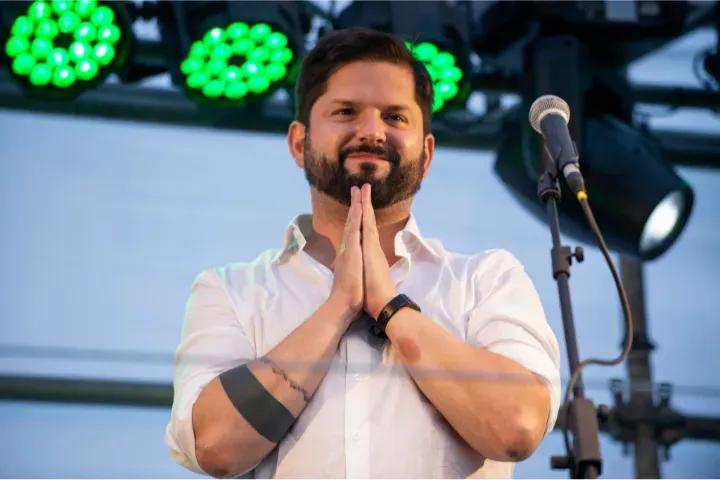
Since his victory in the presidential elections at the end of 2021, the young Chilean President Gabriel Boric became the President of the Republic of Chile. In a tense climate due to the COVID-19 pandemic and the aftermath of the social explosion of 2019, students and precarious workers placed their hopes in the young President.
On March 11, 2022, Gabriel Boric Font assumed the Presidency of Chile convinced of the difficult and challenging task he had to face. The South American country, once an island of dialogue and consensus embedded in a region characterized by polarization, accusations of corruption among government and opposition representatives, social explosions, and political trials.
However, in mid-2019, as a consequence of the subway fare increase, a powerful social explosion erupted on the streets of Santiago. Mostly led by university students and precarious workers, this protest movement arose against a series of injustices and unequal measures that characterize young Chilean democracy to this day.
In the early 1990s, through a negotiated transition, Chile regained a democracy that would become the unwitting heir of the Pinochet dictatorship. The privatizations and neoliberal economic measures implemented by the Chicago Boys marked the daily lives of Chileans for the decades that followed.
In this sense, when in October 2019 the then Piñera government announced an increase in the subway fare, hundreds of thousands of workers and students, tired after years of struggling to make ends meet, took to the streets, giving rise to the largest protest movement since the return of democracy.
With the COVID-19 pandemic and Sebastián Piñera's failure to handle the health crisis, by the presidential elections at the end of 2021, it was clear that Chileans were looking to shake things up by choosing an unusual President, different from all those who had occupied the Palacio de La Moneda since the end of the dictatorship.
Gabriel Boric Font was a young student leader, a former member of the Communist Party, who was a presidential candidate supported by a coalition of leftist and center-left parties. The young candidate promoted a transformative program that sought to consolidate and respond to the demands expressed in 2019.
At the runoff, two unusual candidates reached: Boric, from the left; and Kast, representing an even harsher right than Piñera's. The fear of the Pinochetist right and the hope for a more egalitarian future led to Boric winning the election and becoming President.
However, as the months passed, Boric realized the difficulties he would have to face to implement his policies. In September 2022, when a referendum was held to reform the Constitution, in Chile, the fundamental law has remained in effect since the dictatorship, the majority of Chileans rejected the proposed reform.
Regarding security, although Boric promised to leave behind repressions like those in October and November 2019, the security plan intensified, especially in Araucanía, the southern region of the country where the Mapuche minority is located.
Yet not everything was negative during Boric’s presidency. On the international front, he became one of the few international leaders with the moral clarity to condemn both Russia's invasion of Ukraine and Israel's offensive in Gaza and the attacks of October 7.
The Boric government functions in a way as a lesson for social-democratic governments around the world, which must grapple with implementing necessary social reforms to achieve a more equitable distribution of wealth without allowing the extreme right to gain ground.

Comments