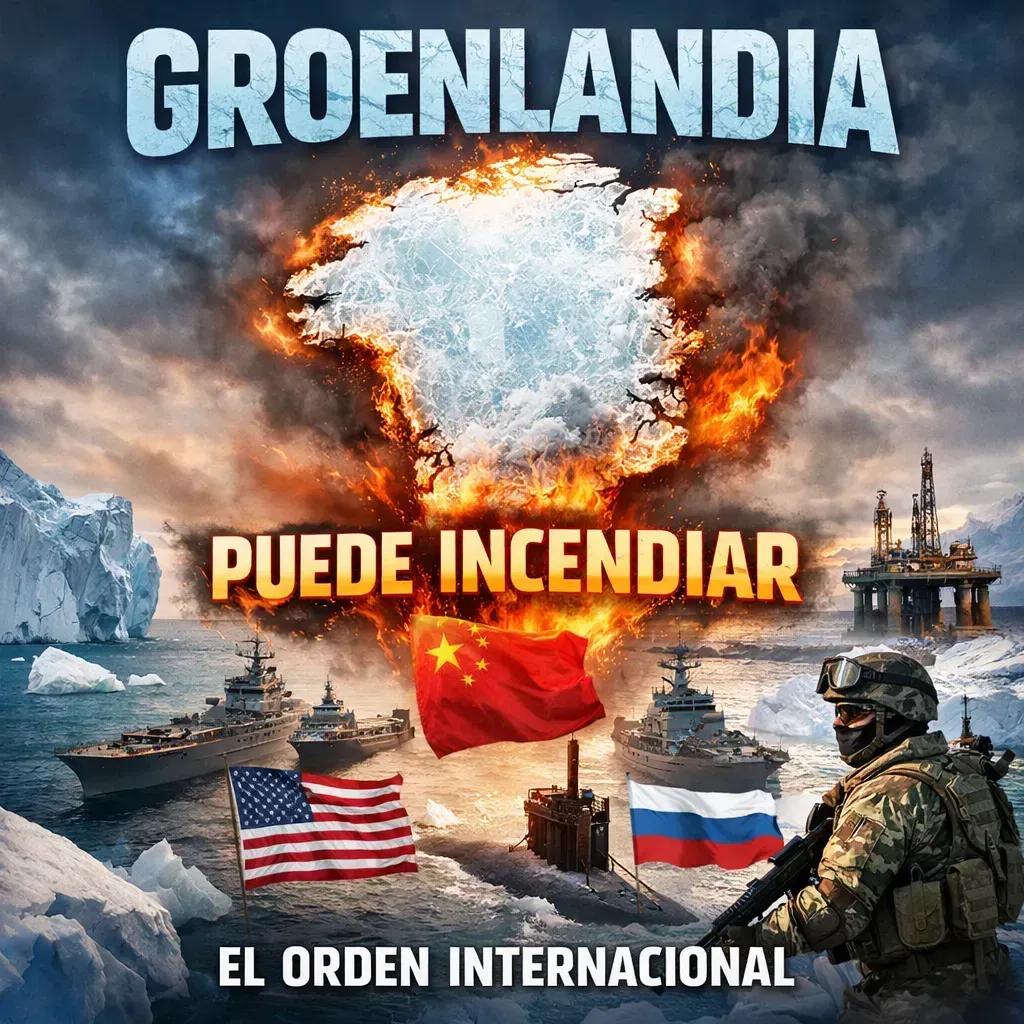
In school maps, Greenland appears as a vast white, remote, and almost empty expanse. In the offices of Washington, Moscow, and Beijing, however, that icy island has become one of the most coveted territories on the planet. The renewed interest of the Trump Administration in acquiring it —even through methods that border on outright coercion— reveals to what extent the Arctic has ceased to be a geographical periphery to transform into one of the great stages of 21st-century global politics.
Greenland is, in physical terms, a colossus. With over two million square kilometers, it is the largest island in the world, although nearly 80% of its surface is covered by a layer of ice several kilometers thick. It is home to just 56,000 people, mostly Inuit, concentrated in the coastal strip of the southwest.
Politically, it is an autonomous territory within the Kingdom of Denmark that, since 2009, governs its internal affairs and controls its natural resources, while Copenhagen retains foreign policy and defense. On paper, it is a periphery of the Danish state. In practice, it is a central piece of the global geopolitical board.
The reason for this interest is twofold. On one hand, its location. Greenland is situated at the vertex between North America, Europe, and the Arctic Ocean. It is part of the strategic GIUK corridor —Greenland, Iceland, and the UK— which since the Cold War has served as a natural barrier to monitor the transit of submarines and Russian fleets from the Arctic to the North Atlantic. Whoever controls this corridor controls one of the vital arteries of Euro-Atlantic security. On the other hand, its subsoil and seas hide an increasingly accessible wealth: hydrocarbons, iron, uranium, and, above all, rare earths, minerals essential for the technology industry, batteries, renewable energies, and next-generation defense systems.
Global warming has multiplied this strategic value. As the ice retreats, new maritime routes open up that promise to shorten the journey between Asia, Europe, and North America by thousands of kilometers. The Arctic, for centuries a frozen desert, is starting to resemble a new northern Mediterranean, a space for transit, trade, and, inevitably, military competition. In this context, Greenland is a natural platform from which to project power over this emerging ocean.
The United States has known this for decades. During World War II, they occupied the island to prevent it from falling into the hands of Nazi Germany and, since then, they have never fully withdrawn. Today, they maintain at the Pituffik Space Base —the former Thule— one of the pillars of their early warning missile defense and space surveillance system, integrated into NORAD's command. From there, they monitor potential launches from Russia and track the traffic of satellites and objects in orbit, a reminder that, in the nuclear and space age, Greenland is an irreplaceable watchtower.
But Trump’s interest goes beyond strictly military concerns. In a world marked by rivalry with China, securing direct access to Greenland's rare earths amounts to reducing a strategic dependency on Beijing, which today dominates much of those supply chains. And at a time when Russia is strengthening its military presence in the Arctic and China is self-defining as a "near-Arctic state" to justify its economic expansion in the region, Washington perceives Danish sovereignty over Greenland as a geopolitical anomaly, a crack in a space they consider vital for their security.
It is no coincidence that Jorge Castro has summarized this urge by pointing out that Trump's interest in Greenland is not a whim but a direct consequence of global warming and the shift of the strategic axis toward the Arctic.
Where the ice melts, new borders of power emerge. The problem is that the way the Trump Administration proposes its ambition implies a break with the rules that the United States helped construct after 1945. The principle of territorial integrity and the prohibition of the use of force to acquire territories are pillars of international law. If Washington violates them to annex or subjugate Greenland, the blow would not only be legal but political and symbolic: the power that stood as a guarantor of the liberal order would become one of its main violators.
The consequences would be felt far beyond the Arctic. Russia would find in this precedent a perfect argument to legitimize its annexations in Ukraine, from Crimea to the occupied territories of Donbas. Israel could invoke the same logic to consolidate an indefinite occupation of Gaza. The message would be clear: borders are no longer defined by norms but by the correlation of forces.
NATO would also be on the brink of an existential crisis. Greenland is part of the Kingdom of Denmark, one of the founding members of the Atlantic Alliance. An American annexation would equate to one ally stripping another of part of its territory. Even without armed conflict, the political trust that sustains NATO would be severely damaged. What value would the collective defense clause hold if the aggressor is the main military guarantor of the alliance itself?
Statements from Trump, his vice president J.D. Vance, and his Secretary of State Marco Rubio point in the same direction. The president has defined Greenland as an “absolute necessity” for U.S. security and has not ruled out the use of force to obtain it. Vance has gone further by presenting the liberal international order as an obstacle to defending U.S. vital interests. Rubio, with a more diplomatic tone, has made it clear that sovereignty and international law cannot take precedence over what Washington considers its strategic security. It is a vision of the world of spheres of influence, of naked realpolitik, that more resembles the imperial divisions of the 19th century than the post-war multilateralism.
In the short term, the most likely scenario is not an invasion but increasing pressure on Denmark and the Greenlandic government itself. Investments, security agreements, promises of prosperity, and an intense influence campaign can turn the island into a de facto protectorate of the United States without the need to formally change its status. But even this path would erode the delicate political balance of the region and Washington's international credibility.
Greenland, that immense expanse of ice and minerals, has thus become something more than a remote territory. It is a mirror of the emerging world: an international order increasingly governed by force and less by norms. What occurs in its fjords and military bases may better anticipate, than any speech, how global politics will unfold in the years to come.

Comments