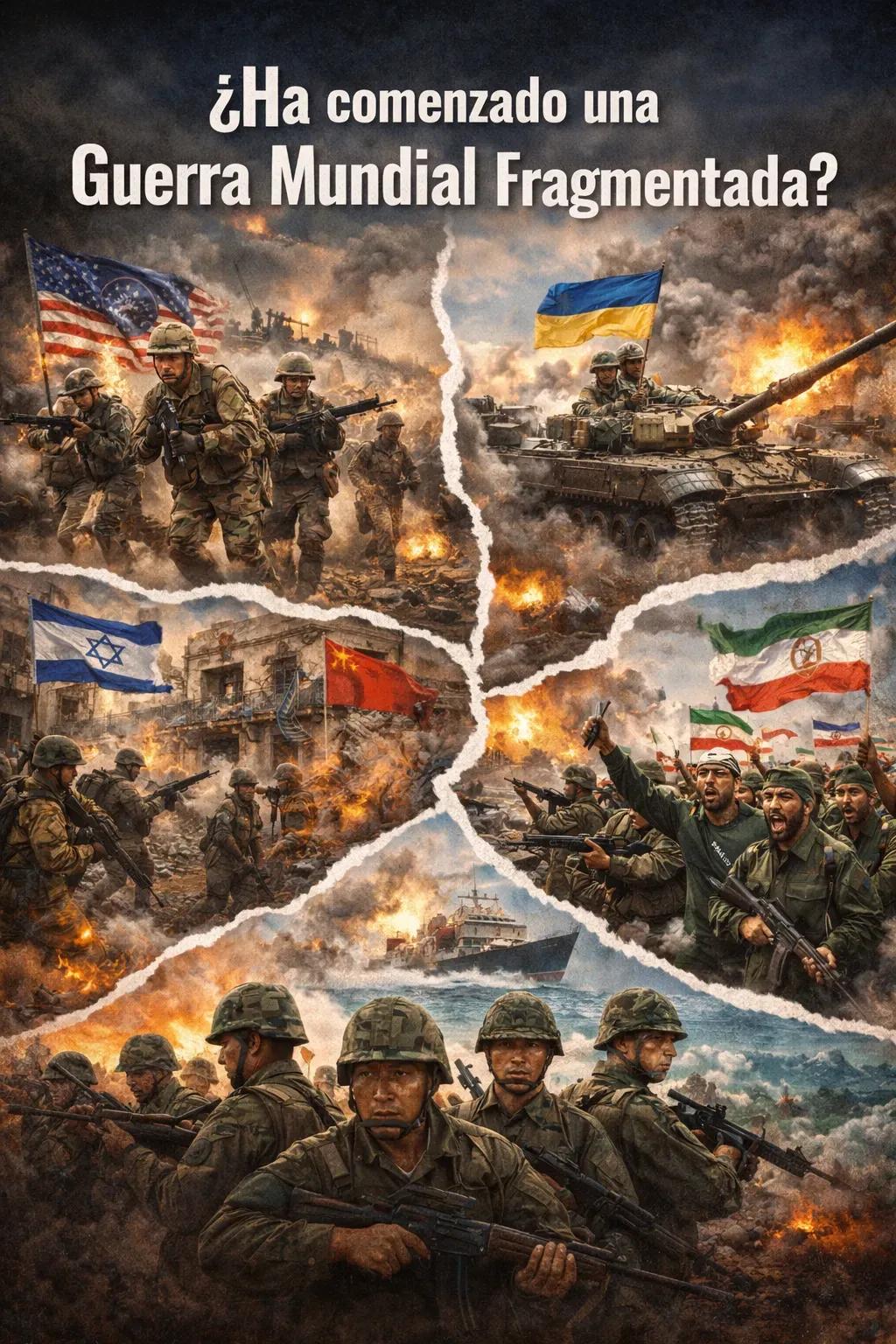
The warning no longer comes from marginal analysts or classified intelligence reports. In recent months, military leaders, presidents, and prime ministers across Europe have begun to speak openly about the need to prepare their countries for a possible war with Russia. As NATO reinforces its armies and European societies begin to be mentally mobilized for a scenario of prolonged conflict, the continent is facing a troubling horizon: the real possibility of a large-scale armed confrontation before the decade ends.
The sense that the international order is going through a strategic turning point extends from Eastern Europe to the Persian Gulf. Two theaters of operations—Ukraine and the Middle East—currently concentrate tensions that can no longer be considered isolated conflicts but episodes of a broader geopolitical crisis.
The European Scenario
For decades, much of the world lived under the conviction that war between major powers had been relegated to history books. Russia's invasion of Ukraine in February 2022 shattered that consensus with a brutality that continues to reorder the European strategic landscape today.
Four years later, the language used in major Western capitals has changed perceptibly. References to deterrence, dialogue, or diplomacy now coexist with a term that had been carefully avoided for decades: war.
In reality, since 2020, the world has witnessed an indirect confrontation between blocs. Russia, politically and strategically backed by countries like Belarus, China, Iran, North Korea, and Cuba, is fighting in Ukraine against a country receiving extensive military, financial, and technological support from members of the North Atlantic Treaty Organization (NATO).
Moscow has partially sidestepped Western sanctions with the support of its partners. China and Iran have supplied technology, military equipment, and industrial support, while Belarus has allowed the use of its territory as a logistical and military platform for Russian forces. North Korea has gone further by sending troops and weaponry to bolster the Kremlin's war efforts. Cuba, for its part, has allowed the participation of volunteer fighters integrated into Russian units.
Ukraine, on the other hand, has been sustained by a broad Western coalition. The United States, the United Kingdom, Germany, France, Poland, Canada, and Italy have provided advanced weaponry, military training, satellite intelligence, financial assistance, and humanitarian aid. Canada, for example, has committed nearly $25 billion in economic and military support over four years, in addition to delivering hundreds of armored vehicles.
The prolonged combat has resulted in a high number of casualties on both sides. Faced with difficulties in sustaining internal recruitment, both Russia and Ukraine have resorted to foreign fighters and mercenaries. In many cases, these fighters actually belong to active units of special forces from countries that officially declare themselves neutral.
The economic consequences of the war have also been profound. Western sanctions against Russia, the disruption of cheap hydrocarbon supplies from that country, and the destruction of shared energy infrastructures have deeply altered the economic balance of the continent.
The impact is not limited to the states directly involved in the conflict. Much of the European economy has suffered from the combined effects of rising energy costs, inflation, and increased military spending.
To these economic damages, social consequences are added. Millions of people have been displaced by fighting or have fled from bombed cities. At the same time, thousands of young people have left their countries to avoid compulsory recruitment. Even in some European countries, migratory movements towards Latin America motivated by the fear of a possible widespread war have begun to be detected.
Europe Rearms
While the conflict has persisted, the major European powers have begun to prepare for a possible direct confrontation with Russia.
France has taken a central role in this strategic shift. President Emmanuel Macron's decision to authorize the construction of a new nuclear aircraft carrier—the PANG program, intended to become the largest warship ever built in Europe—constitutes both a military project and a political message: Paris aims to maintain its status as an autonomous strategic power within the Western defense system.
But the signs of preparation for conflict go far beyond the strictly military sphere. The French government has ordered its health system to prepare plans for the eventual arrival of thousands of military wounded before 2026. At the same time, the civilian population has been advised to keep emergency kits for several days, a measure that evokes the tensest moments of the Cold War.
The warnings from French military leaders have been particularly explicit. General Fabien Mandon, Chief of Staff, warned Parliament that the Armed Forces must be prepared for a "more violent shock" with Russia within three to four years. His predecessor, Thierry Burkhard, was even more direct: "War is already in Europe."
Germany, traditionally reluctant to take on a prominent military role after World War II, is also undergoing a profound strategic transformation. Berlin has initiated a rearmament process that would have been unthinkable just a decade ago.
The extraordinary fund of 100 billion euros allocated to modernize the Bundeswehr symbolizes the definitive abandonment of the so-called "culture of restraint" that characterized German policy since 1945. There is even debate about the possibility of fully integrating Germany into the French nuclear umbrella through shared deterrence agreements.
Poland, for its part, has become the European country preparing most decisively for a possible war. Warsaw allocates more than 4% of its GDP to military spending and aims to build the largest land army in Europe.
Militarization has even acquired a social dimension. Shooting training programs in schools, paramilitary training for officials, and a rapid expansion of reserve territorial forces are part of a national strategy aimed at preparing society for a potential conflict.
The Netherlands has also reinforced its commitment to NATO's collective defense. In the event of military escalation with Russia, Dutch professional forces would be quickly deployed to support the Baltic states or other allies on the eastern flank.
The government has increased defense spending and approved the acquisition of modern military equipment, including F-35 jets, naval helicopters, armored vehicles, and air defense systems.
The Netherlands is also participating in European initiatives such as the European Sky Shield Initiative, aimed at strengthening the continent's missile defense against aerial or ballistic attacks. At the same time, the country has joined European strategic preparedness programs like the Rearm Europe / Preparation 2030 plan, which seeks to strengthen the collective military capabilities of the bloc.
The Dutch authorities have also begun to prepare their civil infrastructure for possible wartime contingencies. Hospitals, emergency services, and regional authorities are developing response plans for crisis situations while the population is being advised to have basic reserves of water, food, and supplies for at least 72 hours.
Unlike other European countries that have reintroduced mandatory military service, the Netherlands has opted for a model of incentivized volunteer reservists. This system allows the armed forces to increase in size without resorting to conscription while maintaining a high level of social support for the defense effort.
The United Kingdom, a nuclear power and key ally of Washington, has also intensified its strategic preparations.
London is bolstering its naval and missile defense capabilities through the development of new military technologies. These include autonomous systems for underwater surveillance in the North Atlantic and advanced weaponry like the naval laser system DragonFire.
At the same time, the British government maintains an active diplomatic presence in international forums like NATO or the Organization for Security and Cooperation in Europe (OSCE), where it promotes mechanisms for military transparency and risk reduction aimed at avoiding accidental escalations.
However, beyond diplomatic discourse, the overall trend on the continent is evident: rearmament has ceased to be a political option and has become a widely accepted strategic necessity.
The Middle East Theater of Operations
While Europe prepares for a possible future confrontation, the Middle East is already experiencing an open war.
Since the Hamas attack on Israel on October 7, 2024, much of the region has found itself trapped in a spiral of violence that has progressively expanded the number of involved actors.
If one considers the successive military escalations and the recent offensive by the United States and Israel against Iran as part of the same war dynamic, the regional conflict directly or indirectly involves more than twenty countries.
Among them are the United States, Israel, the United Kingdom, France, Greece, Spain, Georgia, Lebanon, Syria, Iran, Bahrain, Oman, Yemen, Saudi Arabia, the United Arab Emirates, Qatar, Kuwait, Iraq, Jordan, and Cyprus.
In this broad and complex theater of operations, the intensity of combat has, in many cases, exceeded that recorded on the European front. Gaza, for example, has been practically reduced to rubble after months of bombings and urban fighting.
The early hours of February 28 marked a new phase in the regional crisis. In a coordinated operation, the United States and Israel launched air and missile strikes against strategic targets in Iran, including military installations, nuclear research centers, and bases of the Revolutionary Guards. The offensive—presented by Washington as a preventive action aimed at neutralizing strategic threats—resulted in hundreds of casualties and the destruction of critical infrastructure.
The Iranian reaction was immediate. Tehran responded with ballistic missile attacks, drones, and indirect operations carried out by allied militias in the region. U.S. bases in Iraq, Syria, and Gulf countries were attacked, while Israeli targets in the eastern Mediterranean and the Red Sea came under threat.
The crisis quickly shifted to the Persian Gulf, where Iran announced the closure of the Strait of Hormuz, one of the most sensitive points in the global economy.
This maritime corridor sees the daily transit of about twenty million barrels of oil, approximately one-fifth of global consumption, in addition to nearly twenty percent of the world's liquefied natural gas trade.
The blockade of the maritime passage has left hundreds of ships trapped in the Persian Gulf. Oil tankers, container ships, and gas transports remain detained as shipping companies suspend operations for fear of attacks.
The economic consequences have been immediate. Oil prices have seen sharp increases, and financial markets have reacted with great volatility. If the blockade were to last several months, various analysts estimate that the price of crude could exceed $120 or even $150 per barrel.
An International System on the Verge of Fracture
In this context, the question becomes inevitable: has the Third World War already begun? Formally, not yet. There is no declared war between the major powers. But the global map shows an increasingly troubling reality.
Eastern Europe, the Middle East, and several regions of Asia concentrate interconnected conflicts in which the major powers of the international system are directly or indirectly involved.
The world seems to have entered an era of simultaneous conflicts between rival blocs, a situation that some analysts describe as a "fragmented world war."
The open question is whether these regional wars can be kept contained or if, as happened in the great conflagrations of the 20th century, they will ultimately converge into a global confrontation. For now, the planet is not yet experiencing a third world war. But it cannot be said that it continues to live in peace.
Adalberto Agozino is a Doctor of Political Science, International Analyst, and Professor at the University of Buenos Aires.

Comments