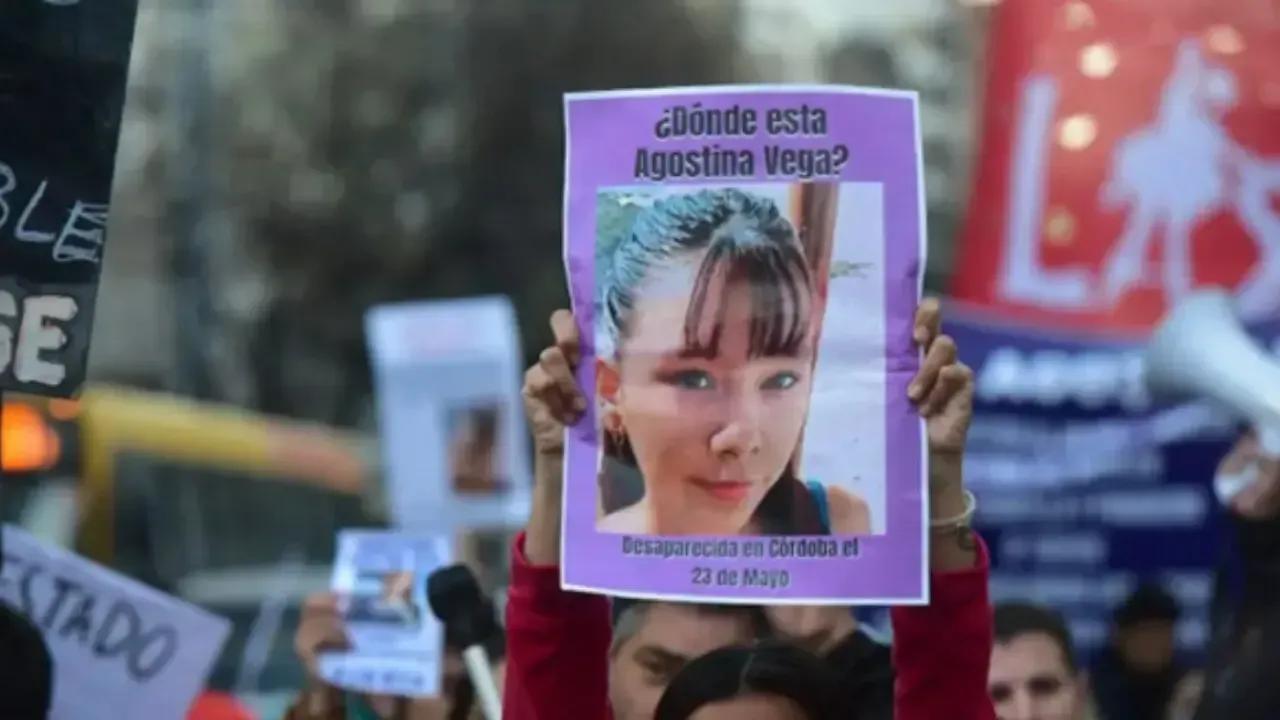
On Saturday, May 23, 2026, shortly after 11 PM, Agostina Vega disappeared in Córdoba. It wasn't quick. She spent a night with the man who had previously kidnapped her. She spent a morning while her grandparents waited at a police station for someone to take the complaint. She spent an entire Monday while the police searched for a ghost named Franco. Agostina was murdered, at least, almost four hours before the Córdoba Police received the report of her disappearance.
A week later, her body was found buried in a clearing in Ampliación Ferreyra. The time frame is estimated to be between 11 PM on Saturday, the 23rd, and 5 AM on Sunday, May 24. Suffocated. With signs of sexual abuse.
The man arrested is Claudio Barrelier. He has a criminal record. That is to say: Justice already knew who he was. They had seen him before. And they let him go.
The first young woman who escaped
In 2025, a woman managed to escape from Barrelier. According to the complainant, the man forced her to undress, tied her hands and feet, and covered her mouth with duct tape. The young woman managed to escape and was aided by neighbors who called the police. It all happened in the same house. The same modus operandi that he would later use with Agostina.
For that incident, Barrelier was detained for 20 days for illegal deprivation of liberty, but regained his freedom after paying bail.
This is what still lacks a clear answer: who ordered that bail. What was the criterion? Why did a Córdoba judge decide that a man who had kidnapped, gagged, and tied up a woman deserved to be released with the promise of paying money.
This prior record involves a complaint with identical operational characteristics made by another young woman. This precedent reinforces the prosecution's accusatory hypothesis and the suspicion of a systematic pattern of recruitment and violence by the accused. Systematic pattern. That means it wasn't an accident. It was a strategy.
And someone in a Córdoba court decided that it deserved bail.
The hours when no one did anything
On Sunday, May 24, in the early hours of the morning, Agostina's grandparents went to a police station. Hours had passed. She wasn't answering her phone. She hadn't returned home. According to Agostina's grandparents, they went to a police station in the early morning hours of Sunday and were attended to several hours later.
While they waited. While filling out forms. While they were told to wait. Agostina was already dead. Not recently. She had been dead for between 4 and 12 hours, depending on when exactly Barrelier killed her.
But there's more. The complaint alleged that the mother's testimony diverted focus onto a false suspect, delaying Barrelier's arrest, who already had a record for kidnapping. "Until Tuesday morning, he was not focused on as a suspect. The focus was on a person named Franco, mentioned by the mother," explained the lawyers for Gabriel Vega, the father of the teenager.
This means: that the investigation took almost 36 hours to point to the man who was already registered for kidnapping in the same house. Thirty-six hours. During which, Barrelier could have moved the body, planned the concealment, talked to whoever helped him.
Agostina's grandparents provided essential elements for the progress of the investigation in recent hours and assured Justice that Barrelier's ex-partner lied in her previous statement. The ex-partner. Not the police. Not the prosecution. The grandparents, sleeping little, screaming in courts, chasing leads that the system should have seen years ago.
The pattern that no one stops
This is not a rare story. It is a typical story from Argentina.
In at least 101 connections (44%), there were recorded prior incidents of gender violence before the femicide. Almost half. What it means: there is a record. There is a precedent. There is a lead. And it keeps happening.
In 36% of cases, the victim lived with the active subject at the time of the incident, while 53% did not. What it means: the majority of the men who kill no longer lived with the woman. There had already been separation. There had already been a breakup. And still, they killed. What it means is that femicide is not an act of passion. It is an act of power over someone who tried to leave.
In 2025, on average, there was 1 direct victim every 44 hours, with a rate of 0.85 direct victims per 100,000 women. One femicide every 44 hours. In a country of 46 million people. That is 200 deaths per year. It's like erasing a small city every year.
So far in 2026, around 100 murders for gender reasons have been recorded, a figure that reflects the persistence of a problem that continues to mobilize thousands of people across the country. One hundred. In five months. This means Argentina is on track for 240 femicides in 2026.
And some of those men already have records. They have already been detained. They have already hit someone before. And they were released.
The questions that remain unanswered
Who was the judge who authorized Barrelier’s bail in 2025?
What criteria did he decide it was safe to leave him on the street?
Why did Agostina’s investigation take almost two days to focus on the man who was already registered for kidnapping in that same place?
Who are the accomplices who transported the body? The judicial lens extends over the intimate circle of the detainee and the owners of the Ford Ka vehicle involved in the transfer, analyzing serious contradictions in their spontaneous statements to the police. One vehicle. Some owners. Some contradictory statements. Who are they?
Why did it take "several hours" in a Córdoba police station to take a report of a missing minor?
How many other cases are there like Barrelier's? How many men released on bail for gender violence are now living in neighborhoods where there are other women who don’t know who they are?
What happened afterwards
The charge changed from illegal deprivation of liberty to femicide, a crime that carries the sentence of life imprisonment in case of a conviction. Life imprisonment. Of course. Because now there can be no doubt. Now there is a body buried. Now there is an autopsy.
But a year ago, there was doubt. Or at least that’s what a judge decided. There was enough doubt for bail. Enough doubt to release him.
Agostina’s maternal grandparents were accepted as private complainants and joined Agostina’s father in representing the family within the case. This is what remains: a family that has to fight with the system so that their granddaughter is not forgotten. That they have to look for evidence that the police did not seek. That they have to ask judges why they released the murderer.
Meanwhile, the accused remains detained in Bouwer prison, in Córdoba. According to sources in the investigation, he recently had an episode in which he threatened to take his own life and has since been under permanent psychiatric observation.
Psychiatric observation. Because of course. Now the system cares about his mental health.

Comments